Amazon is adding a fuel surcharge to its e-commerce deliveries. Mortgage rates have risen to their highest mark in seven months. And consumers may soon see higher prices for soda bottles and detergents.
These are all early indications of the Iran war’s impact on the U.S. economy. So far, the costs of the joint U.S.-Israeli military campaign have been modest, especially compared with the economic turmoil roiling Asia, and U.S. growth remains solid. On Friday, the Labor Department said employers added a robust 178,000 jobs in March.
But like thunderclaps that herald an advancing storm, rising energy bills, interest rates and supply shortfalls may be warnings of worse to come.
Americans, by a margin of 56 percent to 7 percent, expect the war to have a “mostly negative impact” on their personal financial situation, according to a March 31 Ipsos poll. A Middle East conflict that lasts for several more months would almost certainly spread higher prices and supply chain disruption beyond Asia and Europe to American shores.
“I don’t think the U.S. will avoid it. These are global markets,” said Rachel Ziemba, a New York-based analyst who advises corporations on geopolitical risk. “Experts, even a week ago, were worried. Now they are more worried.”
President Donald Trump has suggested the war could end later this month and told the nation on Wednesday that the conflict was “nearing completion.” Oil market pricing shows that investors anticipate a return to normal operations in the Middle East by midsummer.
But Friday brought reminders of the danger of an escalatory cycle that could prolong the fighting. The two-person crew of a U.S. F-15 fighter were reported missing after their plane was downed by Iranian fire. (One was later rescued.) And Kuwaiti authorities said an Iranian missile had struck a desalination plant, which the kingdom depends on for drinking water supplies.
The Iranian chokehold on the Strait of Hormuz, through which about 20 percent of global oil supplies pass each year, represents the largest energy shock in history, according to the International Energy Agency in Paris.
A three-month interruption of normal maritime commerce would drive oil prices to $170 per barrel, said Bloomberg Economics. If the war lasts for six months, the global economy — starved of 13 million barrels of oil each day — would sink into a recession, Oxford Economics said on Thursday.
Blocking the strait already has cost the global economy hundreds of millions of barrels of oil, with the effects felt on a rolling basis that corresponds with travel time from the Persian Gulf, said a recent client note from JPMorgan’s commodities specialists.
First to feel the loss of Gulf oil shipments was Asia, where governments have ordered rationing and conservation measures. Europe is likely to suffer physical shortages by mid-April as the last vessels that were loaded with oil before the war arrive at continental ports.
Since it takes 35 to 45 days to reach U.S. ports from the strait, the United States will be the last market to suffer. Prices will rise, but shortages of refined products starting in late April or May will probably be confined to California, which is physically isolated from the nation’s fuel supply system, the JPMorgan report said.
“We will only have shortages if we ration. Otherwise, we’ll experience price shocks,” said Robert McNally, president of Rapidan Energy Group, a policy analysis firm in D.C.
Disruption of seaborne traffic through the strait affects more than oil and gas shipments. The region produces other critical commodities, including aluminum and helium, used to produce semiconductors.
Agricultural exporters in South America and Asia face a shortage of refrigerated shipping containers with thousands trapped in the Gulf. Food shipments to the Gulf states soared right before the war as stores stocked up for Ramadan and the Eid-al-Fitr festival, customarily celebrated by family feasts.
“You have an enormous mountain of empty reefer containers in the Gulf countries. Right now they can’t get out. But those reefers are now needed to be moved to other places in the world where harvesting season is coming,” said Lars Jensen, chief executive of Vespucci Maritime in Copenhagen.
Outside the U.S., government officials speak of the looming crisis in dire terms.
In a televised address Wednesday, Australian Prime Minister Anthony Albanese warned his voters that “the months ahead may not be easy.” In London, British Prime Minister Keir Starmer warned that the world was on a “volatile path.” South Korean President Lee Jae Myung said “the situation is so serious it even keeps me up at night.” The Marshall Islands declared a 90-day national emergency over fuel shortages.
Financial markets across Asia and Europe have taken a beating since the war’s onset. South Korean stocks are down more than 12 percent. Jakarta’s main index has lost 10 percent, while Mumbai’s slid by 9 percent. Investors in Europe’s main markets have lost about 8 percent.
On Wall Street, the losses have been modest by comparison: The S&P 500 index has given up around 4 percent. Investors expect strong earnings growth supported by the president’s signature tax legislation, steady job growth and investments in artificial intelligence.
The U.S. economy has defied naysayers for several years, powering through the coronavirus pandemic, high inflation, aftershocks from wars in Ukraine and the Middle East, and Trump’s tariffs. Over the past five years, the S&P 500 has gained 64 percent.
If investors today seem overly sanguine amid the world-shaking events occurring in the Gulf, it may be because they have seen so many epic moments.
“This is investors drawing on their experience. Everything they’ve gone through teaches them, quote unquote, not to overreact to that,” said Nathan Sheets, global chief economist for Citigroup.
In Washington, the president betrays little concern over the war’s economic toll. He said Wednesday, “Our economy is strong and improving by the day, and it will soon be roaring back like never before.”
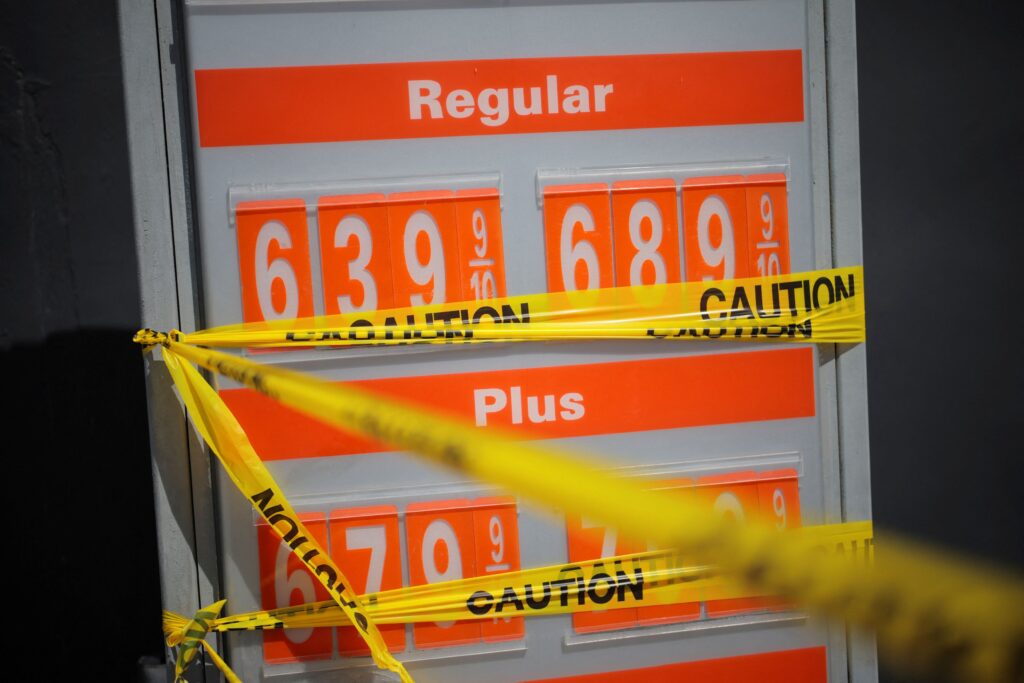
But Americans’ war tab is mounting. Regular gasoline prices now top $4.09 per gallon, according to AAA. At $5.53 per gallon, diesel — which powers the freight and farm sectors — is approaching the all-time high of $5.82, reached after Russia’s 2022 invasion of Ukraine.
Investors who fear that higher energy costs will push up inflation are demanding more compensation to hold bonds. That pushes up yields on the 10-year treasury security, which explains why 30-year mortgage rates, now averaging 6.46 percent, are up nearly half a percentage point since the war began.
All of this is a political headache for a president who returned to office decrying the 40-year high in inflation that occurred under his predecessor. Though Trump declared on Wednesday that the nation now has “no inflation,” government statistics disagree.
Prices rose at an annual 3.1 percent pace in January, the most recent data available for the Federal Reserve’s preferred metric, core personal consumption expenditures index, which excludes volatile food and energy components. That’s higher than the Fed’s 2 percent target for price stability, and Wall Street economists expect the Gulf conflict to push inflation higher.
Bank of America says the broader headline inflation figure will approach 4 percent in the next few months, up from 2.8 percent today.
The strait’s closure, cutting off crude oil shipments to Asia, means that petrochemical plants in places like India and China are running short of the feedstock they use to make all kinds of products, including cosmetics, auto parts, paints, household cleaners, beverage containers and aerospace components.
In early March, South Korea’s Yeochun NCC, a petrochemical producer, declared force majeure in early March, formally notifying customers that it could not fulfill its contracts because the war had interrupted its raw material shipments.
“We’re now getting very close to the point where you’re going to see the price of everything start going up,” said Eric Byer, president of the Alliance for Chemical Distribution, an industry group.
Getting a precise handle on the war’s economic impact is difficult, given uncertainty over its duration. But whenever the fighting ends, it will leave a lasting imprint on the global and U.S. economies.
Three of the world’s top 10 producers of urea and anhydrous ammonia fertilizer — Saudi Arabia, Qatar and Iran — are in the conflict zone. Most American farmers have already locked in their fertilizer orders for this year’s plantings, though those who have not will face soaring bills, according to Krista Swanson, chief economist of the National Corn Growers Association.
The price of urea fertilizer, for example, is up roughly 50 percent since the end of February. If the war lasts into May, farmers will still confront high prices in August when they order next year’s fertilizer, she said.
“If this continues on, this will be an issue for all corn growers for the 2027 crop,” Swanson said.
The closure of the strait has blocked roughly one-third of the global supply of another critical industrial input, helium, which is a by-product of natural gas production. The loss of Qatar’s Ras Laffan gas complex, heavily damaged by Iranian missile and drone strikes last month, will depress global supplies of the industrial gas for up to five years.
Helium is used to make semiconductors for consumer products and artificial intelligence data centers. So far, manufacturers have kept operations going by relying on stockpiled supplies. But the U.S. and Iran have both threatened to broaden their attacks on energy infrastructure in the Gulf, which could aggravate the market impact.
“To get back to the full supply scenario prior to the war, that’s going to take a very long time. And the worry is that conditions could deteriorate even further,” said one industry executive, who spoke on the condition of anonymity to provide a candid assessment.
Aviation was one of the first sectors to feel the war’s effects. In Singapore, a major global hub, jet fuel has more than doubled in price since the conflict began. Three South Korean airlines, including Korean Air, announced they were adopting an “emergency management” stance that involved shrinking routes and raising fares to preserve cash.
Major European airports in London and Frankfurt, Germany, are developing contingency plans to cope with potential shortages of jet fuel that could ground commercial jetliners.
Ryanair, the budget airline, will be forced to cancel up to 10 percent of its flights between May and July if the strait is not reopened, Michael O’Leary, the head of Ryanair, told ITV News.
“The sooner this war is over, the better,” O’Leary said.
The post Americans are feeling the Iran war’s economic pain with hints of worse ahead appeared first on Washington Post.