Biruté Galdikas spent two months in the rainforest before she saw an orangutan. She was 25, and she had given up an easy life in Los Angeles for what people told her would be an impossible one in Indonesian Borneo.
Every day, Dr. Galdikas walked up to a dozen miles through a dense wood plagued by fire ants and pit vipers. Leeches fell out of her socks. It rained so much, the swamps swelled up to her armpits. Most nights, she wrote in a 1995 memoir, she arrived back at her bark-walled hut “drenched in sweat and convinced that the wild orangutans had all moved out of the study area simply to spite me.”
It was 1971 and few people, let alone women, had attempted the kind of immersive scientific study Dr. Galdikas hoped to complete. She was the third in a group who would come to be known as the “Trimates” and “Leakey’s Angels,” a nod to their mentor, the famed paleoanthropologist Louis Leakey. The other two angels, Jane Goodall and Dian Fossey, had already produced groundbreaking research on chimpanzees and gorillas, respectively.
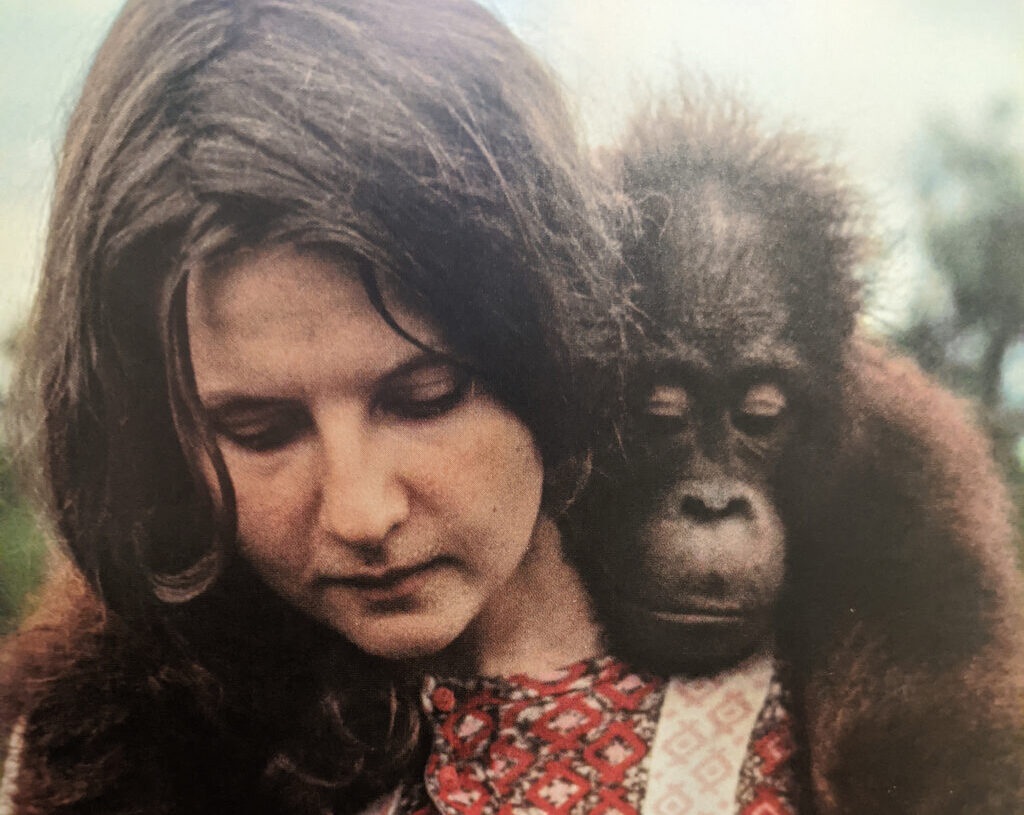
Dr. Galdikas worried she might never succeed the way Goodall and Fossey had, but every morning before dawn, she trudged into the tea-colored swamp and learned to listen to the trees. Finally, on Christmas Eve, Dr. Galdikas heard a branch snap a hundred feet up. She peered into the canopy and saw a 70-pound female orangutan with an infant on her shoulder.
Dr. Galdikas let out “an involuntary gulp of joy.” She spent the next 10 hours tracking the red-haired apes. She wrote down what they ate and how far they traveled. She described their interactions. By the end of the day, Dr. Galdikas had 30 pages of notes and the beginning of what would become the world’s longest continuous study by one person of a wild mammal.
Leakey had told Dr. Galdikas he would pay for 10 years of research. But by the end of that first observation, Dr. Galdikas had decided a decade would not be enough.
“I began to think I’d need a lifetime,” she wrote.
She spent most of the next 55 years, the rest of her life, in the rainforest. She died March 24 in Los Angeles, seven weeks shy of her 80th birthday, following a battle with lung cancer and pulmonary fibrosis, according to Orangutan Foundation International.
Dr. Galdikas’s death marks the closing of an era of legendary conservationists. Fossey was murdered in 1985, and Goodall died last year. Together, the women reshaped our idea of what it means to be a scientist and an explorer. They willed themselves to the top of a male-dominated field. They sacrificed their own health for conservation, and they discovered almost everything humans now know about primates.
“I don’t think there will ever be another Biruté,” said Nancy Briggs, a colleague who worked with Dr. Galdikas for 40 years. “She was a force of nature, and I have to say, brilliant. She was a superior scientist and ardent primatologist, and she saw that we had to save the rainforest and respect the country to preserve the animals and the habitat.”
Long before Dr. Galdikas saw her first wild orangutan, she obsessed over them. While other young women in the late 1960s partied or dreamed of families, she tried to find her way to Southeast Asia. She haunted UCLA professors’ offices, and she wrote to a museum director in Borneo because she had read that his wife kept orangutans. She even sent letters to the newly independent nation of Malaysia, hoping someone might allow her to move into its forests and study the objects of her obsession. No one wrote back.
But then, one afternoon when Dr. Galdikas was 22, Leakey came to speak to her class on archaeological dating techniques. Leakey had lost most of his teeth, and he couldn’t walk without a cane, but Dr. Galdikas was mesmerized.
“This is the man,” Dr. Galdikas thought, “who will unlock the universe for me.”
As a master’s student in anthropology, Dr. Galdikas had more experience than Goodall or Fossey did when they began their studies. Leakey offered to help, but three years passed before he could secure funding or permits.
When Dr. Galdikas and her first husband arrived in Borneo in 1971, they found that the world’s third-largest island had no roads or electricity, no hotels, not even a way to receive mail. It was, she wrote in her memoir “Reflections of Eden,” “isolated and pristine,” one of the only places on the planet to study the last arboreal great ape.
At the time, researchers knew almost nothing about wild orangutans. They were sold or kept as pets, but scientists didn’t know whether they were social or solitary, whether they preferred leaves or fruit.
“I was drawn in by that mystery,” Dr. Galdikas said later.
Though orangutans are not our closest relative — both chimpanzees and gorillas share more DNA with humans — Dr. Galdikas saw herself in them. She was born in Germany in 1946 to Lithuanian parents fleeing Soviet occupation. Her family moved to Canada when she was 2 years old, but her parents often told her about the lush forests they had inhabited in Lithuania. She read “Curious George” in the second grade, and afterward, she swung from trees in her neighborhood and imagined the home her parents left behind. She decided then she would become an explorer.
Almost everything Dr. Galdikas learned in the 1970s was groundbreaking. She was the first primatologist to witness a wild orangutan birth and the first to document an orangutan using a stick as a tool in the wild. She discovered that orangutans spend as much as half of their day on the ground, and unlike chimps and gorillas, they prefer to be alone. They like to eat fruit, and occasionally they would share Dr. Galdikas’s lunch of sardines and rice.
Though Dr. Galdikas never quite reached the level of fame as Goodall, she became a household name after she appeared on the cover of a 1975 National Geographic magazine. In the article, which Dr. Galdikas wrote, she described the ways her hut became a halfway house for captive orangutans returning to the wild.
The first was a year-old ape she named Sugito. Dr. Galdikas and her husband found him living in a wooden crate inside an Indonesian man’s home. Sugito was a tiny orange mess with spiky hair, and he smelled like urine and feces when Dr. Galdikas pulled him out of the box. She didn’t feel maternal when she first held him, but he clung to her and refused to let go.
“Changing clothes became a major undertaking, with Sugito screeching and clutching at whatever was coming off,” she wrote in National Geographic.
Their relationship was “endearing but claustrophobic,” Dr. Galdikas wrote in her memoir. He wet the bed nearly every night, and if Dr. Galdikas’s husband approached her, the orangutan bit or defecated on him. For a while, the couple couldn’t even touch. But Sugito soon became “the most important relationship in my life,” Dr. Galdikas wrote.
“He symbolized my need,” she wrote, “my responsibility, to help the orangutan species.”
Dr. Galdikas went on to have more children, both orangutan and human. In 1980, her oldest son, Binti, appeared on the cover of National Geographic in a bathtub with an orangutan around his neck. But the tension that began with Sugito eventually boiled over, and Dr. Galdikas and her first husband divorced. Dr. Galdikas later married an Indigenous Dayak man, Pak Bohap bin Jalan, and had two more children, Jane and Fred, whom they raised in the rainforest.
Fred Galdikas said his mother was as caring as she was laser-focused on her work.
“To be the so-called mother of hundreds of orangutans, you have to have some motherly qualities,” he said. “She was empathetic and she was generous, and even as a kid, I sensed it was important work.”
Over time, Dr. Galdikas’s work shifted from research to activism. Timber and palm oil companies cut into the rainforest, and the orangutan population declined. Dr. Galdikas knew repopulation would be difficult. Early on, she had discovered that orangutans have the slowest reproductive rate of any animal. She began to spend less time in the swamp and more time campaigning for conservation.
In 1982, she persuaded the Indonesian government to establish the Tanjung Puting reserve as a national park, and in 1986 she founded Orangutan Foundation International. She continued to publish new studies on the orangutans’ diets and birth patterns, but by the 1990s, Dr. Galdikas had stopped living full time at her camp, and the Indonesian government had grown wary of her work.
When she tried to renew her research permit, a Forestry Department official told her, “Twenty years is enough,” according to a 1992 New York Times Magazine profile of her work.
Reporters who visited in the years after found the camp deserted and “in shambles.” Other primatologists questioned her rehabilitation methods, and key funders rescinded their financial support.
Corrupt bureaucrats “want to discredit me and send the orangutans off to east Borneo,” she told the Guardian newspaper. “Then the logging companies can move in.”
Eventually, those controversies faded into the background. She traveled the world to speak about her research, and she taught classes in Vancouver, British Columbia. But she continued to return to Borneo. When she made her final trip in December 2024, Borneo’s orangutan population had dwindled to about 100,000 — less than half the size it was a century ago.
Dr. Galdikas learned she had lung cancer soon after that trip, but she refused to retire. Her foundation still employs 256 people near the camp, and she told friends and family that both those families and the orangutans depended on her. She continued working and writing from her hospital bed.
Indonesian government officials plan to repatriate her body next week, and she will be buried alongside her second husband. Fred Galdikas said he will continue her work.
Although her death did not receive the fanfare that the other Trimates’ did, Fred Galdikas said his mother might have preferred it that way; she didn’t seek celebrity outside of her will to leverage her name for the good of her obsession.
A few years ago, after she had spent 50 years in Borneo, Dr. Galdikas spoke to a podcast host at the Leakey Foundation, and she tried to make sense of the National Geographic covers and the legacy she might leave behind.
“I’m just a person who sits in the forests and follows wild orangutans and tries to save them by planting trees,” she said.
The post Biruté Galdikas, authority on orangutans, has died. She was one of ‘Leakey’s Angels.’ appeared first on Washington Post.