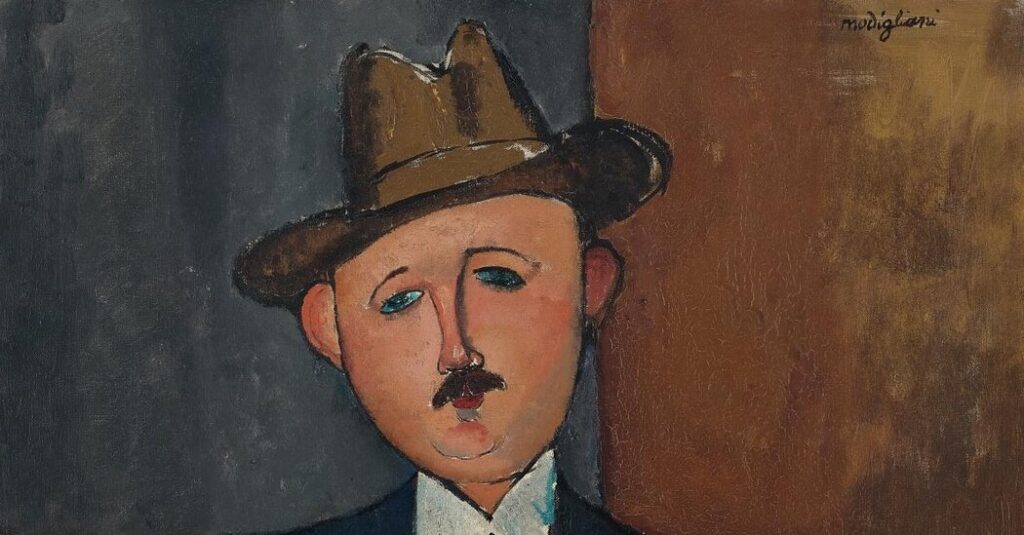
For more than a decade, the estate of a Jewish antiques dealer has tried in court to claim a valuable painting by Amedeo Modigliani, an oil portrait of a dapper chocolate merchant in a hat and tie, seated and holding a cane.
The painting, the estate said, was confiscated from the dealer’s Paris shop during the Nazi occupation of France and sold off more than eight decades ago.
But the claim, registered in a New York lawsuit filed in 2015, has long been disputed by the Nahmad family, a prominent dynasty of art dealers that wields enormous power in the international art market. A Nahmad holding company, International Art Center, bought the work at auction in 1996 and has held it ever since in storage in Switzerland.
The holding company has long argued in court papers that there is doubt about whether the painting it bought is the same Modigliani that the antiques dealer, Oscar Stettiner, once owned.
On Friday, a judge in New York Supreme Court, Joel M. Cohen, ruled that it is the same painting and that Mr. Stettiner’s estate “is entitled to possession of the painting,” known as “Seated Man With a Cane” (1918).
“Oscar Stettiner owned or at a minimum had a superior right of possession of the painting prior to its unlawful seizure,” the judge wrote, and “he never voluntarily relinquished it.”
Judge Cohen wrote that both of these points were supported by a 1946 decision in a French court, to which Mr. Stettiner had brought a claim after the war. The French court ordered that the painting be returned to Mr. Stettiner, but by that time it had been sold and the man who bought it said that he had resold the work and that it was no longer in his possession.
In ruling against the art dealer and billionaire David Nahmad and the Nahmad holding company, Judge Cohen said the defendants had “failed to raise any material issues of fact, and offer no evidence that identifies anyone other than Mr. Stettiner as the owner of the painting or that he voluntarily relinquished it.”
Mr. Stettiner, a Jewish dealer of British nationality, died in France in 1948, according to documents submitted to the court.
The decision is a victory in a long campaign by Mr. Stettiner’s grandson, Philippe Maestracci, and a company, Mondex, that specializes in recovering looted art. They began working to reclaim the painting, once estimated to be worth as much as $25 million, years before filing the lawsuit.
“Our client, Mr. Maestracci, is overwhelmed with joy and the satisfaction that after so many years the quest of his grandfather has finally been fulfilled,” said James Palmer, Mondex’s founder.
“We now look forward to Mr. Nahmad to abide by his promise to return the painting upon receiving the order of the court, which today he has now received,” Mr. Palmer said.
Aaron Richard Golub, a lawyer who represents the Nahmad family and the holding company, said he had no comment.
A lawyer for the Stettiner estate, Phillip Landrigan, faulted the defendants, asserting they had dragged out the litigation “in hope the heir would be forced to give up” and ignored “the compelling evidence presented by Stettiner’s heir to the court.”
Initially, much of the legal jousting in the case concerned whether the Art Center company was controlled by Mr. Nahmad. For years Mr. Nahmad’s representatives avoided making that direct connection, until Mr. Nahmad eventually conceded that it was his. But he said in interviews that he had bought the painting in good faith and cited how he had lent the Modigliani to several museums, including the Jewish Museum in New York in 2004.
“If you had any doubt about looted art, would you really lend it to a Jewish museum?” he asked in an interview with The New York Times in 2016.
The judge said that although the Stettiner family had been misled about where the painting was for 50 years, this was not the fault of Mr. Nahmad, who did not become involved with the work until the holding company purchased it through Christie’s in 1996.
He faulted the provenance information listed for the painting at that auction, stating that “by design or inadvertence” it had been erroneous and misleading. Christie’s declined to comment.
Judge Cohen said that while he found the evidence tying the painting to Mr. Stettiner compelling, including records suggesting he lent the work for a 1930 exhibition in Venice, he determined that the arguments made to rebut that position were speculative.
“The evidence shows a straightforward and persuasive chain of ownership/right of possession flowing directly from Mr. Stettiner to Nazi seizure to a forced sale,” Judge Cohen concluded.
Graham Bowley is an investigative reporter covering the world of culture for The Times.
The post After 11 Years in Court, Heir Reclaims a Modigliani Looted by the Nazis appeared first on New York Times.