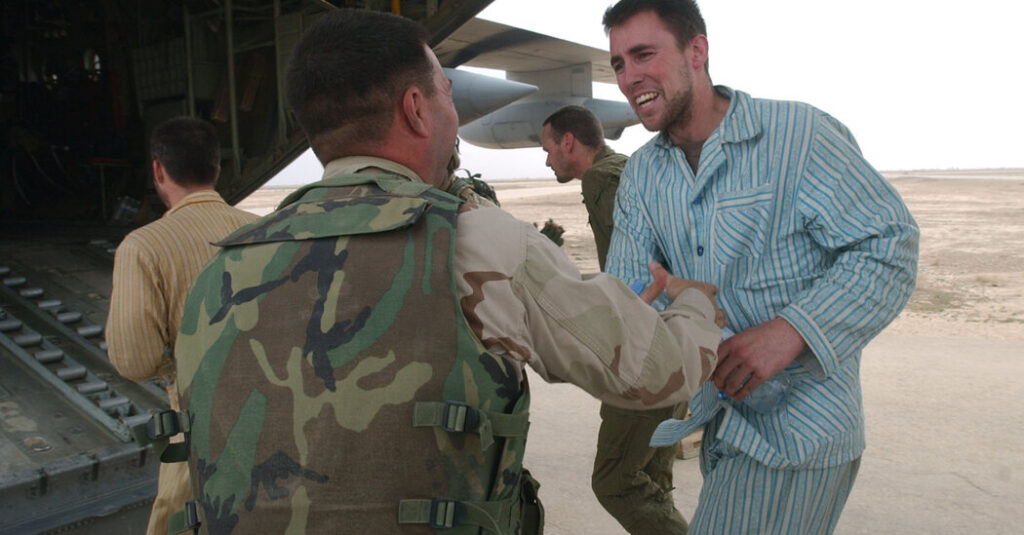
The helicopter crashed in central Iraq in the first days of the U.S. invasion in 2003. Ronald Young Jr., then a 26-year-old pilot, jumped out and scrambled for cover. Under the glow of a full moon, he recalled suddenly feeling like prey.
“There’s nothing that replicates a situation when you’re shot down,” Mr. Young said in an interview with The New York Times on Friday. “You can’t even wrap your head around what’s happening to you. People are hunting you. They are trying to kill you. And you realize that you just want to stay alive.”
Mr. Young was a chief warrant officer in the United States Army when his Apache Longbow copter went down that year.
Now, after Iran shot down a fighter jet carrying a two-member crew on Friday, the fate of one crew member of the American warplane remains unclear amid the war in that country. One pilot on the jet, an F-15E Strike Eagle, was rescued, U.S. officials said.
The U.S. military, which began striking Iran alongside Israel on Feb. 28, setting off the war and leading Tehran to retaliate with strikes across the Gulf region, has launched a search and rescue operation to find the second crew member.
Tehran has also begun its own effort to find and capture the missing American.
The stories of U.S. airmen who have survived after crashing in hostile territory in past military operations offer a window into the psychology of surviving — from the first hours of fleeing pursuit to the fortitude it takes to survive captivity.
In 1995, U.S. Marines staged an audacious rescue mission into the Bosnian war zone to snatch up a missing Air Force fighter pilot from his hiding place in the woods. They took him to safety by helicopter amid a smattering of Bosnian Serb missile and machine gun fire.
The Air Force pilot, Capt. Scott F. O’Grady, had been on the move stealthily in hilly woodlands for six nights before his guarded radio signals allowed rescuers to verify his location and home in, The Times reported then.
“I was always living in my future,” he also told CNN in a 2015 interview, adding that he had lived off ants while fighting off thirst and hunger in the woods. “I learned that there’s no guarantee that tomorrow will come.”
In Iraq, Mr. Young and his co-pilot, David Williams, were on the ground for about an hour and a half, he said. They ran through tall grass and hid in an irrigation ditch, where they feared getting hypothermia, before they were captured by gunmen. For 23 days, they were held as prisoners of war, handed off between Iraqi forces.
On the first night, the men were beaten and interrogated in dark rooms in the central city of Karbala as bombs destroyed targets all around them, Mr. Young said. They were later taken by truck to Baghdad, the Iraqi capital, where they were placed in the control of military officials, he said. While in captivity, the men were moved from prison to prison, until Baghdad fell to U.S. forces and they were passed off to others in the city of Samarra.
Eventually, the men were able to escape Iraq in 2003 through a U.S. government deal with their captors, he said.
Mr. Young, 49, is now a speaker and youth pastor living in Athens, Ga. He is married and has three children.
Military pilots are trained in principles called Survival, Evasion, Resistance and Escape, or SERE. After ejecting from an aircraft, pilots must find a secure place to evade capture from enemy fighters, and use radios in their kits to share locations with U.S. forces.
In cases where individuals are captured or taken hostage, pilots are meant to draw on resistance training to deal with extreme stress, interrogation and possible torture while in captivity.
But in practice, Mr. Young said, what happens after being shot down is an existential battle between instinct and consciousness.
“The adrenaline is absolutely through the roof,” he said. “With that comes the capacity to think incredibly clearly,” he said. “You realize you have this bank of knowledge. You just become strictly very reactionary. You find yourself almost in a mechanical process where you just start executing down the line of things you need to do.”
Pranav Baskar is an international reporter and a member of the 2025-26 Times Fellowship class, a program for journalists early in their careers.
The post 23 Days in Iraq: U.S. Pilot Shot Down During Invasion Recalls Battle for Survival appeared first on New York Times.