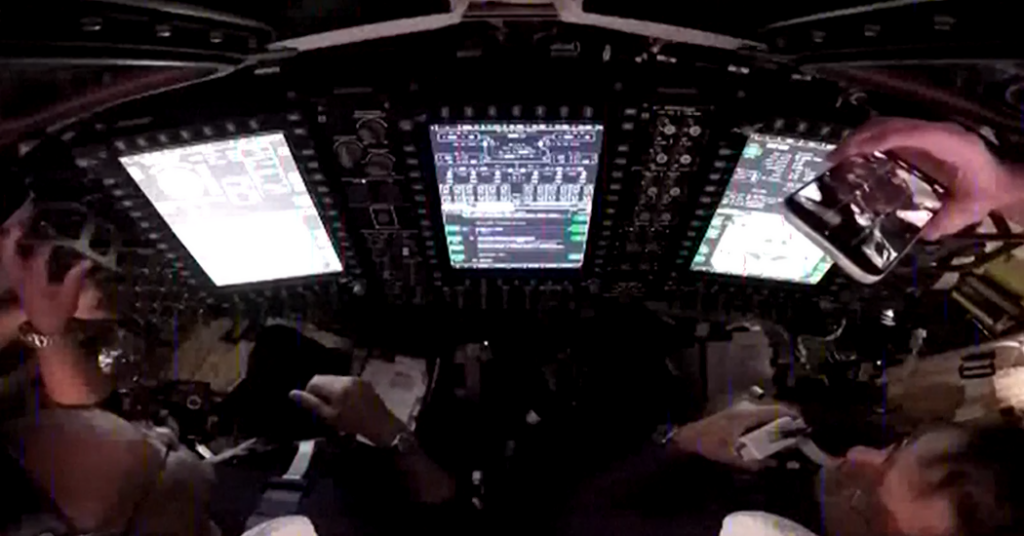
Yes, that really was an iPhone you saw floating inside the cockpit of a spacecraft on Wednesday.
About four hours into the first mission to the moon since 1972, a silver iPhone floated by a camera overlooking the cockpit of the Artemis II spacecraft. It left the hands of Jeremy Hansen, passed over the heads of Reid Wiseman and Victor Glover and landed with Christina Koch.
The mission is one of the first times that NASA has allowed astronauts to fly with smartphones. NASA gave each astronaut an iPhone during the crew’s quarantine, which started in March, the agency said.
But there was no sneaking in a video call on FaceTime or a round of Candy Crush before entering orbit. The phones can’t connect to the internet or use Bluetooth, NASA said. They are primarily for taking photos and videos.
So far aboard the Orion capsule, the astronauts have used their phones to take photos and videos out of the window of the spacecraft, including when they could see the upper stage of the rocket that had sent them to space.
Ms. Koch and Mr. Hansen also took photos and videos of Mr. Glover and Mr. Wiseman as the capsule moved around the rocket, a demonstration that shows how Orion might move and dock with a future moon lander.
“We are giving our crews the tools to capture special moments for their families and share inspiring images and video with the world,” Jared Isaacman, the NASA administrator, said in a social media post in February. “Just as important, we challenged longstanding processes and qualified modern hardware for spaceflight on an expedited timeline.”
The iPhone 17 Pro Maxes being used by the astronauts aren’t the only cameras on the Orion capsule, though they may be the newest since their debut in September. The crew is also taking photos and videos with two Nikon D5s, a model that was introduced in 2016, and four GoPro Hero 11s, which was introduced in 2022.
The process for approving hardware for spaceflight is “usually pretty involved and lengthy,” said Tobias Niederwieser, an assistant research professor at BioServe Space Technologies, a research institute at the University of Colorado, Boulder, that had a payload on the Artemis I mission.
Typically, the process has four phases, Mr. Niederwieser said. The first introduces the piece of hardware to a safety panel. The second identifies the potential hazards of the hardware, which ranges from moving parts to materials like glass that could shatter. The third lays out a plan for addressing such hazards. The fourth proves that the plan works.
“You can imagine — with the shatterable material, for example, it’s just floating in the air,” Mr. Niederwieser said. “It doesn’t just drop to the ground, and you’re protected because you have shoes on.”
The process is meant to protect both the crew and the spacecraft, he said. In “a perfectly sealed capsule” in microgravity, when the effects of gravity are so reduced that things appear to be weightless or in free fall, hardware will work in very different conditions than on Earth. Case in point: NASA discussed using Velcro to mount phones in the Orion capsule, the agency said. Before launch, at least one of the phones was zipped into a leg pocket on a flight suit.
“Everything floats around in space,” Mr. Niederwieser said. “In order to attach anything anywhere, things usually have Velcro. It goes so far as every single pen and the cap of the pen.”
Apple said it wasn’t involved with NASA’s process for approving iPhones for the Artemis II mission. The company said the mission was the first time an iPhone had fully qualified for extended use in orbit and beyond.
Smartphones have flown in space before, though many of those missions were private. In 2021, for example, Mr. Isaacman served as the commander of the Inspiration4 mission, which was operated by SpaceX, and used an iPhone to photograph the Earth. In 2011, the crew of the final space shuttle mission, STS-135, flew with two iPhone 4s as part of an experiment.
Kalley Huang is a Times reporter in San Francisco, covering Apple and the technology industry.
The post How iPhones Found Their Way Into Space appeared first on New York Times.