The Health Department is quietly laying the groundwork to revive a vaccine advisory committee whose membership and decisions were frozen last month by a federal judge.
A document renewing the committee’s charter for the next two years, and scheduled to be published on Monday in the Federal Register, enshrines changes that would allow Health Secretary Robert F. Kennedy Jr. to nominate members of his choice.
If Mr. Kennedy resurrects the committee, which rescinded recommendations for several childhood shots, he will be doing so even as the White House has indicated that it wants to tamp down talk of vaccines before the midterms.
The move would enable Mr. Kennedy to restore at least some of the changes he had made to vaccine recommendations over the past year before the judge halted them. The charter’s renewal appears to be a response to a petition last week by Aaron Siri, a lawyer who for years joined with Mr. Kennedy in court battles over vaccine safety.
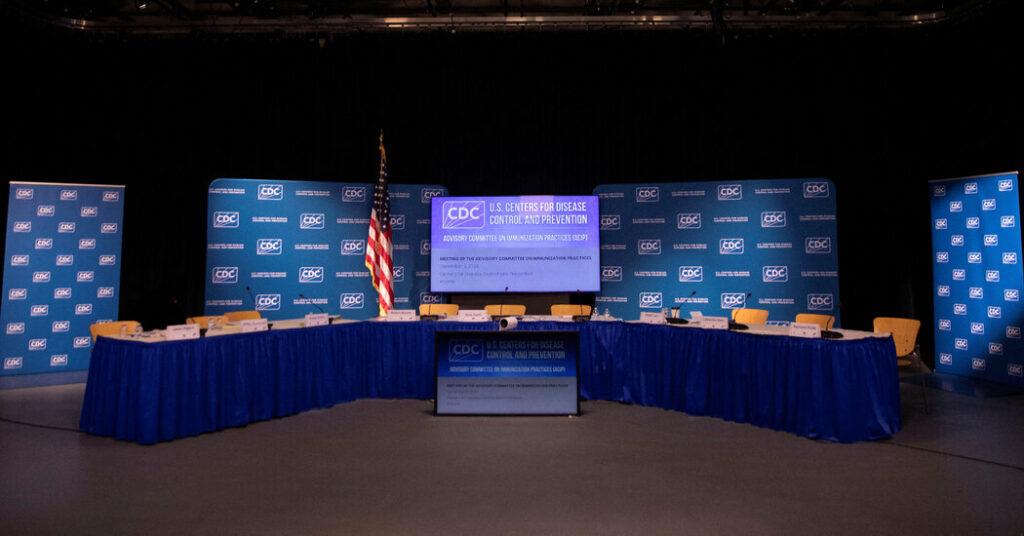
The panel in question, the Advisory Committee on Immunization Practices, recommends vaccines for Americans. Its recommendations have historically guided insurance coverage of shots, as well as state policies on which vaccines are required for entry into day care and kindergarten.
Last month, a federal judge ruled that the members Mr. Kennedy had appointed to the committee were “distinctly unqualified” to make vaccine recommendations. The Health Department has not yet appealed the decision.
A.C.I.P.’s current charter requires its members to “have expertise in the use of vaccines and other immunobiologic agents in clinical practice or preventive medicine, have expertise with clinical or laboratory vaccine research, or have expertise in assessment of vaccine efficacy and safety.”
In his decision, the judge wrote that only six of the 15 panelists Mr. Kennedy had appointed “appear to have any meaningful experience in vaccines — the very focus of A.C.I.P.”
Mr. Siri has openly disagreed with the ruling. In his petition to Mr. Kennedy, he asked the health secretary to reframe the committee’s charter and to nominate at least two members who “have direct and substantial experience advocating for and/or treating those injured by vaccines.”
It is unclear whether the renewal document will be followed by a new charter that lays out changes to the committee in greater detail. The Health Department did not immediately respond to a request for more information.
In a comment emailed to The New York Times, Mr. Siri said “there is a desperate need to balance the committee so that safety is also properly considered.”
“A.C.I.P.’s longstanding membership imbalance has resulted in a failure to properly address and consider vaccine safety in its deliberations and recommendations,” he added.
The renewal document does not mention vaccine safety or injuries, but it does emphasize a “balance of specialty areas” among committee members, including biostatistics, toxicology, immunology, family medicine and nursing. It also suggests that members represent “a diversity of geographic locations within the U.S.”
The broader range of expertise would allow Mr. Kennedy to argue that the experts he appointed fit the criteria as now outlined. Even without appealing the judge’s ruling, he could recreate the committee and bring back some of the same members.
It is unclear whether and how quickly Mr. Kennedy would act to form a new committee, however.
“One of the arguments in the lawsuit was that they did not undertake a serious process in appointing,” said Dorit Reiss, an expert on vaccine policy and law at the University of California College of the Law, San Francisco.
Mr. Kennedy could, in theory, announce new members as early as next week, Ms. Reiss added: “But if he wants to make the new A.C.I.P. less vulnerable, he would at least go through the motions of serious consideration.”
Apoorva Mandavilli reports on science and global health for The Times, with a focus on infectious diseases and pandemics and the public health agencies that try to manage them.
The post H.H.S. Takes a First Step Toward Restoring Vaccine Advisory Committee appeared first on New York Times.