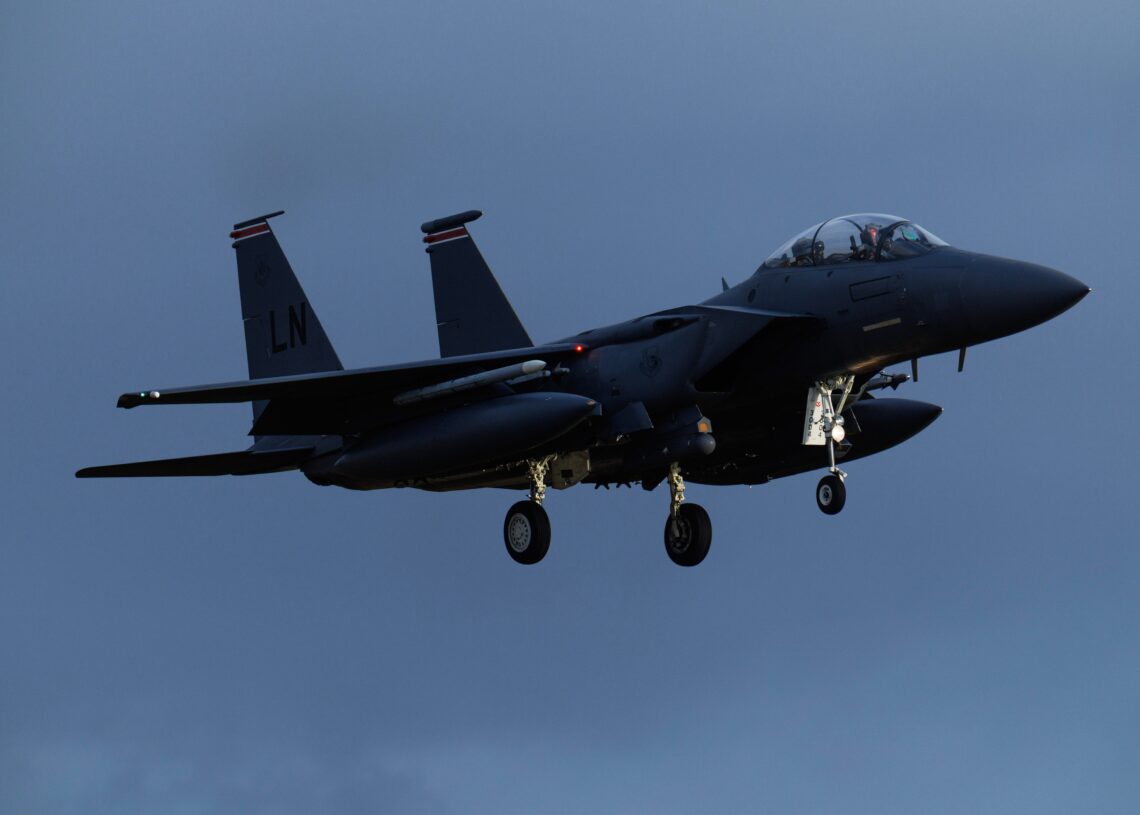
A U.S. fighter jet was shot down in southern Iran on Friday, prompting a frantic search-and-rescue operation that led to the recovery of one of the two downed crew members, U.S. officials said.
The rescued crew member is safe in U.S. custody, though their condition is unclear, and an intense effort is underway to recover the second crew member, the officials said, speaking on the condition of anonymity to discuss the ongoing operation.
The operation marks the most perilous moment yet for U.S. troops in the month-long Iran war, putting the missing crew member and rescuers more directly in the line of enemy fire. It is the first known instance of a crewed American aircraft being brought down by enemy fire inside hostile territory since the conflict began.
The fighter appeared to be an Air Force F-15E, officials said. The two-seat jets are operated by a pilot and a weapons systems officer.
Pentagon spokespeople did not respond to requests for comment.
The incident represents a potential political liability for President Donald Trump, who is facing strong pushback from opponents of the Iran war — including among some of his supporters, who elected him to a second term based, in part, on his campaign promises to avoid costly military entanglements. In a prime-time address this week, the president sought to defend his increasingly unpopular decision to start the conflict while asserting that the operation is “nearing completion.” It was not immediately clear how Friday’s developments could affect that announced timeline.
The U.S. jet was downed by antiaircraft fire by the Islamic Revolutionary Guard Corps, according to Tasnim, a semiofficial news agency tied to the IRGC. The report, which said the aircraft was destroyed, referred to only one crew member, a pilot who it said “ejected and landed inside the country.”
The Iranians have frequently made unverified claims about downing U.S. planes and destruction of aircraft on the ground.
Iranian television broadcast a statement from local merchants in western Iran offering a reward for recovery of downed crew members. Another broadcast called on residents to “target” any Americans they found. IRIB, the state broadcaster, said on social media that “many people” had gone to the crash site to “capture” the pilot and that the Iranian military “called on the people NOT TO LET anyone mistreat the pilot.”
Combat search-and-rescue operations are some of the riskiest missions carried out by the U.S. military. Aircrews and recovery personnel are on constant standby for such operations, then they rush into a rapidly evolving and chaotic environment. While these personnel are backed by combat-capable troops, helicopters and planes used for such missions are vulnerable to enemy fire because they fly lower to the ground and must rely on other armed aircraft to protect them.
“It’s a high-risk mission,” said retired Gen. James Slife, the former commander of U.S. Air Force Special Operations Command, which specializes in infiltration and combat search-and-rescue missions. “The longer somebody is on the ground, the less opportunity you have to safely recover them.”
Teams are launched immediately, usually with incomplete information on what to expect, because of the risks faced by downed pilots and the chance that if they are captured, then they will be exploited by U.S. adversaries, Slife said.
“In addition to the moral obligation we feel to make every effort to recover our isolated personnel, you want to deny the adversary the opportunity to use a captured service member as propaganda,” Slife said.
Video verified by The Washington Post shows a C-130 refueling aircraft flying low in Iran, about 90 miles east from its border with Iraq. The tanker is shown fueling two HH-60G helicopters, which specialize in combat search and rescue, said Mark Cancian, a senior adviser at the Center for Strategic and International Studies.
“The fact that they are flying so low and slow indicates willingness to take a lot of risk,” Cancian said.
Friday’s incident appears to belie Trump’s frequent claims that U.S. aircraft are “roaming” the skies over Iran unimpeded. In his speech Wednesday night, the president said, “They have no antiaircraft equipment. Their radar is 100 percent annihilated. We are unstoppable as a military force.”
Trump has similarly claimed that Iran’s missile stockpiles and launchers have been completely destroyed, although missile and drone attacks continue — albeit to a lesser degree than earlier in the war — on U.S. installations and allies in the region.
On Thursday, just hours after declaring in his address that the war was “nearing completion,” U.S. aircraft blew up a major bridge near Tehran. Trump said in a social media post that “Our Military …. hasn’t even started destroying what’s left” and promised to begin destruction of electricity power plants. Later in the day, the IRGC announced that a “large number” of ballistic and cruise missile and “suicide drones” had been launched against U.S. bases in the United Arab Emirates.
To date, 13 American service members have been killed as a result of Operation Epic Fury, the Trump administration’s name for its war on Iran. Seven died as a result of hostile fire. Six were killed in a plane crash in Iraq. Nearly 370 others have been wounded during the conflict, according to publicly released tallies.
Friday’s incident marks the fourth loss of an F-15 since the Iran war began. In early March, Kuwaiti personnel mistakenly shot down three of the jets. All six crew members ejected and were recovered safely.
Karen DeYoung, Susannah George, Meg Kelly, Dan Lamothe, Joyce Sohyun Lee, Heba Farouk Mahfouz, Samuel Oakford, Aaron Schaffer and Siham Shamalakh contributed to this report.
The post 1 rescued after U.S. fighter jet shot down in Iran; search ongoing for crew member appeared first on Washington Post.