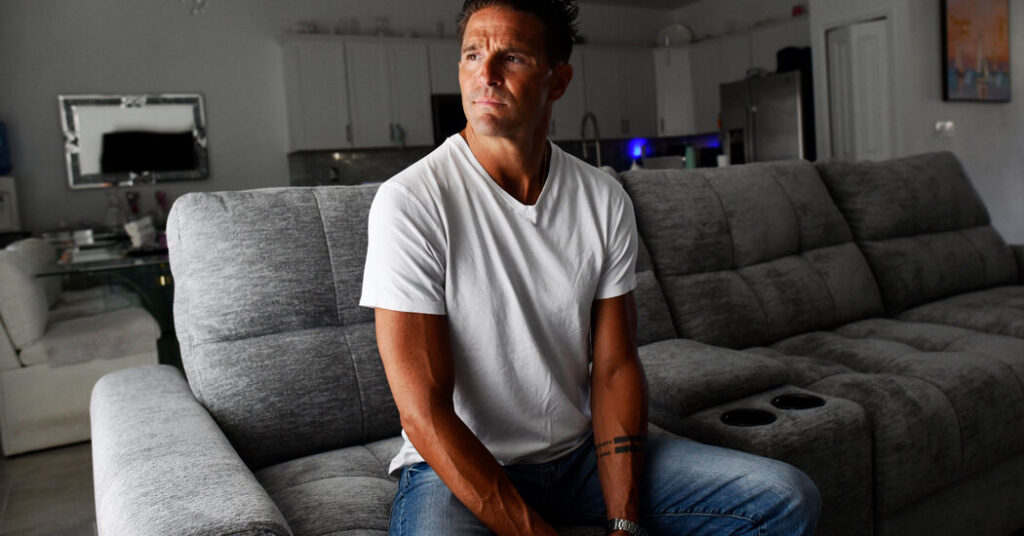
In 2019, Mark Mongiardo, then a high school athletic director, was pulled over in Sullivan County, N.Y., after a dinner with the boys’ golf team. He’d eaten a hot dog and some fries, washed down with a soda.
He hadn’t had a sip of alcohol, but the officer who stopped Mr. Mongiardo for using his phone while driving smelled it anyway. A breathalyzer test showed Mr. Mongiardo’s blood alcohol content was .18 percent, more than twice the legal driving limit.
It was his second drunken driving offense in two years, but these episodes of unexplained intoxication had begun decades earlier.
Ever since the start of his career as a gym teacher and coach in the early 2000s, Mr. Mongiardo, now 43, had been repeatedly pulled aside and warned that players and colleagues smelled alcohol on him. In 2016, he failed a surprise urine test and was required to attend counseling. He left that school district because he “could feel a reputation starting to form,” he said. Two weeks into another job, he got his first D.W.I.
Problems began to arise at home, too. He recalled one Christmas dinner where he struggled to piece together a full sentence or even pick up his fork. “There was no alcohol being served, and suddenly Mark’s drunk,” he said. “My own parents were telling my wife she should leave me.”
It wasn’t the first time this had happened at a holiday get-together. He didn’t associate the symptoms with drunkenness as they were occurring, and the next day his memory was often foggy. Though he insisted he wasn’t being deceitful, his family thought he was sneaking drinks.
Mr. Mongiardo says that on occasions when he did consume alcohol, he was only ever a casual, social drinker. But after his first D.W.I., his wife told him he needed to stop altogether. By the time of his second arrest in 2019, it had been nearly a year since his last drink.
That’s when a family member suggested he see Dr. Prasanna C. Wickremesinghe, a gastroenterologist at Richmond University Medical Center on Staten Island.
“Dr. Wick,” as he is known to his patients, has treated dozens of patients with inexplicable impairment. Under his care, Mr. Mongiardo underwent a full day of testing. He was given a sugary drink, and then was carefully monitored to make sure he didn’t have access to alcohol. Over the course of eight hours his blood was regularly drawn and tested, and his blood alcohol content steadily rose to .14.
“Dr. Wick came in shaking his head and told me, ‘You have Auto-brewery syndrome,’” Mr. Mongiardo said. Mr. Mongiardo’s relief at having an answer was overwhelming. “I just started hysterically crying,” he said.
A Difficult Diagnosis
As our bodies digest food, microbes convert carbohydrates and sugars into ethanol, a type of alcohol — usually in tiny amounts that are quickly metabolized. In patients with Auto-brewery syndrome, those gut microbes work overtime, dramatically increasing ethanol production, said Dr. Bernd Schnabl, the co-director of the San Diego Digestive Diseases Research Center at U.C. San Diego. When ethanol levels outpace what the liver can handle, people with the syndrome get drunk — just as they would from consuming alcohol.
Instances of Auto-brewery syndrome have been reported since at least the 1950s, with the earliest U.S. examples appearing in scientific journals in the ’80s. The condition is considered extremely rare, and most published research consists of individual case reports. It’s been portrayed as something of a novelty on TV, appearing as a plot point in “Grey’s Anatomy” and “The Good Doctor.”
But interest in the condition is starting to grow: At the American College of Gastroenterology’s annual meeting last October, there were five separate presentations on Auto-brewery cases. A recent study in Nature Microbiology, co-led by Dr. Schnabl, included 22 patients. A forthcoming study by Dr. Wickremesinghe and Dr. Fahad Malik, a gastroenterologist at St. Joseph’s Health hospital in Syracuse, N.Y., includes 34.
The more research is publicized, Dr. Malik said, the more cases emerge. He said he has been contacted by patients in Europe and the Middle East. The doctors say the condition may be more common than previously thought.
Cases are regularly missed because diagnosis is difficult. Dr. Malik said his patients had often seen multiple physicians before they arrived at his office. “They’ve seen a neurologist, a psychiatrist, their primary doctor, and they’re all like, ‘We can’t figure this out,’” he said.
Diagnosis is made even more tricky because, just as individuals can act differently while drunk, patients with Auto-brewery syndrome can have varying (and vague) symptoms when their gut is overproducing ethanol. “The most common ones we see are changes in mood, anxiety, depression, aggression, fatigue, brain fog and changes to how they talk and walk,” Dr. Malik said, adding that his patients are often first misdiagnosed with a mental health condition.
Under-diagnosis can also be attributed to doctor skepticism. Patients are routinely dismissed as “closet alcoholics,” Dr. Schnabl said, despite the growing body of Auto-brewery research. “I give talks sometimes, and physicians come up to me afterward and say they still don’t believe it,” he said.
A Horse or a Zebra?
Barbara Cordell, a 74-year-old nurse and Auto-brewery syndrome researcher in Carthage, Texas, often speaks to “people who swear they’re nondrinkers, but they had an accident or a D.U.I. they can’t explain,” she said. “I’ve talked to so many people who are just desperate for an answer; desperate for somebody to believe them.”
Ms. Cordell’s husband, Joe Bartnik, now 77, started getting inexplicably drunk in 2004. Sometimes it would happen on a Sunday morning at church, or during an after-dinner walk. Mr. Bartnik’s eyes would glaze over, his gait would change, and he’d slur his words. During the episodes, Mr. Bartnik, who is also a nurse, would insist he was fine. The next day, he often couldn’t remember anything.
In 2009, Mr. Bartnik had such an intense episode that Ms. Cordell thought he was having a stroke and called an ambulance. At the emergency room, he registered a blood alcohol content of .37 percent, more than four times the legal driving limit. He hadn’t had a single drink.
Doctors insisted Mr. Bartnik was secretly imbibing. “As a health care provider, I know that a lot of people are in denial and don’t always tell the truth,” Ms. Cordell said. “Of course most doctors would assume this is a horse and not a zebra.”
Ms. Cordell wanted to believe her husband, but it was hard not to be skeptical. She began marking liquor bottles, checking the trash for empty beer cans and researching phrases like “drunk without drinking.” By the time he was diagnosed a few months after the emergency room visit, Mr. Bartnik had been dealing with Auto-brewery syndrome for six years.
Ms. Cordell wrote up her husband’s case for a medical journal and later wrote a book on the condition. In 2017, she started Auto Brewery Syndrome Advocacy and Research, a patient nonprofit.
Causes and Treatments
Auto-brewery syndrome appears to be caused by multiple factors. In the Nature Microbiology study, stool samples from Auto-brewery patients were compared with samples from the patients’ unaffected household partners to try to determine which organisms were responsible for the condition. The researchers found an overgrowth of specific gut bacteria, including E. coli and Klebsiella pneumoniae, both of which are known to produce ethanol, Dr. Schnabl said.
Other studies, including Dr. Wickremesinghe’s and Dr. Malik’s, have attributed the condition to an overgrowth of intestinal fungi.
Researchers are still “a little bit puzzled” about the underlying causes of Auto-brewery and why the condition happens only in some people, Dr. Schnabl said. Some experts, including he and Dr. Wickremesinghe, think it could be tied to use of antibiotics, which are known to disrupt the gut microbiome. Dr. Wickremesinghe said that in his study of nearly three dozen confirmed cases, “all but one patient had been exposed to antibiotics,” some shortly before the symptoms began, and others several years before their onset.
For many patients, including Mr. Bartnik, the remedy for Auto-brewery can be relatively straightforward. He cut carbs and sugar completely from his diet and took several rounds of antifungals. The medication works by drastically reducing all the fungi in the gut, not just the overgrown varieties, Dr. Malik said. When the fungi repopulate, the hope is that balance is restored. Patients whose symptoms are caused by bacterial overgrowth, Dr. Schnabl added, are treated with a combination of antibiotics and probiotics to rebalance the microbiota.
“We consider treatment to be successful if patients can eat a regular diet again,” Dr. Malik said, but many patients, like Mr. Bartnik, choose to stay on a diet with very few carbs or sugars.
Mr. Bartnik no longer drinks at all, either. In some patients, drinking alcohol can cause a recurrence. Even if that doesn’t happen, Dr. Malik, who did not treat Mr. Bartnik, said he still recommends that patients abstain, to make diagnosis simpler if symptoms come back.
After treatment, some patients never have another bout of Auto-brewery syndrome. In others, the symptoms become chronic and begin to recur as soon as someone stops taking medication. Still others can relapse months or years later. Dr. Schnabl is currently involved in a small clinical trial examining whether fecal transplants could help restore gut microbiota and treat the condition more permanently.
Even with successful treatment, other problems can arise. Some patients getting their Auto-brewery under control can develop symptoms of alcohol withdrawal, Dr. Malik said, ranging from headaches and anxiety to, in rare cases, seizures.
What’s more, “We’ve had cases where, once we treated them, patients that never wanted alcohol started to crave it,” he said. Sometimes those patients do begin drinking, to satisfy the cravings, and may need to enter an alcohol use disorder treatment program.
And occasionally, Dr. Schnabl said, it turns out that patients don’t actually have Auto-brewery and have been secretly drinking all along. He argues strongly for doctors to acknowledge Auto-brewery syndrome as a legitimate condition, but cautions that a formal diagnostic standard must be established.
Ultimately, repeated court closures and delays during the Covid pandemic meant Mr. Mongiardo’s 2019 D.W.I. case missed its “speedy trial” deadline and was dismissed. In the meantime, Mr. Mongiardo lost his athletic director job and was forced to sell his house. He relocated to Florida in 2020, where he now works for a retail chain. His wife and kids joined him in 2022.
Dietary changes and several weeks of antifungal medication brought his Auto-brewery syndrome under control. He now eats a carb- and sugar-free diet and continues to abstain from alcohol. He has had only two additional episodes in recent years, he said. In late 2025, he started a TikTok channel, which now has more than 10,000 followers, aimed at bringing attention to the condition.
“I want everyone, and every doctor, to see it as a real disorder, and see what it did to me and what it could potentially do to someone who doesn’t know they have it,” Mr. Mongiardo said. “How many times did I get in my car and drive to work? How many times did I have my kids in the car? It’s scary to think, over the years, how many times I could have been intoxicated and didn’t know it.”
Now he keeps a breathalyzer on his key chain. “I blow when I wake up, and all throughout the day,” he said. “I blow all the time. After what I’ve gone through, I won’t take any chances.”
Kate Morgan is a journalist in central Pennsylvania and a media fellow at The Nova Institute for Health.
The post The Mystifying Syndrome That Makes People Spontaneously Drunk appeared first on New York Times.