This story first appeared in TIME’s new AI newsletter, In the Loop. You can subscribe here, for free, to get regular scoops like this directly into your email inbox.
By how much, if at all, will AI boost the U.S. economy?
New research by Anthropic, seen exclusively by TIME in advance of its release today, offers at least a partial answer to that question.
[time-brightcove not-tgx=”true”]
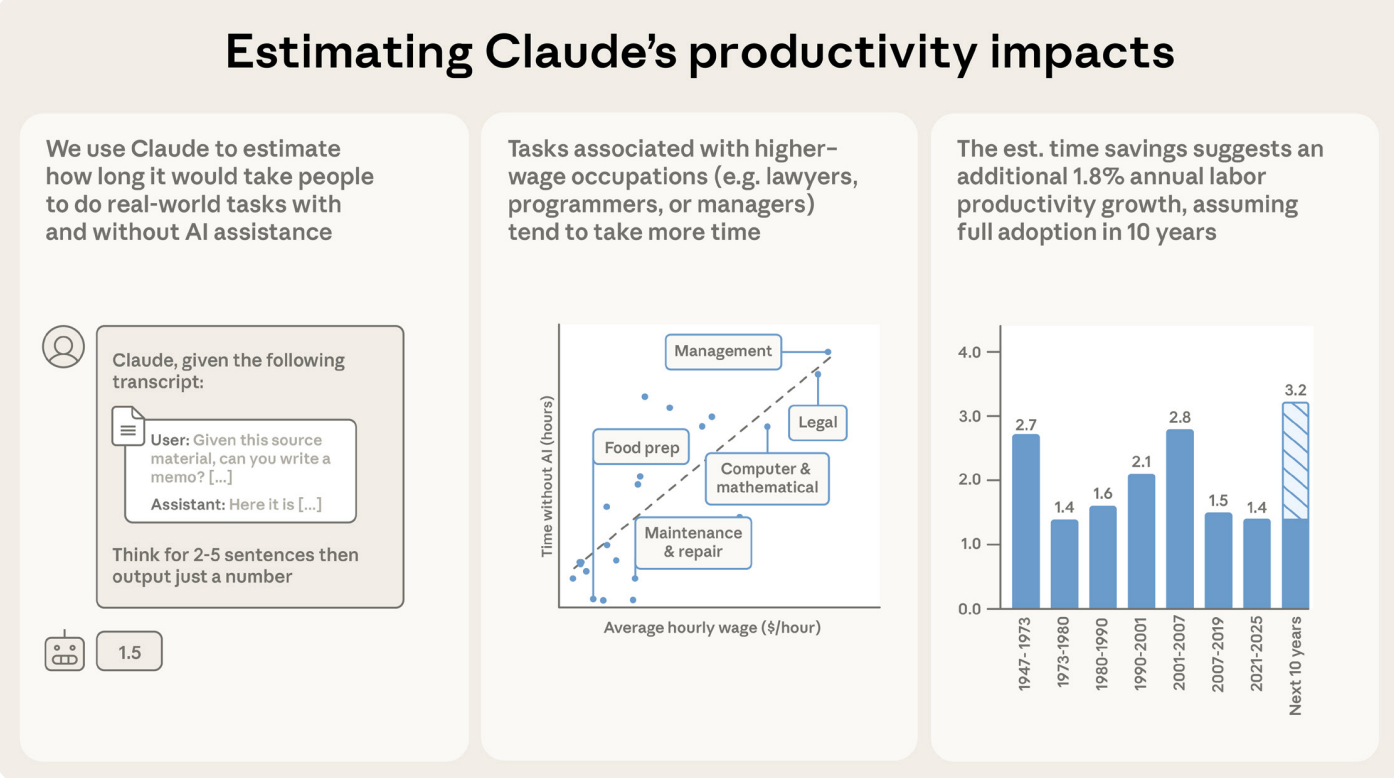
By studying aggregated data about how people use Claude in the course of their work, Anthropic researchers came up with an estimate for how much AI could contribute to annual labor productivity growth—an important contributor to the total level of growth in the overall economy—as the technology becomes more widely used.
Their answer: current-generation AI models could increase the U.S. annual labor productivity growth rate by 1.8%—doubling the average rate of growth since 2019. Assuming that labor makes up 60% of total productivity in the economy, and that AI reaches full diffusion in a decade’s time, “this implies an overall total factor productivity increase of 1.1% per year,” the researchers write. That number, the authors of the study tell TIME, is a close approximation of how much AI could contribute to overall economic growth. “In these models, typically, labor productivity would be GDP growth,” assuming labor supply stays fixed, Peter McCrory, Anthropic’s head of economics and coauthor of the study, tells TIME.
How the study works — But take these numbers with a large pinch of salt, because the method that yielded them is unorthodox. First, Anthropic researchers built a tool (called Clio) that allows them to extract details about real-world Claude usage in what they say is a privacy-preserving way. Armed with a sample of 100,000 conversations, the researchers analyzed them to check what kinds of tasks Claude was performing in each. To quantify how much time Claude saved in each conversation, they asked a separate version of Claude to estimate how long each task would take with and without AI assistance. Then, they consulted existing economic data to calculate the average wage value of that saved time, depending on the profession involved. Finally, they extrapolated those time savings, weighted by each task’s importance to the entire economy, thus arriving at a number showing the efficiency gains contributed by AI across different task profiles.
What are the limitations? — For starters, a major limitation of the study is that it assumes workers spend all the time that they save by using AI on doing more productive labor, rather than on, say, spending more time with their kids, or doing their laundry. It also doesn’t take into account the time people spend on tasks outside of their conversations with Claude, including time checking that its answers are factually accurate. Another limitation is that the researchers rely on Claude to estimate how long tasks would take—although they did validate Claude’s estimates against real data and found them to be acceptable. Lastly, the study doesn’t account for the fast-improving capabilities of AI tools, instead assuming AI remains at its current capability rate for the next decade. All other things being equal, this suggests the study could be underestimating AI’s contribution to productivity growth over the next decade.
Should I be scared? — The paper makes no mention of unemployment, which is especially notable since Anthropic’s CEO Dario Amodei pronounced in May that AI could wipe out half of all entry-level white collar jobs in the next one to five years, and spike unemployment up to as much as 20%. I asked McCrory whether those fears are borne out by the new data. “In our work, we haven’t yet specifically explored this question of attributing [the causes of] job displacement, to the extent that it might be occurring,” he said. Alex Tamkin, the paper’s other coauthor, said that part of the motivation for the study was a desire to prepare the world for the economic upheavals of AI. “Productivity growth is positive for the economy, and we’re also clear eyed about the ways in which the technology may have impacts on the labor market,” he told me. “That’s what we’re trying to do here: just add more facts to the conversation.”
The post Exclusive: AI Could Double U.S. Labor Productivity Growth, Anthropic Study Finds appeared first on TIME.