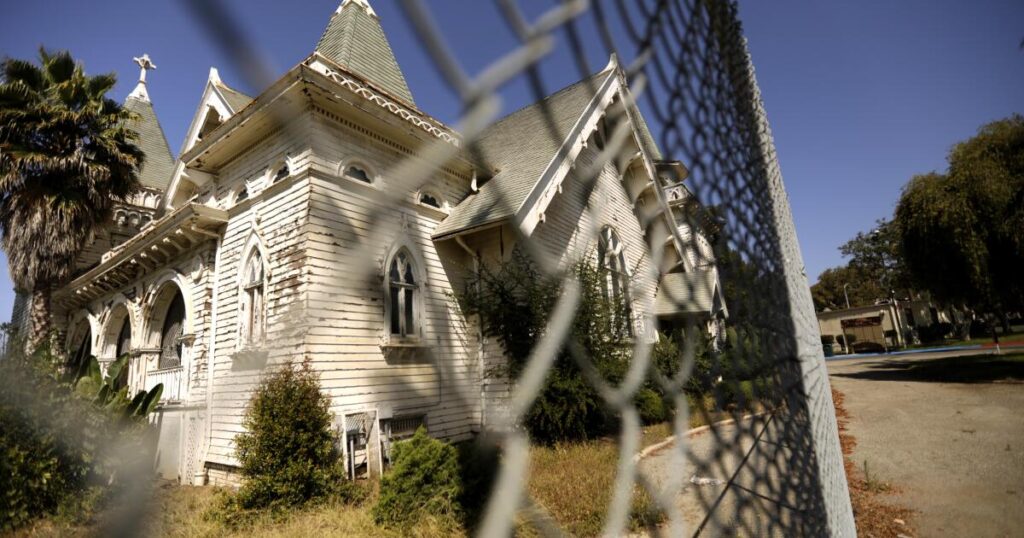
After more than a half-century of neglect, a derelict, historic church known as the oldest building on Wilshire Boulevard may finally be restored to its spiritual mission.
The U.S. Department of Veterans Affairs has notified contractors that it is seeking ideas and cost estimates for the rehabilitation of Wadsworth Chapel, the eclectic Victorian-Carpenter Gothic wooden structure that has stood since 1900 as the most prominent visual feature of the vast VA property in West Los Angeles.
Pursuant to President Trump’s 2025 executive order creating a National Center for Warrior Independence on the 388-acre campus, the notice envisions restoring the building as “a supportive space for veteran interfaith programming and wellness.” A tour of the chapel for potential developers is set for Wednesday.
Though seeking only feedback, not bids, and not backed by funding, the notice buoyed the hopes of activists who have engaged in a long and so-far fruitless effort to bring the chapel back to life.
“When I see this, I’m thinking hallelujah,” said Jonathan Sherin, chairman of a nonprofit dedicated to restoring the building. “It’s the first real indicator that the VA is willing to step up and get that chapel restored, which frankly I think is their responsibility.”
Sherin, former director of mental health for both the VA and Los Angeles County, sees the chapel as key to the connective tissue of the veteran community now being built on the campus following two court decisions and now Trump’s executive order.
“What we’re hoping there is that it would not be just a convening site, but also a site to begin addressing moral injury, which is a phenomenon that traumatized populations suffer, and particularly veterans and combat veterans,” Sherin testified during the most recent legal case.
Moral injury, he said, comes from the “fracture of a belief system, doing things, seeing things that violate one’s code of behavior, one’s understanding of what is right and wrong, can lead to moral distress, moral injury.”
The chapel, whose unusual design includes three spires, two steeples, a belfry and separate sanctuaries for Catholics and Protestants, has been locked and left to decay since being damaged in the 1971 Sylmar earthquake.
Efforts to restore the beloved building, declared a historic monument soon after it was shuttered, have proved elusive.
“Since being placed on the National Register of Historic Places in 1972, however, the building has deteriorated markedly,” The Times reported in 2007. “Intruders have set fires, burning holes in the floors and scorching wood wainscoting and pews. Empty beef jerky bags, discarded underwear and clumps of plaster litter the worn burgundy carpeting.”
At that time, preservation advocates were renewing efforts to raise funds for what was then estimated to be a $11.8-million restoration. Appeals to foundations and wealthy individuals again came up short.
The chapel is one of five early buildings remaining on land donated in 1888 by two prominent early California figures, Sen. John P. Jones and Arcadia Bandini de Stearns Baker, to fulfill Congress’ creation of a Pacific branch of the National Home for Disabled Volunteer Soldiers in 1887.
Over the decades, thousands of veterans of the Civil War, Spanish-American War and World War I lived on the grounds. After World War II, as the VA mission shifted from housing to medical care, the on-campus population declined until the last few dozen residents were abruptly removed after the Sylmar earthquake.
With veteran homelessness emerging as an issue after the 2003 Iraq war, veterans filed a federal lawsuit that ended in a 2015 settlement in which the VA committed to building 1,200 units of housing on campus. Delays in the building program led to a second lawsuit and court order that is now on appeal.
After the 2015 settlement, Sherin worked with Bandini de Stearn Baker’s great-niece Carolina Barrie to form the nonprofit 1887 Fund with authority from then VA Secretary Robert McDonald to restore the five original buildings. Besides the chapel, they are a trolley station, a wing of barracks and the superintendent’s and governor’s residences.
On its website, the 1887 Fund calls the chapel a “beacon of hope for L.A.’s unhoused veterans.”
“Despite its current state of extreme and shameful disrepair that has resulted from neglect over decades, it still stands tall as the crown jewel of this VA, and perhaps all VA[s] nationally,” it says.
Sherin said the group raised about $5 million in pledges and was counting on historical tax credits to fill the gap but still came up several million dollars short.
The post For the derelict Wadsworth Chapel, a 125-year-old landmark in West L.A., is a rehab in the works? appeared first on Los Angeles Times.