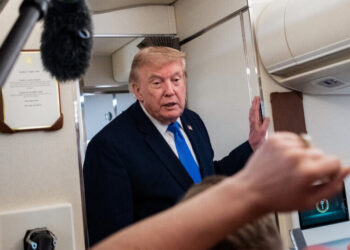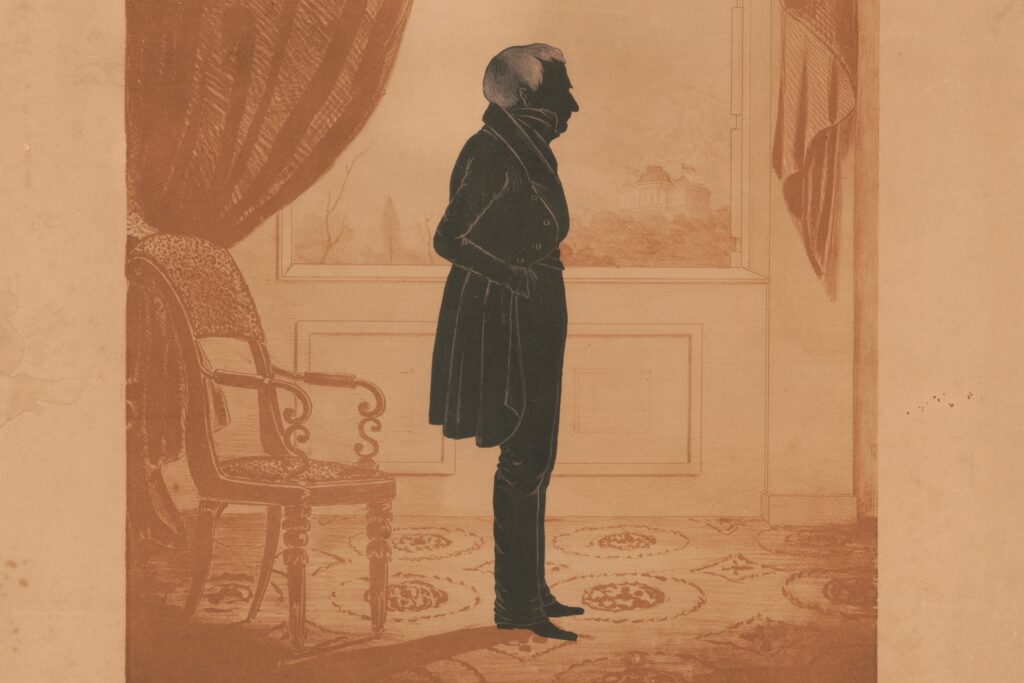
O ut of the many gold-plated portraits in Donald Trump’s Oval Office, the one of William Henry Harrison is the most surprising. If the ninth and shortest-serving president is remembered much at all, it is for the most dubious of reasons: namely, talking too much at his frigid inauguration, getting sick and dying a month later on April 4, 1841.
Trump has apparently “ruminated” about Harrison’s brief tenure and said he keeps images of his predecessors to remind him of how quickly fate can change.
The president is onto something, though he only scratches the surface. On the anniversary of Harrison’s death, and as the nation’s 250th birthday approaches, we’d all do well to consider the 19th-century Virginian not merely as a quirk of presidential history but as an aide to navigating our current politics.
The best way to learn from Harrison is by reading him. His most superlative work was arguably his first on the job. Harrison’s roughly 8,000-word inaugural address is perhaps the most famous presidential speech that nobody has ever read. Some of those who have waded through it have deemed it the worst of the genre — nearly two hours long and “totally boring,” as one former speechwriter noted. But that’s a shame. Embedded within it are warnings about the problems we face and hints of solutions.
Consider President Trump and his recent predecessors, who have entered office promising single-handed cures to our ills. Think “I’ve got a pen, and I’ve got a phone,” or “I alone can fix it.” Harrison was the rare figure who saw the “dangerous temptations” of executive power and pledged to trim his sails accordingly.
Succeeding Andrew Jackson and Martin Van Buren, the men who created the modern two-party system, Harrison warned against the “spirit of faction” and about members of Congress blindly following the president. “All the influence that I possess shall be exerted to prevent the formation at least of an Executive party in the halls of the legislative body,” Harrison intoned. He promised he wouldn’t ask a lawmaker to support “any measure of mine that does not satisfy his judgment and his sense of duty.”
The Founders imagined our politics would play out as an intense competition among branches, not as partisans uniting across branches to check an opposition. The notion that the executive would threaten to unseat representatives who are “totally disloyal to the president,” as Trump has put it, would’ve been foreign to Harrison.
So would the idea of the president’s acting as the boss of all executive branch employees. Harrison asserted that “never with my consent shall an officer of the people, compensated for his services out of their pockets, become the pliant instrument of Executive will.” He worried about the spoils system that Jackson and Van Buren had created and hoped to keep bureaucrats away from “the control of the Executive.”
There has always been the tempting counterview: that the president’s status as a nationally elected figure gives him preeminence in our constitutional order. The chief executive is “the only official in the entire government that is elected by the entire nation, right?” Trump aide Stephen Miller said during a February 2025 news conference. “Judges are appointed. Members of Congress are elected at the district or state level. … The whole will of democracy is imbued into the elected president.” This is often cited whenever courts find that the president hasn’t followed rules established by Congress or stipulated in the Constitution.
Harrison found that unpersuasive. “It is preposterous to suppose that … the President, placed at the capital, in the center of the country, could better understand the wants and wishes of the people than their own immediate representatives, who spend a part of every year among them, living with them, often laboring with them, and bound to them by the triple tie of interest, duty, and affection,” he added. For this reason, he believed presidents should play no larger role in the legislative process than “every other citizen.” Of particular interest in light of Trump’s thwarted claims of sweeping tariff power, Harrison said specifically: “The delicate duty of devising schemes of revenue should be left where the Constitution has placed it: with the immediate representatives of the people.”
This might sound strange to our modern ears. We don’t often hear presidents saying that any power should be reserved to Congress. Indeed, we rarely even hear Congress saying so. The ninth president took the matter further still. Whereas Trump muses about running for a third term, Harrison didn’t believe presidents should serve two. When “corrupting passion once takes possession of the human mind, like the love of gold it becomes insatiable,” he said. “It is the never-dying worm in his bosom, grows with his growth and strengthens with the declining years of its victim.”
A twice-elected president risks “forgetting that he is the accountable agent, not the principal; the servant, not the master,” Harrison added. He believed it was one of the “defects” of the Constitution to allow presidential reelection, and he pledged to do his part by not running again.
He constrained himself in other ways too. Under Trump, the presidential veto has ensured that any legislative efforts to rein in his tariff or war powers would ultimately prove fruitless. Harrison, by contrast, devoted some 1,000 words of his address to critiquing the excesses of that tool. Again he promised restraint: “The negative upon the acts of the legislative by the executive authority, and that in the hands of one individual, would seem to be an incongruity in our system,” Harrison said. He vowed to use it “only with the forbearance and in the spirit which was intended by its authors” — by his lights, against bills he believed were unconstitutional, widely unpopular or designed to allow a majority to gang up on a minority.
Harrison also swore off the idea of “controlling the freedom of the elective franchise through the medium of the public officers,” pledging not to meddle with elections. He added that the freedom of the press was “one of the most precious legacies” left by the Founders, and that “the presses in the necessary employment of the Government should never be used ‘to clear the guilty or to varnish crime.’” He emphasized that “a decent and manly examination of the acts of the Government should be not only tolerated, but encouraged.” One wonders how he would respond to the hyperbolic self-promotion of the White House X account.
Both parties are now wrestling with what to offer after Trump. The progressivism of Alexandria Ocasio-Cortez or the Trump-like trolling of Gavin Newsom on the left. The populism of Vice President JD Vance or the more mainstream conservatism of Sen. Ted Cruz on the right. Democrats are already discussing a “Project 2029” to use Trump’s precedents to their own ends — doing to ICE what the president has done to the Education Department, or declaring their own national emergencies on climate change or gun violence.
But Trump’s example of executive power is one that has led to depressed poll numbers, few lasting accomplishments and an inversion of our Framers’ belief that the best public policy would emerge from the deliberative process of a legislature. For years, executive overreach has made our politics sicker, cutting Congress out from such matters as student-loan and trade policy, federal spending, immigration and war — leaving these issues to the whims of one man.
When casting forward, then, perhaps both parties should consider a William Henry Harrison: a candidate who seeks to “restore the Government to its pristine health and vigor.” Someone who knows that the way to do so is by giving up power, not by grabbing it.
It wouldn’t be the first time the country followed such a pattern. Harrison was elected as a rejoinder to “King Andrew” Jackson, and the post-Watergate reforms of Jimmy Carter followed Richard Nixon. A restrained executive is perfectly suited to the post-Trump era. Broadly supported measures are available for such a candidate to champion. Majorities of Americans support a constitutional amendment limiting the president’s pardon power, as well as laws reviving congressional control over national emergencies, war powers and major regulations. Such could be the foundations of a self-effacing, politically palatable presidential run. A pitch to return politics to the people after years of its arrogation in the White House.
President Harrison’s last words before he died, presumably intended for his successor, were: “Sir, I wish you to understand the true principles of the government. I wish them carried out. I ask nothing more.” Of our leaders now, we should ask the same.
The post Will the next William Henry Harrison please stand up? appeared first on Washington Post.