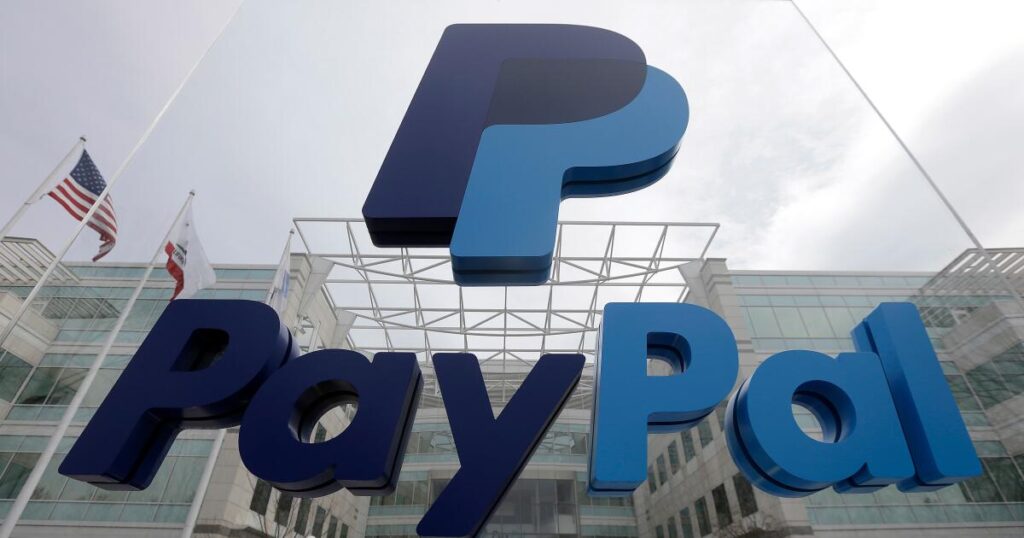
PayPal, once the cutting-edge trailblazer of digital payments, is struggling to cash in on consumer clicks like it used to.
The San José fintech giant is losing market share to competitors and had to swap out its leadership recently as its shares plunged, and it scrambled for a faster fix.
When online shoppers reach the checkout screen, they’re not clicking on the PayPal button to buy items as much as they did in the past. People have payment options from Apple, Google and others, some of which are easier to use on their smartphones.
A slowdown in PayPal’s branded checkout is at the core of the company’s biggest challenges, analysts and company executives said.
In February, PayPal let go of its chief executive, who had been working to fix the problem, but the company said his “pace of change and execution” over two years didn’t meet the board’s expectations.
In the fourth quarter, PayPal’s online branded checkout growth slowed to 1%. The company reported an adjusted profit of $1.23 per share on revenue of $8.68 billion, missing Wall Street’s expectations.
Since January, PayPal’s stock price has fallen by more than 20%.
“The problem is that transition and push for branded checkout really has not paid off,” said Grace Broadbent, a senior analyst of payments for eMarketer.
PayPal attributed the slowdown partly to the “K-shaped economy,” in which wealthier Americans see their incomes rise while lower-income Americans struggle financially. PayPal has many middle-income customers and some lower-income customers, so a pullback in spending affects use of its payments platform.
Other factors that have hurt it recently include product execution and a hit in high-growth areas such as crypto, gaming and ticketing.
The slowdown raised questions about whether PayPal’s turnaround efforts were working. The company makes most of its money by charging fees for payment services.
“The vast majority of PayPal’s profits come from the branded checkout button,” said Mizuho analyst Dan Dolev. “The yield they get when you click on the branded checkout button is multiples of any other product that they have.”
Now the pressure is on Enrique Lores, who became PayPal’s president and chief executive in March, to get the company back on track. Lores was on PayPal’s board for nearly five years and came from computer and printer maker HP, where he served as chief executive. PayPal is investing $400 million to improve and grow branded checkout this year.
“The payments industry is changing faster than ever, driven by new technologies, evolving regulations, an increasingly competitive landscape, and the rapid acceleration of AI that is reshaping commerce daily,” Lores said in a February statement. “PayPal sits at the center of this change, and I look forward to leading the team to accelerate the delivery of new innovations.”
PayPal has seen growth in its subsidiary Venmo, a social mobile payment app, and its buy-now-pay-later services. The company is scheduled to report its first-quarter earnings in May.
“They’re going through some hard times, but I still think there’s a lot of value in PayPal,” Dolev said. “Not that many companies out there that have this kind of moat, which is a global wallet that everyone recognizes.”
Before PayPal transformed into a multibillion-dollar company with 23,800 employees and 439 million active consumer and merchant accounts across roughly 200 markets, the startup weathered a lot of change.
Founded in 1998 under a different company name by Max Levchin, Peter Thiel and Luke Nosek, the startup initially focused on security software for handheld devices before shifting to digital payments.
After merging with Elon Musk’s online bank X.com, the company was renamed PayPal. The platform made it possible for people to securely send money digitally using their email address, which was easier than writing up a check or filling out a money order.
PayPal went public in 2002 and shortly after EBay acquired the startup for $1.5 billion. In 2013, PayPal acquired the fintech company Braintree, which owned the social payment service Venmo, giving PayPal an edge in mobile commerce.
Two years later, it became an independent company when it split from EBay.
PayPal’s founders and early employees, dubbed the “PayPal Mafia” by Fortune magazine in a 2007 story, would go on to invest or build successful Silicon Valley companies.
During the COVID-19 pandemic in 2020, PayPal was flying high. People spent a lot of time stuck at home and online shopping skyrocketed. PayPal’s stock price peaked in July 2021, but has plummeted since then.
Over the last five years, its share price has dropped more than 80%.
“Now the industry is maturing, so there’s less growth to go around,” Broadbent said.
The competition is heating up, especially in the United States.
PayPal’s core users in the United States are projected to grow by fewer than 1% year-over-year to 92.1 million in 2026, eMarketer forecasts. Nationwide, Apple and Google are expected to see their digital wallet users grow more, reaching 90.5 million and 55 million U.S. users, respectively.
Apple Pay is popular among Gen Z and makes it easy to pay by double-clicking the side of their phone.
“They do so much more shopping on their phone than ever before, so Apple Pay is ingrained in their iPhone,” Broadbent said.
Google has also integrated its payment service into products such as its browser, Google Chrome. Then there are more buy-now-pay-later services that people are taking advantage of as they spread out their spending on expensive items.
Other challenges are on the horizon for payment services.
Tech companies are contending with the rise of artificial intelligence, which could disrupt the way people shop. Tech executives have talked about a future in which AI agents will shop and buy items on behalf of consumers, with their approval.
Last year, PayPal teamed up with AI company Perplexity so people could use its service to purchase products from retailers such as Abercrombie & Fitch and Ashley Furniture within Perplexity’s chat interface.
“That’s a future challenge for PayPal that opens up a lot of different dynamics of who’s gonna win,” Broadbent said.
The post PayPal transformed digital payments. Why the California fintech giant is now struggling appeared first on Los Angeles Times.