Welcome back to Gilead.
Margaret Atwood’s dystopian saga, which began with her 1985 novel “The Handmaid’s Tale,” continues with a new adaptation of “The Testaments,” the novel’s 2019 sequel. “The Handmaid’s Tale” has been hailed as one of the most chilling works of political satire of the 20th century; its TV adaptation ran for six seasons and won 15 Emmy Awards, including Best Drama.
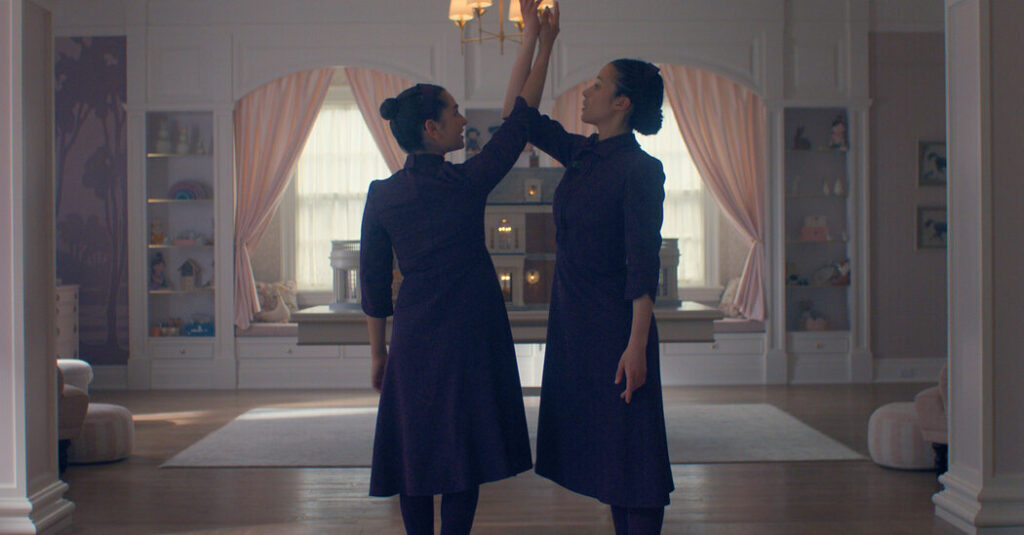
The TV version of “The Testaments” was developed by Bruce Miller, who also adapted “The Handmaid’s Tale,” and retains the previous series’s tense, character-driven tone while introducing a new generation of Gileadeans — led by Agnes, played by the “One Battle After Another” breakout star Chase Infiniti — and bringing back fan favorites like the sadistic Aunt Lydia (Ann Dowd). The new series premieres on Hulu on April 8. Whether you’re a fan of the books, a devotee of the first show or a total newbie, here’s what you need to know.
What is “The Handmaid’s Tale” about?
“The Handmaid’s Tale” imagines a near-future United States transformed into Gilead, a Christian nationalist dictatorship that seizes power amid a fertility crisis and reorganizes society along rigid, patriarchal lines. Women are stripped of rights, and those who can bear children are forced into reproductive servitude as “Handmaids” assigned to elite households.
The novel is narrated by Offred, a Handmaid navigating this new surveillance state. Her voice is measured and constrained, defined as much by the words she holds back as the ones she speaks. The book’s power lies in that tension, showing both the tightening grip of authoritarian control and the calculations people make to adapt, endure or resist. (Mary McCarthy, the author of “The Group,” praised the book’s “sardonic humor” in her New York Times review but was skeptical of its premise, which she dismissed as hysterical catastrophizing.)
How did the TV series change the story?
When “The Handmaid’s Tale” debuted in 2017, it began as a relatively faithful adaptation of Atwood’s novel. But after its first season, the series expanded, following Offred — who reclaims her pre-Gilead name, June Osborne — beyond the novel’s ambiguous ending as she becomes a ferocious leader of the Mayday resistance movement.
The show turns figures like Serena Joy, a former televangelist and wife of a high-ranking commander, and Aunt Lydia, the strict overseer of the Handmaid program, from purely unsympathetic villains into fully realized, evolving characters. We see the ambitions, compromises and private struggles that shape their choices. The adaptation also broadens its lens to explore the political machinery that keeps Gilead running, Mayday’s efforts to bring it down and the world beyond its borders.
What is “The Testaments”?
Published in 2019, “The Testaments” returns to Gilead 15 years after the end of “The Handmaid’s Tale.” The novel is narrated by three women. Offred’s older daughter, Agnes (Hannah in the TV series), was taken from her as a young child and raised by a commander and his wife; now a teenager, she is sheltered and naïve to the horrors beyond her cloistered world. Offred’s younger daughter, Nicole, was smuggled as a baby from Gilead into Canada, where she is now living under a pseudonym. And then there is Aunt Lydia, who proves to be more strategic, self-aware and morally complex than the enforcer readers met in Book 1.
Together, their stories form a coming-of-age narrative under extreme conditions, interwoven with a spy thriller (there is a mole in Gilead). “Atwood’s sheer assurance as a storyteller makes for a fast, immersive narrative that’s as propulsive as it is melodramatic,” our critic wrote. The book focuses less on lurid violence than on the ways humans respond to inhumane, everyday conditions. “Atwood understands that the fascist crimes of Gilead speak for themselves — they do not need to be italicized, just as their relevance to our own times does not need to be put in boldface.”
What should viewers expect from the new series?
The show picks up a few years after the events of the series finale of “The Handmaid’s Tale,” which already extended well beyond the timeline of the novel. If the first series focused on survival within a tightly controlled world, “The Testaments” turns toward awakening. It explores what happens when people who have grown up being told that certain truths are inalienable start to see the cracks in that facade. Expect to join characters on a morally complex journey as they grapple with wonder, confusion, fear, shame and the slow recognition that the life they were taught to accept is not a foregone conclusion — if only they can dare to imagine something different.
The post A ‘Handmaid’s Tale’ Sequel Is Coming to TV. Here’s What You Need to Know. appeared first on New York Times.