The Trump administration has all but cut off Cuba’s oil supplies since January to force its Communist government to the negotiating table, causing more nationwide blackouts and worsening a humanitarian crisis.
The United States granted a temporary reprieve by allowing a Russian tanker to deliver oil, but Cuba’s bleak conditions have started stirring the kind of protests rarely seen on the island.
Cubans have been banging pots and pans in nightly demonstrations, and anti-government graffiti has appeared on walls.
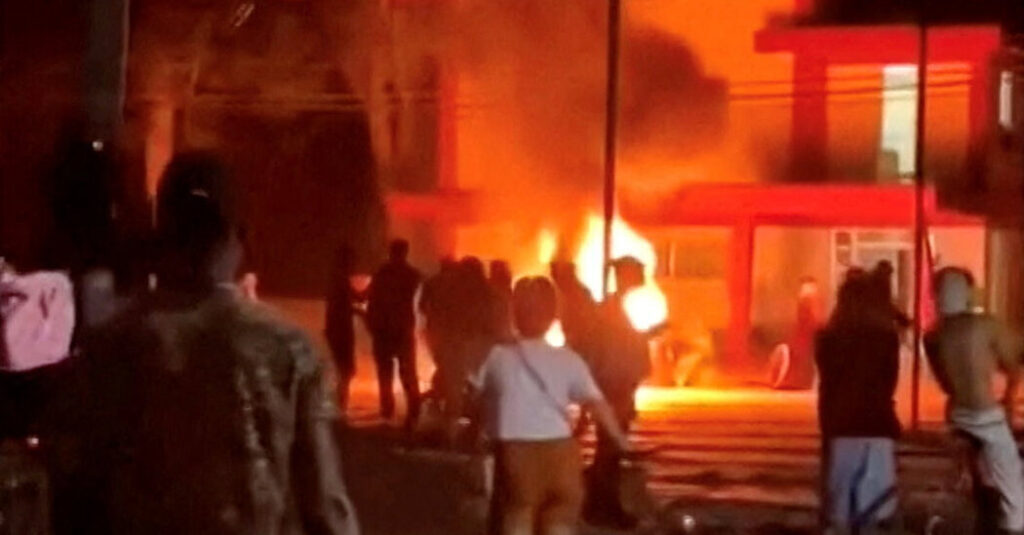
In perhaps the most noteworthy sign of rising anger, people in the central city of Morón ransacked a Communist Party headquarters in March. Experts on Cuba said it was the first time a government office had been attacked in the nearly 70 years since Fidel Castro seized power.
“Civil society — gradually, little by little, as tends to happen in a system like this — is indeed emerging,” said Alina López, a historian and activist in Matanzas, a port city east of Havana.
Still, Cuba lacks a significant dissident movement because many opposition figures have been jailed or forced into exile.
The exodus of more than a million people from the island since 2020 has also left Cuba with one of the region’s oldest populations, Ms. López said, and far fewer young people to lead the charge.
Still, the number of grass-roots protests is growing — to 229 in March from 30 in January, according to Cubalex, a Cuban human rights group with headquarters in the United States.
Cuba’s president, Miguel Díaz-Canel, acknowledged people’s frustration with blackouts and shortages of fuel and food after the Morón protest, but blamed the U.S. oil blockade. The Cuban government did not respond to questions.
This year’s protests have been small, but some experts say they are a signal that more could flare up if conditions remain dire.
“If citizens, at least in the one relatively small town of Morón, are trying to burn down the Communist Party headquarters after less than three months of this, what does another five or six months do?” said Michael J. Bustamante, a professor of history and chair in Cuban and Cuban American Studies at the University of Miami.
While Cuban exiles have cheered the nascent anti-government protests, experts say they are unlikely to grow into a popular uprising that threatens the Cuban regime.
There is no viable political opposition, no leader with a strong enough network or a plan for taking over, Mr. Bustamante said. Referring to Venezuela’s main opposition leader, he said, “There is not a Maria Corina Machado.”
Cuba’s government also adopted measures after huge protests broke out in 2021 that further criminalized dissent, including online speech. Offenses such as “defamation,” “contempt,” and “cyberterrorism” carry prison terms.
Conditions in Cuba today resemble those that set off the 2021 protests. There are blackouts, hunger and a health crisis — this time, from mosquito-borne illnesses like chikungunya.
And although the Cuban government has said it will release some political prisoners, security forces are once again cracking down.
Yoani Sánchez, an independent journalist with a popular podcast and a large online following, posted a video of the Morón protest with the caption, “We are all Morón.”
She said that hours later a masked government security officer prevented her from leaving her apartment.
Anna Sofía Benítez Silvente, a 21-year-old known online as Anna Bensi, assailed the Communist government in a video posted on X last month that spread rapidly.
Comparing the regime to a “cartel” that exploits Cuba’s resources and people, she whispered, “Your time is running out.”
Ms. Bensi recently said she had been ordered not to leave her home. Her mother was also interrogated, she said. Neither could be reached for comment.
The dynamic around dissent is now different.
In the past, after people spoke out, repression followed and regime critics fled. Now, the United States is cracking down on migration. Nicaragua, under U.S. pressure, stopped visa-free entry for Cubans, closing a key escape route.
“The Cuban government cannot simply turn to exporting dissent,” said Mr. Bustamante, the Cuba expert.
Internet access, expanded during the Obama administration, also continues to help Cubans bypass censorship and to connect.
Ms. Sánchez, the journalist, cited the example of two young men from the eastern city of Holguín who release videos under the handle, El4tico (pronounced “el cuartico” — “the little room”).
“They have gained thousands of followers and have been able,’’ Ms. Sánchez said, “with very few resources, to disseminate their views on Cuban reality from eastern Cuba, a region with even more economic and energy problems and stricter surveillance.’’
In a February video, Kamil Zayas Pérez, of El4tico, dances in pajamas in the little room where their videos are typically filmed.
“The days of this dictatorship have come to their end,” says Mr. Zayas.
“It may be that the deal that comes is one we don’t like altogether,” he adds, referring to talks between Cuba and the United States. But whatever comes next will be worth it, he says, if it leads to “a true democracy.”
Three days later, he and his collaborator were detained.
Annie Correal is a Latin America correspondent for The Times.
The post Could There Be a Popular Uprising in Cuba? appeared first on New York Times.