Emily Bazelon: Hi David. I should start on a light and friendly note, I know, but I confess that the birthright citizenship case is making me feel trolled. President Trump began his term with an executive order professing to end the right of citizenship for the children of undocumented immigrants and foreign residents with temporary visas, among others. I understand the politics — light up the base and then torch the court if it stands in the way.
To me this is the headline: Trump Trolls America. Because I don’t think the administration is making a serious legal argument. D. John Sauer, the solicitor general, offered some shreds of evidence from the historical record, which some conservative scholars have tried to weave together, to argue that the president can end birthright citizenship with a stroke of his pen. But on the other side of the scale are the meaning and longstanding interpretations of the 1866 Civil Right Act and the 14th Amendment and the 1898 Supreme Court decision United States v. Wong Kim Ark and a 1952 statute. Those are heavy weights, all stacked up.
I understand that to do their jobs the justices have to take the president’s legal positions seriously. They pressed Sauer and also Cecillia Wang, the A.C.L.U. lawyer representing the opposing side. We should do our jobs by analyzing the argument — what stood out to you?
David French: There was an incredibly telling exchange between Chief Justice John Roberts and the solicitor general. “We’re in a new world,” Sauer said, because “eight billion people are one plane ride away from having a child who is a U.S. citizen.”
Chief Justice Roberts’s retort was perfect — “Well, it’s a new world,” he said, but “it’s the same constitution.” In that one moment you saw the contrast between the MAGA legal philosophy and the legal philosophy of most of the justices. MAGA wants specific results, the justices interpret texts. And when MAGA’s argument contradicts the constitutional text, it’s almost always going to lose — as it has lost time and again before this court.
Emily: Well, I’m not sure about time and again, given the many wins the administration has had on the emergency docket (and some significant victories to come this term, in all likelihood). Another thing that bothers me about the birthright case is that at the end of the term, assuming the administration loses, it will help make the Supreme Court seem more middle of the road than it is. The term will come across as Trump lost some and won some. But that’s a benefit of going to extremes — it makes the court seem moderate by comparison when truly it is not.
However, you’re right that abandoning the methods of interpretation conservative justices have promoted, rooted in text and history, at the president’s bidding, is too much for most of the conservative justices to swallow. (Justice Samuel Alito seemed happy to go along. Hard to tell where Justice Clarence Thomas will land, I think.)
I’m most struck, still, by how Trump has dragged the court onto his wrestling mat and tried to unsettle the nation’s self-understanding. Most countries — the vast majority — don’t have birthright citizenship. For the United States, it has been a defining characteristic and a strength — core to how the country has successfully integrated newcomers, to our great benefit. Justice Elena Kagan spoke about birthright citizenship as a tradition, from British common law, which this country adopted. “And then what the Fourteenth Amendment did was accept that tradition and not attempt to place any limitations on it,” she said. “And everybody took Wong Kim Ark to say that and to say that, as a result of that, of course, birthright citizenship was the rule. And I think everybody has believed that for a long, long time.”
Then she asked Sauer: How much evidence would it take to undo that understanding and accept your “revisionist theory?”
Sauer started by offering, not statutory text or court precedents — you know, law — but instead a 1921 law review article. In response, Evan Bernick, a law professor, posted excerpts from that article to show that the solicitor general got it wrong.
In court, the weakness of the government’s position matters. Most of the justices seemed ready to rule against the administration. But I find myself wanting something more — some deeper reckoning with the way in which politics is infecting the administration’s approach to law. Do you know what I mean or do you have a different take entirely?
David: I completely understand what you’re saying, but I don’t think it’s the court’s job to deliver that rebuke. Not only does the court have very limited tools at its disposal to punish Trump, if it ratchets up its rhetoric against the administration it risks eroding the perception of impartiality.
It’s enough for the court to uphold the Constitution. It’s really up to the American people to punish MAGA, and it’s certainly looking like they might in the midterm elections.
I think it’s very important, however, to explain how dangerous the administration’s core argument truly is. Trumpian nationalism is very much of the European blood-and-soil variety. Many people in MAGA reject the idea that America is a creedal nation — united and defined by the ideals enshrined in the Declaration of Independence rather than by ethnicity, religion or geography — and instead prefer the idea that America is for so-called heritage Americans, those with long family roots in our country.
Birthright citizenship, by contrast, recognizes the universality of the American idea. There is no ethnic or familial or historic barrier to becoming an American. To raise the barrier to citizenship is to declare, in essence, that our idea is not enough.
But I’m interested in a different aspect of the way things played out. What did you make of Trump’s decision to attend in person?
Emily: Yes, you’re right that the court should stay in its lane. The deeper reckoning has to come from the democratic process. One lesson I think about a lot is how much more durable social change is when people vote for it and the states or Congress enact it.
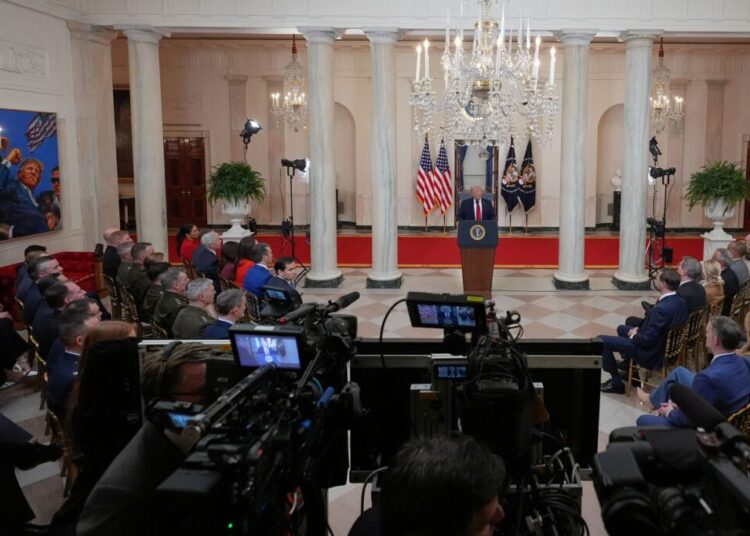
I thought Trump went to the argument to make it about him, at a moment when he is having a lot of trouble selling Americans on his war in Iran, which he gave an uninspired speech about that same night. In another timeline, the president attending a Supreme Court argument could be civics-minded or harmless. In ours, it reads as part of Trump’s mission to turn the courts into political props, as he did by saying, after the court struck down his tariffs in February, that some of the justices “sicken” him, and by recently calling for a crime bill that “cracks down on rogue judges,” whatever that means.
The most Trumpian move, of course, was to leave shortly after Wang’s turn at the podium began. Why listen to the other side when you know you have nothing to learn from anyone who disagrees with you?
Here’s another bit of law-as-politics maneuvering that is eating at me. Stephen Miller, the main architect of the harshest immigration enforcement tactics since the 1950s, has been suggesting that Texas end public school funding for undocumented kids. A 1982 Supreme Court decision, Plyler v. Doe, requires states to pay for the education of all students, no matter their immigration status. But Miller and his allies would like nothing better than to set up a court challenge that could lead to the reversal of Plyler. It’s all in the service of immiserating immigrants to induce them to leave. I hope this is obvious, but taking away school from children — that is a real betrayal.
David: I don’t think there’s much question that Trump is treating the justices the same way he treats Republican members of Congress. He’s trying to insult, mock and bully them into compliance, but it’s not going to work. With precious few exceptions, the judiciary from top to bottom is unmoved. Judges are not so easily intimidated.
Regarding Miller, it’s important to know that the effort to reverse birthright citizenship is just one aspect of a larger project. The idea that America is a beacon of freedom is out. Miller seems to despise at a visceral level the notion that noncitizens can enjoy the blessings of liberty.
But the Constitution is clear that many of its protections apply to “persons,” not just citizens. That means that immigrants enjoy free speech rights, they enjoy rights to due process and equal protection of the law. This was no accident.
As James Madison wrote in his “Memorial and Remonstrance against Religious Assessments,” one of the very purposes of our young republic was to offer “an Asylum to the persecuted and oppressed of every Nation and Religion, promised a lustre to our country, and an accession to the number of its citizens.”
To a man like Miller, those words are fingernails on a chalkboard, but they’re also indispensable to understanding the nature of our republic.
Emily, while we were chatting, the news broke that Trump ousted Pam Bondi and is replacing her, at least for now, with Todd Blanche, the deputy attorney general.
She definitely deserved to be fired. She helped Trump turn the Department of Justice into an instrument of partisan vengeance. But we both know that’s not why she was fired. Trump was angry at her incompetence, not her corruption, and he’s chosen an arguably even more ruthless person to run the department while he looks for a permanent successor.
As bad as Bondi has been, I’m concerned that Blanche is worse. What do you think?
Emily: Months ago, assistant U.S. attorneys who worked with Blanche when he was in the Southern District of New York told me they hoped he would be a straight shooter as the No. 2 in the Justice Department. They soon thought the opposite. Who can forget how much Blanche has done to run defense on the Epstein files? The Office of the Deputy Attorney General — his office — has been at the center of some of the most dubious efforts to weaponize the D.O.J. Blanche is also the author of a memo last April ordering an end to investigating crypto when, according to ProPublica, he held significant investments in it.
Maybe we should talk more about the legal arguments the administration made in the birthright case but I’m going to recommend a piece by our colleague Jamelle Bouie and move on. I have another question for you. Last week, the court heard two cases that appeared to turn on a few words of text. The first was a challenge to a Mississippi law that directs the states to count mail-in ballots if they’re postmarked by Election Day but received up to five business days later. The text the justices focused on was “election day,” which Congress set in 1845 and 1872. They were trying to decide if by establishing an Election Day back then, Congress pre-empted laws like Mississippi’s today.
In that case, some of the conservative justices seemed inclined to read a lot into those two words, suggesting they mean that all votes must be cast on (or maybe by, to allow for early voting?) Election Day. The liberal justices were saying hold on a second, what do you mean that by establishing a day for in-person voting in the 19th century, Congress precluded the mail-in balloting laws, like Mississippi’s, which many states also passed? Can’t you cast a ballot by dropping it in the mail? And what about a 2022 law, the Electoral Count Reform Act, in which Congress suggests voting can take place in a period of time?
The next day, the argument was about the Trump administration’s policy of preventing people from applying for asylum at the southern border by stopping them from entering the country. The 1996 statute at issue here says a noncitizen can apply for asylum if he or she is “physically present in the United States” or “arrives in the United States.” So this time, the fight was over the meaning of “arrives in.” Justice Sonia Sotomayor suggested that by knocking on the door of the United States, so to speak, by coming to the border, an asylum seeker arrives in the United States. And it was the conservative justices saying, wait, what? “In” means “in.”
And then Justice Brett Kavanaugh made the practical point that this is a losing battle for the asylum seekers, because “wherever the line is, the government’s presumably going to stop you on the other side of that line and prevent you from getting to wherever the line is, right?”
I will note, on the side of the liberals, that the 1996 law is a mess in many ways. “Arrives in” and “physically present” seem like two ways of saying the same thing, for starters. But still, do you think that as a matter of interpretive method, the conservatives and liberals switched sides in these cases?
David: I don’t think so. The term “election day” doesn’t lend itself to an automatic answer to the question of whether it’s defining the day by which votes are cast or the day by which votes are received. If we don’t want judges to decide that question, then Congress should define the day more specifically.
Regarding asylum, the core question — as I see it — is whether the term “arrives in” also means “arrives at.” If I knock on your door but don’t enter, am I in your house? Or am I at your house?
I tend to believe that “in” means in, and it’s not a synonym for “at.” The statutory words in the asylum case are more clear and easy to define than the words in the ballot case.
It’s worth noting that the Obama administration began the practice of “metering” asylum seekers at parts of the border before Trump’s first term. Trump then expanded the policy. Stopping undocumented immigrants before they enter has been a bipartisan practice and a consequence of Congress’s total failure to address longstanding problems with America’s overcrowded asylum system.
And that brings me to a final point — a considerable number of the Supreme Court’s most contentious cases involve difficult judicial interpretations of ill-considered or poorly written statutes. If Congress doesn’t like the court’s decisions, it can write better laws.
We could cure many national problems if the most democratic branch of government decided to step up and actually do its job.
Let’s change gears a bit — earlier this week the Supreme Court decided Chiles v. Salazar, reversing a court of appeals decision that upheld Colorado’s ban on so-called conversion therapy for minors, which the statute defined as including any effort to “change behaviors or gender expressions or to eliminate or reduce sexual or romantic attraction or feelings toward individuals of the same sex.”
At the same time, as the court noted, the statute allowed for “practices” that provide “acceptance, support, and understanding for the facilitation of an individual’s … identity exploration and development.”
The decision was 8-1, with Justice Ketanji Brown Jackson in dissent. I wasn’t surprised by the outcome or the vote — after all, the court has a long history of disfavoring viewpoint discrimination. If a law allows a person to express one viewpoint but prohibits someone from expressing the opposing view, then it’s almost always going to be struck down.
But Justice Jackson saw the case as primarily regulating medical practice, not speech. She quoted a 1926 court decision called Lambert v. Yellowley for the proposition that “There is no right to practice medicine which is not subordinate to the police power of the States.” How did you see the case?
Emily: Viewpoint discrimination is a statute killer. That’s why Justice Kagan said she joined the majority, in a concurrence that Justice Sotomayor also signed. The majority of the court also ruled against California in 2018 for trying to make anti-abortion crisis pregnancy centers post notices saying that the state has programs with free or low-cost family planning services.
There’s a question in Chiles about how professional speech can be regulated. There are plenty of things medical professionals can get in trouble for saying to their clients, because the speech itself constitutes substandard care. (Imagine a therapist who counsels your daughter to harm herself, like a Chatbot gone bad.) The majority opinion, by Justice Neil Gorsuch, takes the position that the proper remedy for this kind of harm is the malpractice suit. This path provides “breathing room for protected speech,” Gorsuch said, quoting a 2003 decision, because to win a malpractice suit you have to show you were injured by a breach of duty. That’s different from a ban, which goes into effect whether or not there’s a showing of harm.
Justice Jackson thinks that conversion therapy is substandard care that states can ban because it “causes lasting psychological harm.” She concedes that Colorado’s law restricts speech but says it still comports with the First Amendment because a conversion therapist is “using speech to harm the minors in their care.”
You can see the dispute between Jackson and the majority as a difference about remedy — malpractice suits versus bans. Or you can see it as taking sides in the “fierce public debate,” as Gorsuch writes, over kids and teenagers navigating gender identity or sexual orientation. I like the former reading better than the latter, because at this point there should be a consensus that conversion therapy does serious harm.
David: After watching this court closely for many years, I have a word of advice for state and federal lawmakers (straight from Justice Kagan). As she wrote in her concurring opinion, “We apply our most demanding standard when there is any ‘realistic possibility that official suppression of ideas is afoot.’ ”
Emily: We could let the justices have the last word, but they get enough of that in life. On another planet or maybe I should say moon, are you excited about Artemis II?
David: I watched the Artemis II launch with the same glee I felt when I saw the first Space Shuttle launch in 1981, when I was 12 years old. I felt like a kid again. Maybe I liked it even more than I liked watching launches as a kid — in part because the launch is one of the few things this year that’s truly pulled us together.
And Artemis really is about us. It was first conceived under another name by President George W. Bush as the Constellation program, continued under President Barack Obama when he authorized the Space Launch System — the rocket that actually lifted off on Wednesday — and then Trump formalized the Artemis program during his first term. I was able to see part of the first, unmanned, launch during President Joe Biden’s term (I could see the rocket in the sky all the way from Miami), and I loved every minute of Wednesday’s launch.
We can still accomplish great things as a country. But I’ve got a question for you — as a fellow Gen X-er, how nervous were you when you saw the rocket launch? I’ve got to admit, my heart was in my throat.
Emily: I wasn’t nervous because I didn’t watch. I’m a bad space fan. I started this exchange on a cranky note so I hate to end on one, but — didn’t we go to the moon in 1969? And why is this incredibly expensive undertaking how we prove that we can do great things? I’m all for adventure and new frontiers but I would like something with more immediate benefit for humankind.
Artemis does give me an excuse to mention a movie I love: “A Walk on the Moon,” which uses the 1969 landing to great effect. Give me a viewing or listening or reading recommendation to go out on!
David: I see the space program — to quote the plaque left on the moon in 1969 — as being “for all mankind.” This is humanity’s accomplishment, not just America’s, and this is the first step to another moon landing, a moon base, and then Mars and beyond. I’m hearing the opening words of “Star Trek” in my head — “Space, the final frontier.” As for a movie recommendation, I’m going with “First Man,” starring Ryan Gosling. It’s about a great American, Neil Armstrong, and it captures the beauty, danger and mystery of space travel so well.
Catch the fever, Emily! You won’t regret it.
The Times is committed to publishing a diversity of letters to the editor. We’d like to hear what you think about this or any of our articles. Here are some tips. And here’s our email: [email protected].
Follow the New York Times Opinion section on Facebook, Instagram, TikTok, Bluesky, WhatsApp and Threads.
The post Is It Legal to Bully the Supreme Court? appeared first on New York Times.