If my friend Beth Mazur had asked, “May I end my life while I’m visiting you?” I would have said no and done everything I could to stop her. But she didn’t ask.
When she arrived in Santa Fe in mid-December of 2023, my husband John and I had just finished building our casita, a tiny guesthouse, and Beth was our second guest. She and I had only met in person a few brief times before. Yet as her five-day visit drew to a close, we were so comfortable together that John and I asked her to stay through Hanukkah and Christmas. The only problem, John joked, was that we had run out of the chocolates she had brought.
A dozen years earlier, Beth and I met in an online patient group that felt like part laboratory group, part refugee camp. We were both sick with myalgic encephalomyelitis/chronic fatigue syndrome or M.E./C.F.S., a devastating disease medicine has mostly abandoned.
As a science journalist, I was stunned to find myself desperate enough to chase treatments at the edge of science. Beth, a fellow M.I.T. alumna and computer scientist, had a calm, reasoned approach that made it feel safe to examine even the strangest of ideas.
Over the years, I wrote investigations about near-fraudulent science and a memoir-cum-science-book about M.E. Beth, quieter but further reaching, co-founded the advocacy organization #MEAction, transforming an angry, chaotic patient community into a coordinated force for change. She organized protests, lobbied Congress, urged Google to rewrite its medical pages on ME.
Each morning during her visit to Santa Fe I brought her gluten-free muffins while she worked painfully to attain verticality. Each afternoon she curled up on the couch while our cat, Lao, settled into the perfect hollow between her belly and the heating pad, and our dog, Roo, rested her throat on Beth’s scratching fingers. I massaged Beth’s head and neck; we hurt in the same places, so my fingers knew where to go. I felt myself channeling every soothing touch John had given me, grateful that I was well enough to pass the comfort forward.
I had been through a brutal four years — multiple neurosurgeries, seizures, paralysis — but recently I had been improving. Beth’s visit felt shockingly normal; we even went to a spa. For her, though, the illness never offered dramatic swings. It just ground on, relentless.
We talked about all M.E. had taken from us. From her, it had stolen her career, her imagined children, snowboarding, often even the strength to get out of bed. But the worst theft was her brilliant technologist’s mind. She told me she constantly felt concussed, as if every attempt to engage with the world required smashing her fragile brain through a wall of concrete.
“I feel like I don’t really exist,” she said, her voice small. Her cognitive dysfunction didn’t show — from the outside, her brilliance still blazed — but that invisibility deepened her frustration. She had tried hundreds of treatments, each demanding research, money, risk, sometimes travel, always the resummoning of hope. None had restored her injured brain.
On top of her physical and cognitive suffering, I occasionally saw depression twist her thoughts into dark, sticky spirals. Once, when I felt her descending, I asked her to recall a time she felt safe. She remembered being 19, hanging with college friends. I invited her to sink into that feeling, but her voice grew hoarse: “It’s been so long! I never feel safe anymore.”
She had fought the depression as powerfully as she fought M.E., trying treatment after treatment. Antidepressants had failed her, but she was about to try them yet again.
On the eve of the winter solstice, we built a fire. She rested her head on my lap; I stroked her impossibly soft hair. “If I knew I’d never get better,” she said, “I’d end it. But I know how much that would hurt the people I love. But then I’m just living for other people, and — ”
I listened, knowing all too well the thoughts that can intrude as suffering grinds on. I hoped that simply witnessing her pain might ease its weight.
Eventually, yawning, I extricated myself from the cuddle pile to go to bed. Lao’s eyes were squeezed tight with pleasure. She stroked his fur, her breathing steady.
In the morning, I received an email from her with the results of her cognitive testing: In some areas, she was in the first percentile, the bottom of the scale. I wondered why she sent it — of course I believed her.
Then a FedEx driver knocked on our door with chocolates Beth had ordered to replace those we had eaten.
“Did you know someone is lying over there?” he said.
She had created a nest for herself next to the frozen stream with a blanket and pillow. Beside her was an empty, residue-coated glass.
Not long after I found her, I received a text she had scheduled to be sent after her death: “Please don’t feel bad in any way — I cannot imagine a better last evening. Even Roo and Lao joined in the nurturing.”
Ridiculously, she apologized for not cleaning our casita.
The police went through a notebook she had left. Alongside a scrawled will, she wrote, “I feel at peace. It’s a powerful feeling.”
After everyone left and my gasping tears settled down to a seep, I sat quietly in my house. It seemed as though I could feel in my body the news of her death spreading, the cries moving from family to close friends to people around the world.
I tried to imagine her thoughts the previous night: Had I upset her? Was her decision justified, or had she made a terrible mistake?
I stopped myself. I had to believe her words and my own experience: She felt loved when she died. And I couldn’t possibly judge her decision, not knowing what it was like to live inside her body and brain.
Three years earlier, she had almost done this but had stayed instead. For those three years she had given herself to the world, continuing to fight for M.E. patients, to offer me her friendship, to support everyone around her. Rather than judge her decision to leave, I felt grateful for all her decisions to stay.
So why now, here? Did she imagine what this would do to me?
Well, where else? I wouldn’t have wanted her partner to find her, or her mother, or a friend with children in the house. Maybe the sweetness of our time together made her terrifying act possible. Maybe she trusted me to have the strength to handle it. Did I?
I thought about how she had endured the night’s cold. That had to have been for my sake, protecting the new casita from traumatic images.
These questions, I knew, I would chew on for years. But I felt an immediate clarity: Regardless of whether I agreed with her choice, accepting it and caring for her community after her death were the ways to love her.
I wrote a social media thread telling the community what I understood about her death. For a week, we held daily online shivas, gathering dozens from across the globe. Her memorial drew hundreds in person and on Zoom.
People told stories that revealed a scope I hadn’t seen. She educated researchers and persuaded the C.D.C. to create M.E./C.F.S. research centers. She and her partner were among the first to warn that Covid was likely to trigger a wave of M.E./C.F.S. cases. She became a godmother to long Covid advocates, teaching them how to gain influence, strategize and care for one another.
She had been so modest about her work I’d missed that she was the hidden wizard behind nearly every significant shift. My friend was a giant.
We also learned about who she was before the illness: the one who cleaned everyone’s clock in the game of hearts during college; a joyful, pink-helmeted snowboarder surrounded by friends.
Her family and I built an altar on a tree stump next to the stream. On it, we placed a palm-shaped protective amulet called a hamsa, a synagogue’s donation box from prewar Poland, figurines of a dog and a cat, and of course, some chocolate.
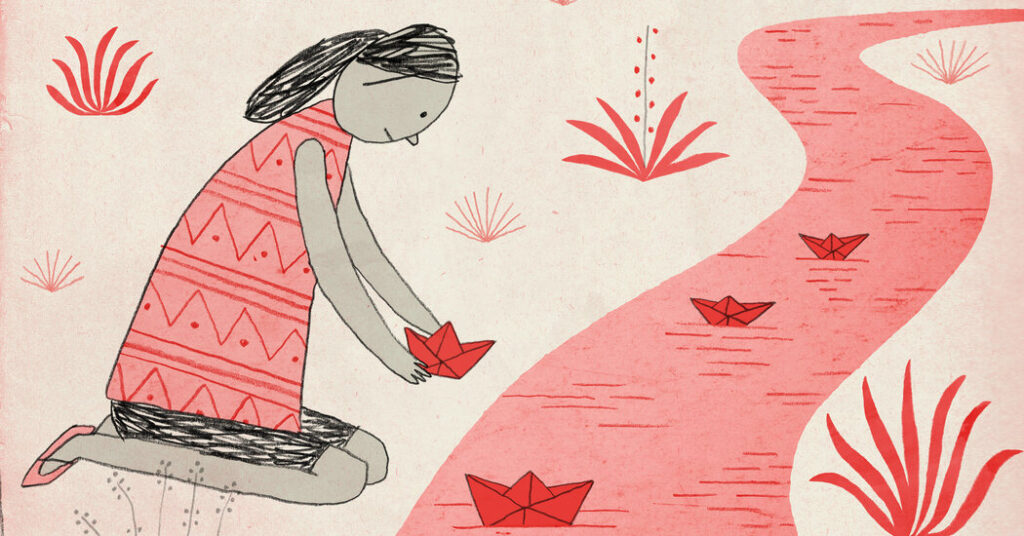
A year later, her family returned. We folded red origami boats and filled them with flowers and a bit of her ash. The boats floated down the stream, caught for a moment, and then slipped free.
I couldn’t keep her. But I could accompany her, almost to the end.
If you are having thoughts of suicide, call or text 988 to reach the National Suicide Prevention Lifeline or go to SpeakingOfSuicide.com/resources for a list of additional resources.
Julie Rehmeyer, a science writer in Santa Fe, N.M., is the author of “Through the Shadowlands,” an investigative memoir about myalgic encephalomyelitis.
Modern Love can be reached at [email protected].
To find previous Modern Love essays, Tiny Love Stories and podcast episodes, visit our archive.
Want more Modern Love? Watch the TV series, sign up for the newsletter and listen to the podcast on iTunes or Spotify. We also have two books, “Modern Love: True Stories of Love, Loss, and Redemption” and “Tiny Love Stories: True Tales of Love in 100 Words or Less.”
The post May I End My Life With You? appeared first on New York Times.