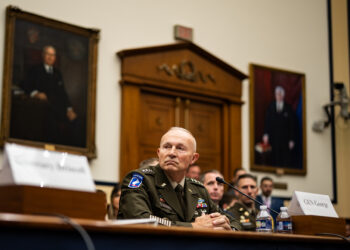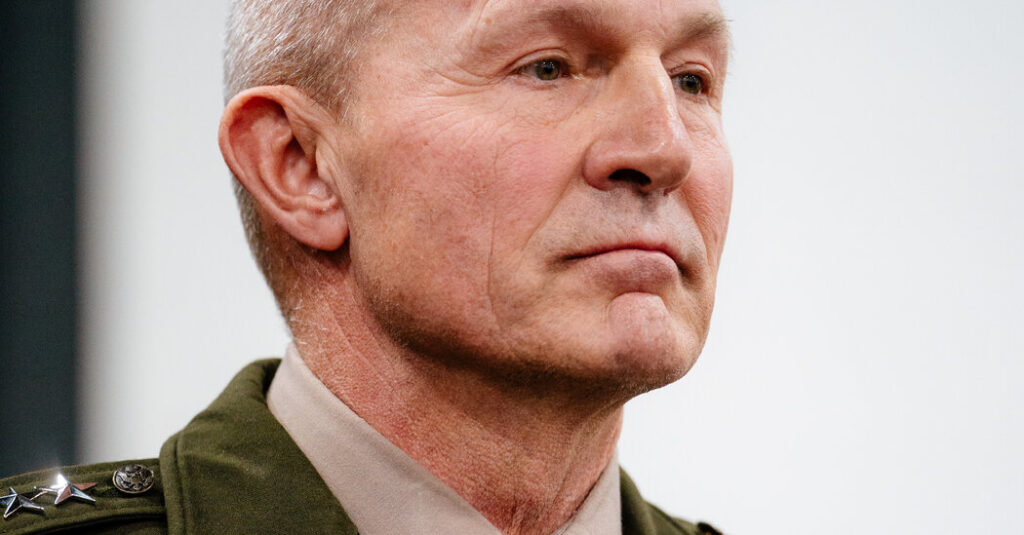
Defense Secretary Pete Hegseth fired Gen. Randy George, the Army’s chief of staff, on Thursday, a move that reflects growing hostility between Mr. Hegseth and the Army’s leadership, military officials said.
General George, who was appointed to his position in 2023, led the Army out of one of its worst recruiting crises in history in 2024 and more recently has pushed the service to accelerate its acquisition of cheap drones and other weaponry that has come to dominate the war in Ukraine.
The tension with Mr. Hegseth was not rooted in substantive differences over the direction of the Army, military officials said. Rather it is the product of Mr. Hegseth’s long-running grievances with the Army, battles over personnel and his troubled relationship with Army Secretary Daniel P. Driscoll, the officials said.
Over the last year, General George and Mr. Driscoll had formed a tight partnership, officials said.
Mr. Hegseth has also clashed in recent months with General George and Mr. Driscoll over the defense secretary’s decision to block the promotion of four Army officers to be one-star generals.
Two of the officers targeted by Mr. Hegseth are Black and two are women on a promotion list that consisted of 29 other officers, most of whom are white men. Mr. Hegseth’s highly unusual decision to remove the officers prompted some senior military officials to question whether they were being singled out because of their race or gender, officials said.
Mr. Hegseth had been pressing Mr. Driscoll and General George for months to remove the officers from the promotion list. But Mr. Driscoll and General George refused, citing the officers’ long records of exemplary service.
Two weeks ago, General George asked Mr. Hegseth to meet with him to discuss the removal of the four officers from the one-star list, as well as the general’s view that Mr. Hegseth was interfering unnecessarily in Army personnel decisions overall, the officials said. Mr. Hegseth refused to meet with General George about the matter, they said.
Last week, Laura Loomer, a far-right conspiracy theorist who is close to Mr. Hegseth and President Trump, posted on social media that the defense secretary was “seriously considering” removing General George. Ms. Loomer has also repeatedly attacked Mr. Driscoll.
General George also had a close relationship with Lloyd J. Austin III, Mr. Hegseth’s predecessor and a former Army four-star general.
General George is expected to be replaced by Gen. Christopher LaNeve, who previously served as Mr. Hegseth’s senior military assistant in the Pentagon.
General George’s dismissal had been rumored for months. He learned that he was being replaced on Thursday during a 4 p.m. phone call from Mr. Hegseth, Army officials said. CBS News reported his firing around the same time Mr. Hegseth placed the call.
Senior Army officials described General George’s dismissal as a blow to a service that has seen many of its top three- and four-star officers with deep experience fighting in Iraq and Afghanistan fired or sidelined in recent months.
In October, Gen. James J. Mingus, the Army’s vice chief of staff, was forced to step down from his position a year earlier than expected. His retirement was hastily announced with little input from senior Army leaders.
Senior Army officers reacted with anger and frustration to the news of General George’s dismissal, characterizing it as the latest blow to a service that already feels under siege by Mr. Hegseth.
General George served multiple tours in both Iraq and Afghanistan, where he earned a reputation as an innovative combat leader. In Afghanistan he pulled troops from remote valleys, where they were engaged in bloody and often pointless battles, and refocused them on protecting population centers. Instead of just hunting the Taliban, he pressed his troops to also target and remove corrupt Afghan government officials who were terrorizing the Afghan people.
As Army chief of staff, he initiated a program called “transformation in contact” in which 3,000-soldier Army brigades were pushed to experiment with new kinds of drones, new tactics and new targeting systems, powered by artificial intelligence.
To pay for the changes he was making, General George eliminated weapons that he and other senior leaders believed would not be able to survive on the modern battlefield.
He cut the M-10 Booker, a light tank that was designed to fight through enemy machine-gun fire, mortars and rocket-propelled grenades. The Army had spent more than $1 billion to develop it but decided last year that it could be too easily destroyed by a $500 or $1,000 kamikaze drone.
And he invested in the Infantry Squad Vehicle, a dune-buggy-like troop carrier that consists of nine seats, an engine and some roll bars. Instead of armor, it relies on its speed and its ability to move off-road and under tree cover to evade attack.
In recent months, General George pushed the Army to accelerate development of the M1E3 Abrams, the latest version of its main battle tank. The new tank is supposed to be lighter, faster and more mobile than its predecessors.
Eric Schmitt contributed reporting.
Greg Jaffe covers the Pentagon and the U.S. military for The Times.
The post Hegseth Fires Army Chief Amid Battle With Its Leaders appeared first on New York Times.