In the lead-up to President Donald Trump’s Wednesday night address, international markets rallied, betting Trump would use the broadcast to signal he was winding down the war in Iran that has triggered economic strain around the world.
Instead, Trump’s speech, in which he promised to push Iran back “to the stone ages” with continued strikes, has rattled global markets, intensifying anxiety over an oil crisis that experts say is likely to spread.
Trump complained about allies not contributing to the war effort in the speech and said it would be up to other countries to reopen the Strait of Hormuz, the geopolitical chokepoint that Iran has effectively closed with the threat of missiles — leading to a global oil and gas shortage that is worsening by the day.
“Investors were expecting an announcement that would point towards a near-term end to hostilities,” said Joe Brusuelas, chief economist at consulting firm RSM. “That is not what they received.”
With the war set to continue, the economic pain from the energy crisis already being felt acutely across Asia will soon spread, Brusuelas added. “What’s going on in Asia, where there’s energy shortages or rationing, will move toward Europe in the coming days and weeks,” he said.
The financial turmoil stemming from the war with Iran is adding more pressure to the already-strained web of alliances the United States has nurtured for decades. The dispute with Washington has widened cracks in the NATO alliance: Trump has chided Europeans for not offering unflinching support for the war or joining it more directly by deploying ships to the strait.
The administration has suggested the U.S. could pull support for NATO and for Ukraine in its war against Russia if European leaders do not acquiesce to Trump’s demands. The president said this week that he was considering withdrawing from the U.S.-led alliance, which has been a cornerstone of American foreign and military policy in Europe for about eight decades.
The tensions were laid bare Thursday as world leaders responded to Trump and organized their own meeting to try to plan a resolution or response to the crisis — without the participation of the U.S.
“This isn’t a show. We are talking about war, about the lives of women and men, about the risks to our countries,” French President Emmanuel Macron said Thursday, responding to questions about Trump’s threats against NATO. “When we are serious, we don’t say every day the opposite of what we said the day before.”
European leaders are scrambling to limit the fallout of a U.S. war that is roiling the Middle East and buffeting households and businesses across Europe and Asia, in many ways more than in the U.S.
But as they try to calm tensions with the U.S., their most powerful ally, European leaders are also maneuvering to avoid joining a war that is deeply unpopular at home and that could make them a target of Iranian retaliation.
Officials from more than 40 countries in Europe, Asia and the Middle East convened by videoconference Thursday to discuss how to clear the strait, a vital corridor for the world’s oil supply that has been choked off by the U.S.-Israeli war with Iran.
But using force, as Trump has suggested, does not seem to be on the table.
“We consider it unrealistic,” Macron told reporters during a trip to South Korea. “It would take indefinite time and would expose all those who go through the strait to risks.” He called instead for a ceasefire and a “clear framework” to resume the flow of oil through the narrow waterway.
In his speech, Trump said countries that “refuse to get involved in the decapitation of Iran” should “build up some delayed courage” and help secure the waterway. “Go to the strait and just take it, protect it, use it for yourselves,” he added. “The hard part is done, so it should be easy.”
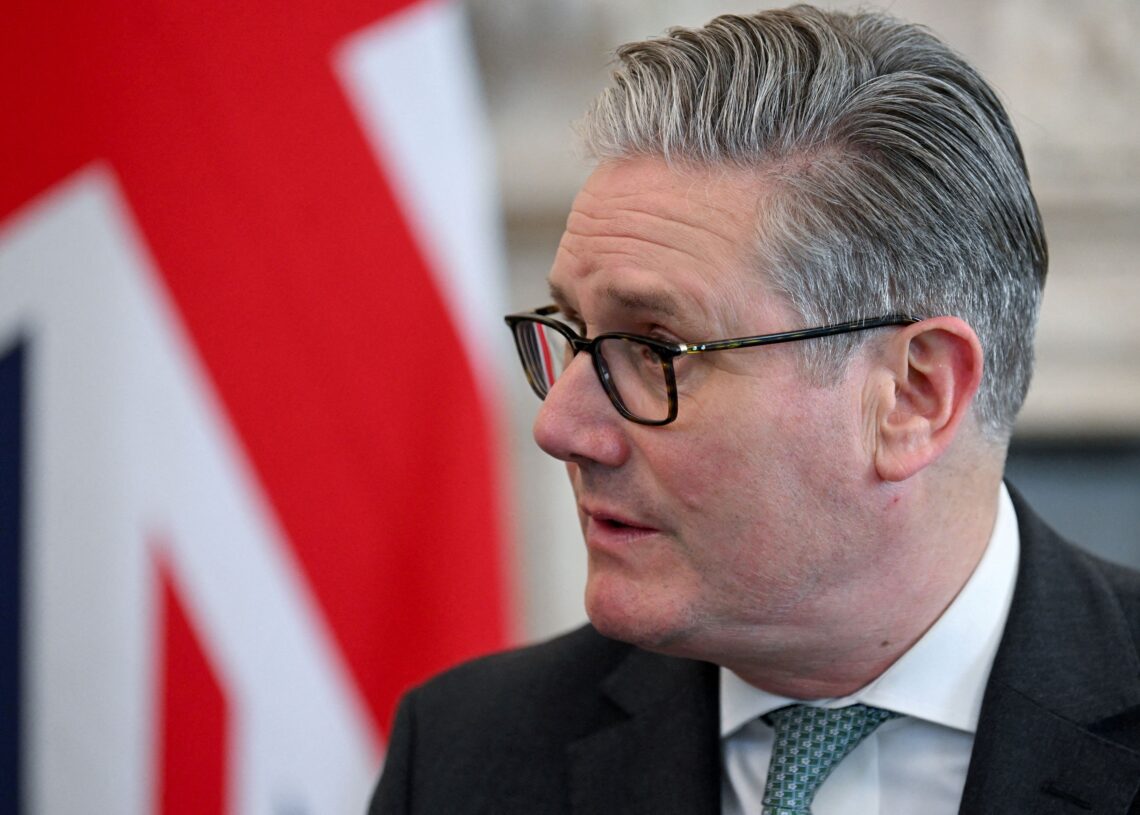
British Prime Minister Keir Starmer, however, cautioned earlier in a speech: “I do have to level with people on this; this will not be easy.” Starmer said the nations meeting Thursday would “assess all viable diplomatic and political measures we can take” and work to restore traffic once the fighting has stopped.
During Thursday’s videoconference, British Foreign Secretary Yvette Cooper accused Iran of trying to “hijack an international shipping route” and hit “global economic security.” She said maritime traffic through the strait had shrunk from about 150 vessels per day to five, with some 20,000 seafarers trapped on about 2,000 ships.
The oil shortages have already triggered violence and political instability in some Asian countries, with thousands of transportation workers going on strike in Philippines to protest rising diesel prices and gas station workers facing angry and armed customers in Bangladesh, India and Pakistan. Shortages will soon begin to impact Europe too, with some tankers that had been heading for ports there re-directing to Asian ports where they can command higher prices, Buseulas, the economist, said.
U.S. consumers, already dealing with gas that costs more than $4 a gallon on average, will begin facing higher prices for other goods as well if the global oil prices stays high, said Sameera Fazili, a senior fellow at the Vanderbilt Policy Accelerator and a former deputy director of the White House National Economic Council during the Biden and Obama administrations.
“The energy supply short-falls and price shocks hitting Asia will impact U.S. manufacturers, retailers, and consumers. We can anticipate price increases and outright shortages — the question is magnitude and timing,” Fazili said in an email.
During his speech, Trump defended the increasingly unpopular war and said the military campaign was “nearing completion.” But without a timeline or plan to reopen the sea lanes for oil and gas, the optimism coming from energy traders earlier in the week has deflated.
The Thursday meeting of world leaders included officials from France, Germany, Italy, the United Arab Emirates, Australia, Canada and Japan. Cooper said that they had agreed to ramp up pressure on Tehran, including through the United Nations, to allow all ships through and that they would explore “economic and political measures” targeting Iran, such as more sanctions.
Iranian officials have said the Strait of Hormuz is closed to “enemies of the nation.”
France, Britain and other countries have said their navies would help secure the waterway and escort tankers once the fighting abates, but not while missiles and drones are flying. Several of Washington’s traditional allies, such as Britain and Germany, also have allowed the U.S. to use their airspace and military bases for the war.
Col. Guillaume Vernet, a spokesman for the French military, said Thursday that talks would also begin on what military assets could be deployed to the strait.
“We will need to assemble a sufficient number of vessels and have coordination capabilities in the air, at sea, as well as the ability to share intelligence,” Vernet said at a news conference. He said coordination with Iran eventually also would be necessary to ensure security guarantees for ships, which seems unlikely for now.
France’s military chief convened officials from more than 30 nations last week to strategize, and his country, a member of the U.N. Security Council, is also taking part in diplomatic efforts at the U.N. Even if there is a de-escalation between the U.S., Israel and Iran, securing the waterway will require naval assets for demining and deterrence, officials say.
Nations along the Persian Gulf, where Iran has directed many of its missile and drone attacks, also are pushing to reopen the strait as the conflict triggers some of their worst economic turbulence in decades.
In parallel with talks on building a coalition, some Gulf states have backed an effort for a Security Council resolution that could provide legal cover for an international operation to unblock the strait.
The post As Trump doubles down on Iran war, markets shudder and oil prices climb appeared first on Washington Post.