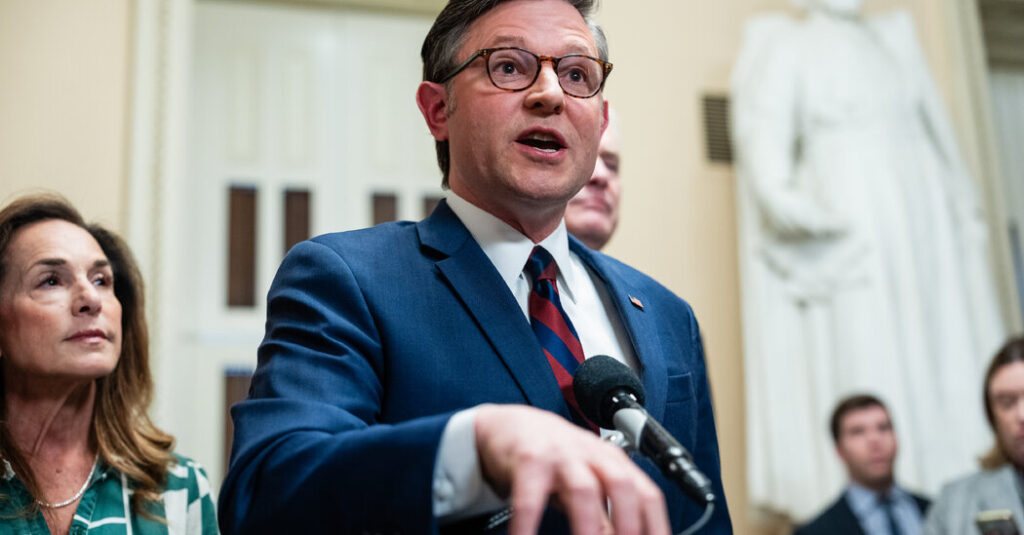
Last Friday, Speaker Mike Johnson indignantly dismissed a Senate-passed bill deal to reopen the Homeland Security Department without funding for immigration enforcement as a “joke.”
By Wednesday, he was jointly issuing a news release with the Senate leader endorsing it.
But early Thursday morning, he declined to bring it up in the House, punting a chance to try to reopen the department until at least mid-April and avoiding the risk that hard-right Republicans would either block it or threaten to oust him for doing so. Then, he spent much of the afternoon huddled in a heated conference call with his angry G.O.P. colleagues, privately trying to persuade them to eventually embrace the deal, which he had decried as “ridiculousness” just days before.
That, too, apparently failed; there were no plans for the House to quickly reconvene, and by Thursday evening, it was not clear when or even whether Mr. Johnson might bring the bill up.
Mr. Johnson’s contortions on the homeland security measure over the last several days reflect his weak hold on his tiny and fractious majority, a persistent vulnerability that has characterized his tenure in what is supposed to be the most powerful job in Congress.
They were the whipsawing moves of a leader who derives his influence nearly entirely from President Trump and defers to him routinely, and who must live in constant fear of being thrown overboard by restive Republicans who have shown they are more than willing to oust a speaker who compromises with Democrats to get something done.
As the leader of a body where the majority always rules, Mr. Johnson would seem to enjoy a hefty amount of clout. Speakers have traditionally had tight control of the floor and asserted some degree of independence from the executive branch — even from presidents of their own parties — sometimes pushing their own legislative priorities, particularly if it meant protecting their members from political liability.
Mr. Johnson, by contrast, has defined his speakership as a tool to further Mr. Trump’s power and cheerlead his agenda, and in turn relied on the president to help him corral Republicans on tough votes.
Because his voting margin is so thin, individual lawmakers wield substantial power to throw up roadblocks to Mr. Johnson’s plans. And while the president’s support has helped keep Mr. Johnson in his position, it has also weakened the iron grip that speakers typically exert over their ranks. Rather than lead his divided party through choppy political waters, Mr. Johnson has often turned to Mr. Trump to steer the ship, or allowed his oarsmen to chart the course.
That has made things especially tricky for Mr. Johnson during the homeland security shutdown, as the president has repeatedly changed his own position. It was Mr. Trump who initially cut a deal with Democrats to negotiate on immigration enforcement restrictions that could be included in a homeland security spending measure, only to angrily reject any such compromise weeks later. Then in recent days, he had said he would consider a deal to reopen the department, only to condemn it when it materialized and then, finally, signal through an aide on Wednesday that he would, in fact, sign it if it reached his desk.
Mr. Johnson’s shifts have mirrored Mr. Trump’s even as Senate Republicans have gone in a different direction, cutting a deal with Democrats to end the shutdown that infuriated many conservatives and left the speaker with few appealing options.
So on Thursday, when the House met for a perfunctory session, Mr. Johnson did not push for swift passage of the plan he had endorsed to reopen the Homeland Security Department. Faced with potential objections from a flank of recalcitrant right-wing members, he did not even appear on the floor.
Had he pressed forward with the plan, he would have risked angering the ultraconservatives who, if unified, could move to sack Mr. Johnson. His speakership was born out of a right-wing revolt that sank his predecessor, Kevin McCarthy, a rebellion whose specter has hovered over the current speaker’s tenure.
During his first year in the job, Mr. Johnson faced a similar effort to force him out. That attempt, in May 2024, failed after Democrats came to his rescue, though 11 Republicans voted in support of his ouster.
With Mr. Trump in the White House and the midterm elections approaching, Mr. Johnson can expect no such cover from the opposition. Under House rules, nine Republicans can band together to try to vacate a speaker, an effort that would probably draw broad Democratic support.
So he has catered to his right flank and avoided any risk of angering Mr. Trump.
“I spoke to the president a few moments ago,” Mr. Johnson told reporters last week as he panned the Senate-passed measure to fund the Homeland Security Department without money for immigration enforcement. “He understands exactly what we’re doing and why, and he supports it.”
But after days of conversations among the White House, Mr. Johnson and Senator John Thune, the South Dakota Republican and majority leader, Mr. Trump announced that he had come around to the idea of funding immigration enforcement through a special bill that Democrats could not filibuster. Hours later, Mr. Johnson issued his statement with Mr. Thune, saying that was the best path forward for Republicans.
The speaker has not publicly explained the shift. But privately, he and House Republican leaders concluded that the Senate deal had forced their hand by giving ground to Democrats, according to two people familiar with their thinking.
Mr. Johnson made that case in his call with House Republicans on Thursday. But even as he pitched the plan, he called on the White House for backup.
The president’s Office of Management and Budget sent a memo to G.O.P. lawmakers to allay their concerns over the funding deal. And Mr. Johnson brought a special guest to field questions from angry House Republicans during the telephonic huddle: Russell T. Vought, Mr. Trump’s budget chief.
Michael Gold covers Congress for The Times, with a focus on immigration policy and congressional oversight.
The post Johnson Wavers on Ending the Shutdown, Reflecting His Weak Hold on Power appeared first on New York Times.