Scathing criticism by the French president. Taunts and more missile strikes from Iran. Surging oil prices.
President Trump’s 19-minute speech on Wednesday night, in which he threatened to bomb Iran “back to the Stone Ages” and said the war would last several more weeks, failed to appease deep global anxieties over where the war was leading.
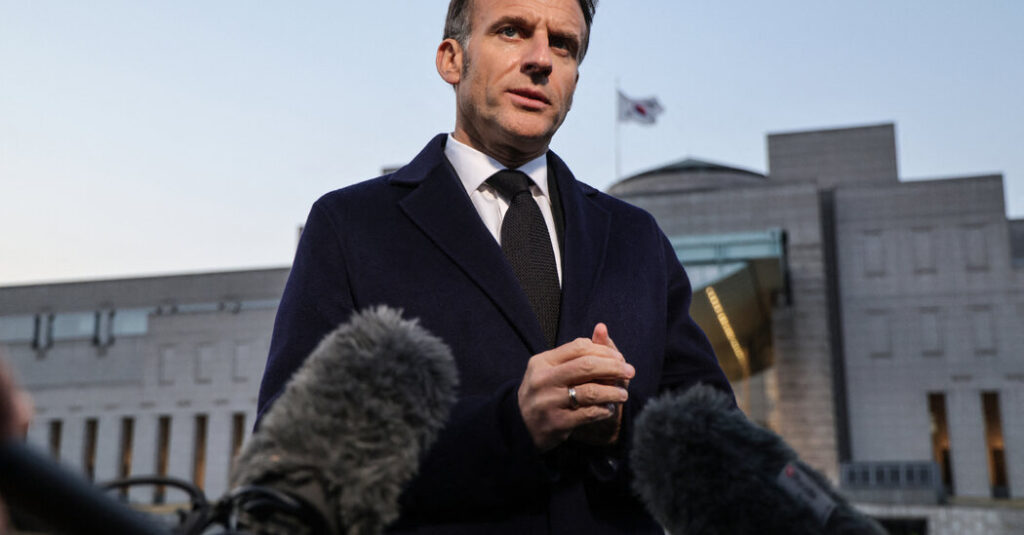
President Emmanuel Macron of France expressed blunt disapproval on the handling of the war on Thursday, chastising Mr. Trump for speaking cavalierly and contradicting himself.
“When we’re serious, we don’t say every day the opposite of what we said the day before,” Mr. Macron told reporters in response to a question about Mr. Trump’s threat to continue the war and bomb Iran intensively. “And, maybe, one shouldn’t speak every day.”
Mr. Macron, speaking of Mr. Trump’s verbal attacks against NATO, also said, “If you create doubt every day about your commitment, you hollow it out.”
His comments came during a trip through Asia, the region hit hardest by Iran’s selective closure of the Strait of Hormuz to oil tankers and other maritime traffic crucial to the global economy.
Iran’s defiance on Thursday came in the form of mocking statements and missiles fired across the Middle East.
“Your information about our military power and equipment is incomplete,” a spokesman for the leadership of Iran’s Islamic Revolutionary Guards Corps said in a video statement on Thursday. It came after Mr. Trump, in his speech on Wednesday, said that Iran’s ability to launch missiles and drones had been “dramatically curtailed.”
The Israeli military and United Arab Emirates’ Defense Ministry both that they had intercepted missiles launched from Iran on Thursday. Saudi Arabia’s Defense Ministry also said its forces had intercepted a missile, but did not specify the origin.
Iranian officials, who have consistently denied holding direct talks with the United States, taunted Mr. Trump after the speech. Mohammad Ghalibaf, the speaker of Iran’s Parliament and a key figure overseeing the war, warned in a social media post that “when it comes to defending our homeland, each and every one of us will become a soldier of this country.”
“Armed, ready, and standing,” he wrote. “Come on in, we’re waiting.”
The bombings of Iran continued on Thursday, with the government saying that a strike had destroyed the Pasteur Institute of Iran in Tehran, one of Iran’s leading public health organizations, which produced and distributed vaccines. Dr. Hossein Kermanpour, spokesman for Iran’s Ministry of Health, said the attack had been “a direct assault on international health security.”
Strikes struck a bridge just outside Tehran, the capital, on Thursday, causing it to collapse, the Iranian government said. State media reported that at least eight civilians were killed and 95 others wounded when bombs hit the bridge, which linked Tehran to the nearby city of Karaj and was part of an ambitious highway project to connect the capital to the northern shores of the Caspian Sea.
A local official said on state TV that the bridge, which is in the mountains, had not been complete and the casualties were from a nearby village picnicking nearby during a national holiday in Iran.
U.S. forces struck the B1 bridge, eliminating a planned military supply route for sustaining Iran’s ballistic missile and attack drone force, according to a U.S. military official who spoke on condition of anonymity to share operational details. U.S. Central Command, which oversees American military operations in the Middle East, did not reply to a request for comment.
Mr. Trump celebrated the destruction of the bridge, warning on social media that there was “much more to follow.”
America’s allies, most of them kept out of the loop on military planning before the war, have been searching for ways to contain the conflict’s economic fallout and to unblock the Strait of Hormuz.
Britain on Thursday hosted a virtual meeting with dozens of nations — but not the United States — about the strait. Britain’s foreign minister, Yvette Cooper, began the meeting by accusing Iran of hijacking “an international shipping route to hold the global economy hostage.” In the past 24 hours, she said, 25 vessels had navigated the waterway, which would normally be used by 150 ships a day.
Ms. Cooper said there had been more than 25 attacks on vessels, leaving about 20,000 seafarers stranded on around 2,000 ships unable to sail.
Even as he has called on European allies to help open the strait, Mr. Trump reiterated in his speech on Wednesday that the United States was “totally independent of the Middle East.”
“We don’t need their oil; we don’t need anything they have,” he said. “But we’re there to help our allies.”
Iran signaled on Thursday that it intended to continue to oversee shipping traffic through the strait, even after the war, though it said that it would not restrict transit.
Kazem Gharibabadi, Iran’s deputy foreign minister for legal and international affairs, said in comments reported by Iran’s state news outlet that Iran was drafting a protocol to allow Iran and Oman, which together straddle the strait, to “oversee transit through the Strait of Hormuz.”
Mr. Gharibabadi was quoted as saying that such oversight “are intended to facilitate and ensure safe passage and to provide better services to ships passing through this route.”
Britain said it would host military planners from about 30 nations next week to discuss securing the strait for shipping, although it was not clear that the talks would satisfy Mr. Trump’s call for other countries to “build up some delayed courage” and reopen the sea route.
After hopes for an end to the war had somewhat tempered the panic in global oil markets, nervous traders on Thursday once again bid up the price of oil. Later, Brent, the international oil benchmark, surged 7.8 percent to $109.03 per barrel.
Stocks pared earlier losses after reports that Iran and Oman were in talks to monitor marine traffic through the Strait of Hormuz, with the S&P 500 roughly flat.
A report on Wednesday by Oxford Economics, a research firm, estimated that the war has resulted in a 10 percent shortfall between global oil supply and demand. A prolonged war could cause “widespread rationing,” greater use of coal and disruptions to supply chains in emerging economies, it said.
The Philippines, one of the countries hit hardest by the oil shock, said on Thursday that Iran had granted safe passage to ships under the Philippines’ flag through the strait. Iran’s foreign minister, Abbas Araghchi, assured the Philippines’ foreign secretary, Theresa P. Lazaro, that “Philippine-flagged vessels, energy sources, and all Filipino seafarers” would be allowed through the strait, according to the Philippines’ foreign ministry.
Other countries continued to distance themselves from the war.
Austrian officials said on Thursday that they had been denying American combat aircraft permission to fly over their country since the start of the war, as part of a longstanding national policy of neutrality.
“Austria is a neutral country, and as such, we are obligated to adhere to certain principles,” Col. Michael Bauer, a Defense Ministry spokesman, said on Thursday. “Therefore, we have rejected requests for flights to or from countries at war.”
Switzerland has similarly blocked overflights, citing its neutrality.
Early in the war, the Spanish government denied the United States the use of its military bases to U.S. forces involved in the attack on Iran, including key refueling aircraft.
In his speech on Wednesday, Mr. Trump listed the length of American involvement in World War I, World War II, the Vietnam War and the Korean and Iraq wars to argue that his military campaign has been far shorter than past wars.
He said this war was worth it to eliminate what he argued was the threat from Iran. “This is a true investment in your children and your grandchildren’s future,” he said.
Pete Hegseth, the U.S. secretary of defense, repeated on social media Mr. Trump’s comments about bombing Iran, prompting a response by Sayyid Abdolrahim Mousavi, the commander of the Revolutionary Guards’ Air Force.
“It is you who are taking your soldiers to their graves, not Iran, whom you seek to drag back to the Stone Age,” Mr. Mousavi said. “Hollywood delusions have so poisoned your minds that, with your paltry 250-year history, you threaten a civilization over 6,000 years old.”
Reporting was contributed by Eric Schmitt, Farnaz Fassihi, Stephen Castle, Aurelien Breeden, Luke Broadwater, Tyler Pager, Joe Rennison, Jim Tankersley, Tatiana Firsova, Leily Nikounazar, Jason Gutierrez and Rich Barbieri.
Mark Landler is the Paris bureau chief of The Times, covering France, as well as American foreign policy in Europe and the Middle East. He has been a journalist for more than three decades.
The post Macron Voices Europe’s Frustration With Trump as Fighting Rages and Missiles Fly appeared first on New York Times.