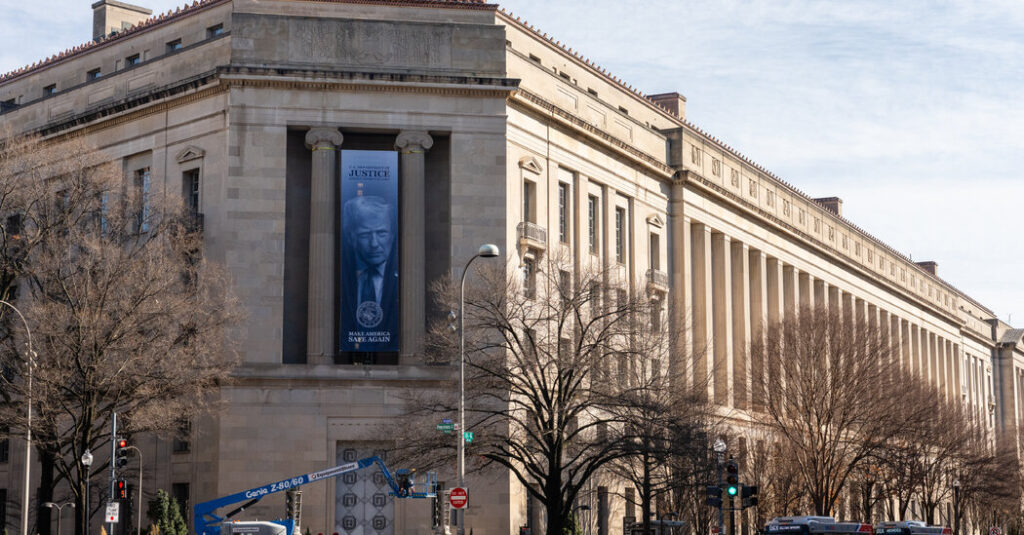
Legal experts inside the Justice Department have issued an unusual opinion claiming that a nearly 50-year-old federal law requiring presidential records to be handed over to the government when a president leaves office is unconstitutional.
The opinion by the department’s Office of Legal Counsel attacking the law, the Presidential Records Act, could set the stage for President Trump to refuse to give the National Archives and Records Administration many of his own official documents when he leaves office after his second term in the White House is over.
Congress enacted the Presidential Records Act in 1978 after the Watergate scandal, when control of former President Richard M. Nixon’s White House files became a subject of intense dispute. It says that the government “shall reserve and retain complete ownership, possession and control of presidential records,” and also set rules for how the National Archives should handle the material when a president departs.
The act defines presidential records as materials the president or his staff create or receive in the course of their official duties, and it excludes personal documents, like diaries and political campaign files. Files produced by other agencies in the federal government are governed by a separate statute.
The Office of Legal Counsel memo, issued on Tuesday by T. Elliot Gaiser, an assistant attorney general, asserts that the act is unconstitutional because it is an example of lawmakers trying to wield too much authority over the president. The act, Mr. Gaiser wrote, “exceeds Congress’s enumerated and implied powers and aggrandizes the legislative branch at the expense of the constitutional independence and autonomy of the executive.”
While the opinion sets policy for the Justice Department, it could be reversed by a subsequent opinion from another Office of Legal Counsel lawyer in the future. Still, if the opinion remains in effect as Mr. Trump is preparing to leave office, he could point to it as a justification for taking his official records with him when he departs.
He did just that in 2021, removing reams of documents, including some that were highly classified, from the White House and storing most of them at Mar-a-Lago, his private club and residence in Florida. Mr. Trump was ultimately indicted on charges of holding on to the classified materials and obstructing the government’s repeated efforts to retrieve them.
The charges in that case did not involve the Presidential Records Act, which does not deal with the mishandling of classified materials. In fact, Mr. Trump sought to use the act to defend his efforts to hold on to the material he removed from the White House even though legal experts accused him and his lawyers of misinterpreting the law.
Alan Feuer covers extremism and political violence for The Times, focusing on the criminal cases involving the Jan. 6 attack on the Capitol and against former President Donald J. Trump.
The post Justice Dept. Says Trump Doesn’t Need to Hand Over Presidential Records After Office appeared first on New York Times.