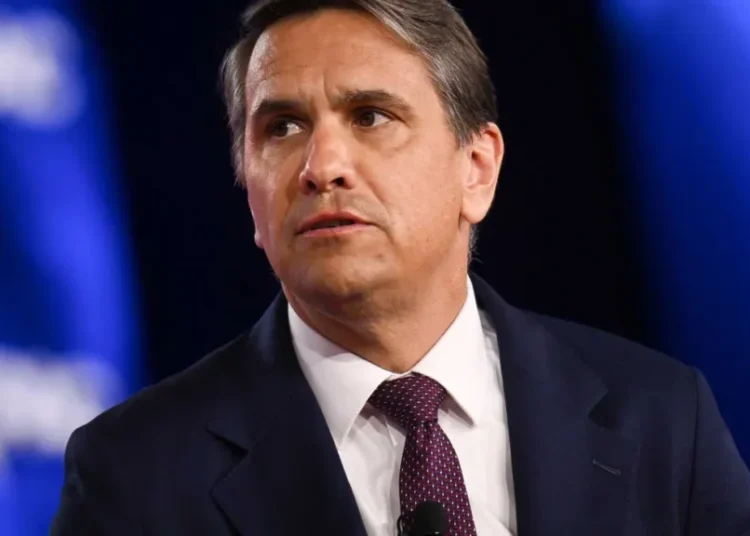
Defense Secretary Pete Hegseth uses language the way an adolescent boy uses Axe body spray — subtlety’s for wimps. President Trump speaks in a stew of unfinished sentences, misused words (“excursion” instead of “incursion”) and useless repetition (“the one regime was decimated, destroyed, they’re all dead”). Some Democrats use vulgarity to convince voters that if they talk tough, they will act tough.
Public figures have often been notably coarse in private. But at a time when average Americans seem less able to speak clearly and fluently, and those in prominent positions could provide a useful model for graceful expression, eloquence is no longer a priority in public speaking.
Articulateness once had a central place in American manners. “He could speak fluently and learnedly on all subjects,” a fur trader said of the explorer Meriwether Lewis around 1810, “but his inveterate disposition against the British stained, at least in our eyes, all his eloquence.” What a finely expressed appreciation by a fur trader for a man of action.
By the late 1950s, Norman Podhoretz turned a harsh light on the new bohemians’ discourse. For them, he said, “to be articulate is to admit that you have no feelings.” Perhaps that was when we began to favor relatability over articulateness.
A healthier culture, and a healthier political culture, would more explicitly value people for speaking well. We hardly need to be as flowery as Cicero or aspire to the heights of the Athenian orators. Bill Clinton’s plain-spoken powers of suasion were much of why he succeeded as well as he did. So, too, with Barack Obama. Other public figures are rarely recognized for their verbal deftness, even on their feet. I think of Senators Amy Klobuchar and Jon Ossoff, and — surprise! — Hegseth’s equivalent under George W. Bush, Donald Rumsfeld. He spoke clearly and crisply, in what often sounded like spontaneously composed paragraphs. That’s a skill, independent of what he actually had to say.
As the lure of authenticity leads politicians adrift from eloquence, an engine of inauthenticity may be having a similar effect on young people.
Over the past year or so, I’ve found that most students in my college classes will use A.I. to at least start their written essays. I cannot hate on them for this, as I am quite sure I would have done the same thing when I was in college if the technology had been available. But by using A.I., students will have ever less experience crafting or taking in arguments with deliberation, exploring vocabulary, writing with steady flow. And with less immersion in the discipline of writing, the ability to communicate orally will further deteriorate.
One solution will be to make oral presentations and rigorous discussion a greater part of class time in high school and college. Students will need to be trained to express themselves in long sentences to craft a point, not just string together observations. What used to be called “speaking well,” or what we can call “talking in writing.”
If Americans could make effective arguments, as well as be eager to listen and respond to them, perhaps tempers could be cooled.
Then, of course, there is “like.” On a podcast recently, a young person was interviewed for a half-hour about a heartbreaking experience regarding a thorny controversy. It was compelling, but I was so distracted by her use of “like” every six words. In a casual situation, I would have been fine hearing her use “like” for practically every word. But her comfort using it so much in a serious and public context marked her as a product of the linguistic expectations of these times. In the old days people were trained to differentiate more between talking casually and speaking. We hear something similar in how commonly serious people interviewed in the media use “like” and “sort of” these days. As I have written, in the technical sense those are not indications of a lack of confidence, and have a grammatical complexity of their own. Yet they are, nevertheless, pauses — as in, breaks in fluency.
I envision an America where people on TikTok — both famous and not — use language carefully to make a point and are admired for how effectively they did so. They will seek a connection with a confident flow of carefully chosen words, not just by going for the gut or trying to sound relatable.
Call it a little touch of Cicero.
In other news, I have seen a very special show at the cozy Marjorie S. Deane Little Theater near Lincoln Center. The top-drawer Broadway songwriters Richard Maltby Jr. and David Shire have rounded out the trilogy of revues that began with “Starting Here, Starting Now” (1976), about being young, and “Closer Than Ever” (1989), about being middle-aged, with “About Time,” about being, well, old-ER. The pair are still at the top of their game, and the performances are super. Sally Wilfert, especially, blew me away. Go see this now; it closes Sunday.
The post Eloquence Has Grown Passé. Let’s Bring it Back into Fashion. appeared first on New York Times.