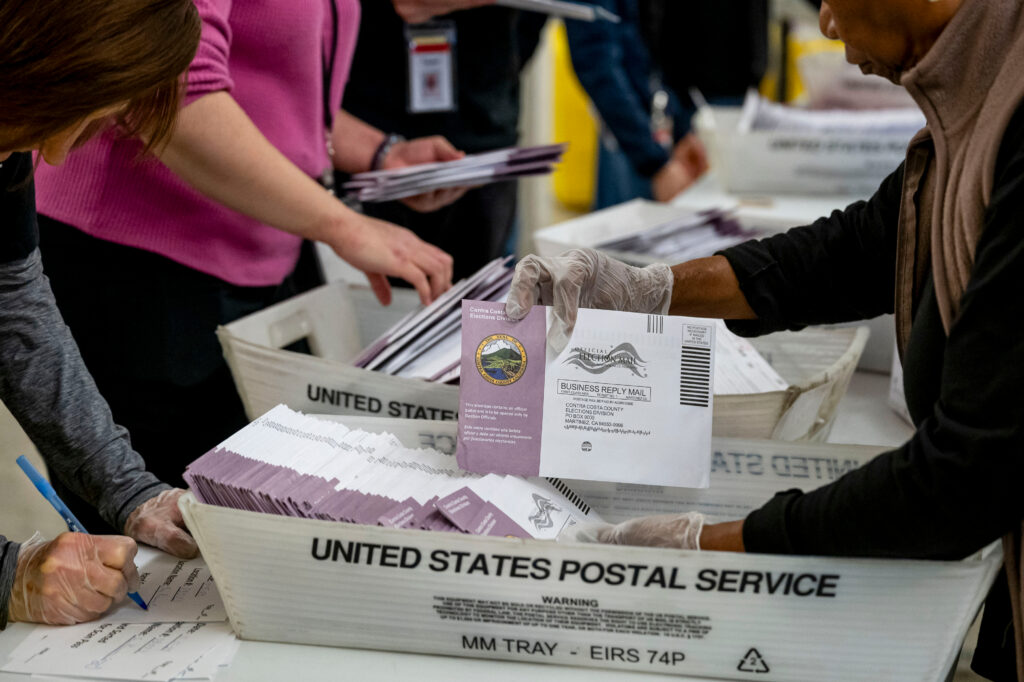
Democrats and a coalition of voter rights groups filed separate lawsuits Wednesday and Thursday in an effort to block an executive order that President Donald Trump signed Tuesday that would limit mail ballots.
One of the lawsuitswas filed by Senate Minority Leader Charles E. Schumer (D-New York) and House Minority Leader Hakeem Jeffries (D-New York) alongside the party’s Senate and House campaign committees, the Democratic Governors Association and the Democratic National Committee.
In a statement Thursday, the Democrats described Trump’s order — which seeks to change rules for mail-in ballots, even though Trump has very limited authority on elections — as “the newest attempt by Republicans to interfere in free and fair elections.”
Trump’s order directs the U.S. Postal Service to send ballots only to voters who appear on a list of citizens to be compiled by the Department of Homeland Security with the assistance of the Social Security Administration. The order also specifies what types of secure envelopes are to be used for mail ballots.
Trump has long assailed voting by mail, which he has claimed — without evidence — is riddled with fraud and which he blames for helping him lose the 2020 election.
Democrats said the actions in his executive order amount to a violation of the Constitution, which directly gives states and Congress the power to regulate federal elections and voter rolls.
“The American people are fed up with Republicans’ price-spiking, health care-gutting agenda and are ready to vote them out,” the Democrats said in their statement Thursday. “That’s why Donald Trump is desperately trying to rig our elections by making it harder to vote for seniors, Americans with disabilities, members of the military, rural communities, and other working families who rely on vote-by-mail. This move is blatantly unconstitutional, and we will fight against it.”
In their lawsuit, the Democrats argue that the president has no lawful authority to enforce such an order, and that Trump is unlawfully attempting to revoke vote-by-mail eligibility from states and hand it to federal agencies. The Democrats also argue that neither the Constitution nor any federal statute give the president authority to decide which Americans can vote by mail.
In a separate lawsuit, voter rights groups — including the League of Women Voters, the Association of Americans Resident Overseas and the U.S. Vote Foundation — are seeking to stop the Trump order, arguing similarly that the Constitution explicitly states that only Congress and the states can set the rules for elections. Additionally, the groups warned that Trump’s call for DHS to build a list of citizens eligible to vote could result in unreliable voter rolls that could lead to mass disenfranchisement of eligible voters.
“This executive order is an illegal and dangerous attempt by the Trump administration to eliminate accessible voting options and subvert our democracy by seizing control of election administration from the states and Congress,” said the plaintiffs, represented by the American Civil Liberties Union, the Brennan Center for Justice and several other organizations.
The lawsuit also targets Trump’s demand that the U.S. Postal Service not deliver the mail ballot of any individual who is not on the federal voter roles that he wants created, and that special envelops be created for mail ballots. Eliza Sweren-Becker, the deputy director for voting rights and elections at the Brennan Center, told The Washington Post that those mandates are “unconstitutional” and that the president “certainly can’t mandate an entirely new policy for mail voting.”
“The President also can’t order the Postal Service to do anything. Congress under the Constitution has authority over the Postal Service,” she said.
The White House did not immediately respond to a request for comment on the two lawsuits.
As The Post reportedearlier this week, election experts said Trump’s order is legally questionable. The Constitution directly gives states oversight of elections, and Congress has the power to establish national standards for them. Under the Constitution, the president does not have unilateral authority over how voting is conducted.
While he signed the executive order on Tuesday, Trump predicted that it would be challenged in court. He claimed that opponents of his actions would find a “rogue judge” to strike down his effort.
“Hopefully we’ll win on appeal if it is [challenged],” Trump said.
Sweren-Becker noted that an executive order issued by Trump last year that also sought to exert control over aspects of federal elections was challenged in three different courts, all of which agreed it was unconstitutional.
“I’m confident the outcome has nothing to do with the judges randomly assigned to the cases,” Sweren-Becker said. “Rather, the Constitution and the law are very, very clear on the president’s authority and the fact that he has none over elections.”
Patrick Marley contributed to this report.
The post Democrats, voter rights groups file lawsuits on Trump order on mail ballots appeared first on Washington Post.