More than a month into a war that he insists will come to an end within two or three weeks, President Trump has put himself in a strategic box from which he is finding no easy exit.
Talks with Iran about a deal to end the conflict, to the degree they are substantive, have so far shown little promise. The key metrics of success described at various points by Mr. Trump — keeping Iran from possessing the fuel to make a nuclear weapon, helping the Iranian people topple a government much of the populous despises and reopening the Strait of Hormuz — remain in the distance, at best.
Iran’s tolerance for pain appears far higher than Mr. Trump anticipated, and despite devastating losses to its arsenal, it retains some ability to strike Israel with missiles. It did so even while Mr. Trump spoke about the war on Wednesday evening.
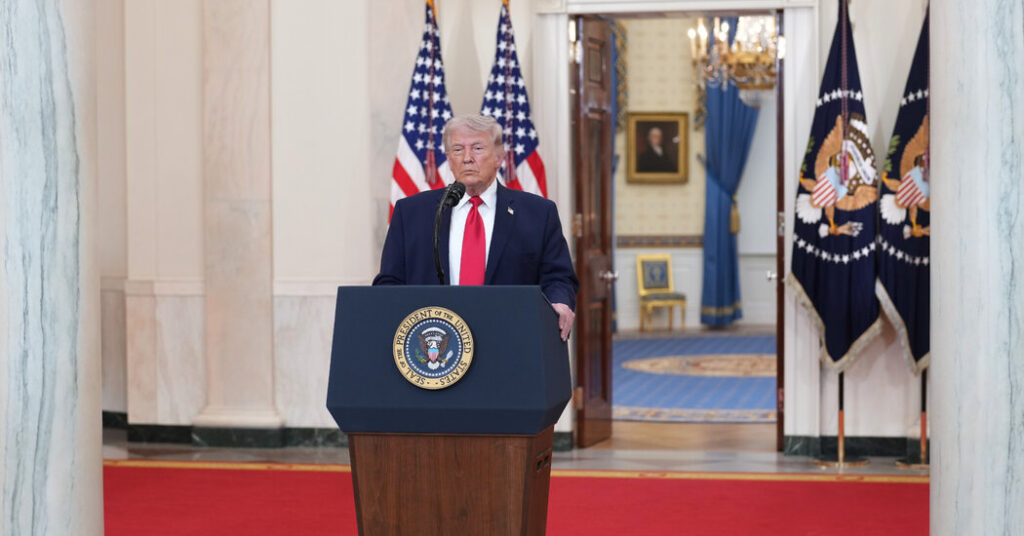
That televised, prime-time address was intended to reassure Americans that the costs of the war would be transitory, that an end to hostilities and a return to normal economic life were imminent. But the markets responded to his speech with deep skepticism.
Oil prices surged 8 percent in the hours after his 19-minute address, largely because he described no plan to end what amounts to a tanker hostage crisis in the Strait of Hormuz that is now rippling across the global economy. The strait, he insisted, would “open up naturally” when the conflict is over.
At this stage, Mr. Trump appears to be offering a host of sometimes contradictory paths forward, and faces the possibility that at the end of his own two-to-three week window, nothing much will have changed. And his promise to send Iran back to the “Stone Ages” if it did not agree to his terms — which he did not specify on Wednesday night — would amount to an expansion of the war, not a winding down.
Mr. Trump has never been troubled by internal contradictions, of course. He is the master of raising and dispensing with arguments to fit the moment. In the opening moments of the war he urged Iranians to rise up and take over their government, but he hasn’t mentioned that approach since, other than to say it would probably lead to the slaughter of the Iranian protesters.
On Wednesday evening he said that “regime change was not our goal,” although he had called for just that after the initial attack by the United States and Israel on Feb. 28. He now claims that “regime change has occurred because of their original leaders’ death,” as if a change of personnel was same as a change of regime. (When Ayatollah Ruhollah Khomeini died in 1989, only to be succeeded by another supreme leader, few argued that it constituted a change of the governing structure.)
In weaving back and forth, Mr. Trump is relying on techniques he honed in the New York real estate world, where he often succeeded at creating his own reality. But war is different. The enemy gets to shape the environment as well, and the Iranians apparently sense they can wait Mr. Trump out. And while Iran has precious few allies — even its biggest oil customer, China, has kept its distance — Iranian leaders seem to be counting on declining stock markets and rising oil prices to speed Mr. Trump’s exit from the conflict.
So whether the U.S. forces pull back in two or three weeks, as Mr. Trump predicted, or whether Washington escalates the fighting and gets stuck, here is a look at the challenges that seem unlikely to be resolved anytime soon.
‘Shortly, Very Shortly’
That is how Mr. Trump described on Wednesday night the length of time required to “complete all of America’s military objectives.” Earlier that day, he said it would be “two weeks,” or maybe just a bit longer, before he began to withdraw.
Set aside for the moment the fact that Mr. Trump frequently criticized former President Joseph R. Biden Jr. for setting a firm deadline for exiting Afghanistan, saying such information would only help the enemy. In this case, Mr. Trump’s goal is to reassure the markets that normality, and an open strait, is on the way.
But at other moments he has described military missions that could stretch to months or years. He has mused openly about “taking” Kharg Island, where Iran loads 90 percent of its oil bound for export. “I don’t think they have any defense,” he told The Financial Times. “We could take it very easily.”
Holding it, however, is another matter. The island is just 16 miles from the Iranian coast. The oil pipelines feeding the port would be an easy target for sabotage.
Mr. Trump not only needs to get the strait open, he needs to keep it open. In the same speech in which he said the problem would more or less take care of itself, he also told allies who rely on getting their oil through the strait that they should “build up some delayed courage” and go “grab it and cherish it.”
But the Europeans are so angry at him — for not consulting them before initiating a conflict that triggered an economic and energy crisis, for conducting what many of them consider to be an illegal attack — that they are meeting this week to discuss their next steps without the presence of American representatives. “This is not our war and we’re not going to get dragged into it,” Keir Starmer, the British prime minister, said on Wednesday.
Mr. Trump can barely contain his fury at such remarks, which have led to his threat to leave NATO. Yet in an Easter-related event at the White House on Wednesday, which was closed to the press but was videotaped and mistakenly posted to YouTube by the White House, Mr. Trump seemed to acknowledge that the United States would need some help. He mockingly referred to phone conversations with President Emmanuel Macron of France.
“I said, ‘No, no, I don’t need after the war is won, Emmanuel,’” Mr. Trump said, recalling his conversation. In fact, his aides concede, any patrol of the strait could last for years.
‘Back to the Stone Ages’
Mr. Trump loves the Stone Age reference, which Beth Sanner, his C.I.A. briefer in the first administration, notes is often associated with Gen. Curtis LeMay, who argued for destroying all of North Vietnam’s infrastructure to force it into surrender. Mr. Trump’s line was immediately picked up by Defense Secretary Pete Hegseth, who posted five words after the speech: “Back to the Stone Age.”
It sounds tough, and fits with Mr. Hegseth’s constant refrains about returning the U.S. military to “maximum lethality.” But it also underscored what was missing from the speech. Mr. Trump never described a new vision for Iran, or the prospect that its people, in their revulsion toward their own brutal government, might embrace democracy or seek to rekindle a long-ago partnership with the United States.
In fact, Mr. Trump never talked about diplomatic or economic inducements, such as sanctions relief or Western investment in the oil sector, for Iran to give up its nuclear program or to restrict the size and range of its missile arsenals. He never mentioned the idea of sending Vice President JD Vance to negotiate directly with the Iranians, though the administration has been working on the possibility for more than a week.
The speech was all about hammers, with no mention of incentives.
‘I Don’t Care About That’
It was only a few weeks ago that Mr. Trump repeated, in a social media post, his primary goal for the war: “Never allowing Iran to get even close to Nuclear Capability,” he wrote, “and always being in a position where the U.S.A. can quickly and powerfully react to such a situation.”
None of the past five American presidents would disagree with that goal, which has been attempted via many paths. The United States sabotaged Iran’s nuclear centrifuges during the administrations of Barack Obama and George W. Bush. Mr. Obama negotiated a broad accord in which Iran gave up 97 percent of its uranium stockpile. In his first term, Mr. Trump withdrew from that accord, imposing crushing sanctions on Iran, but paving the way for the country to build up its current stockpile of near-bomb-grade uranium.
When the war started on Feb. 28, Mr. Trump justified it by making an argument that the presence of that stockpile, enriched to 60 percent purity, was intolerable, even if it was in tunnels whose entrances were buried under the rubble created by an American air attack in June 2025. U.S. intelligence officials said there was no evidence that the Iranians had recovered the casks of nuclear material, though everyone agreed that, sooner or later, the Iranians would likely dig them out.
So it was pretty shocking to hear Mr. Trump, on Wednesday morning, telling Reuters in an interview that he didn’t really care about the stockpile because it is “so far underground.” What made his statement particularly stunning was that Mr. Trump has spoken for more than a decade about the need to block Iran from producing uranium, which it could stockpile and enrich to a form usable in a bomb. It has been a constant theme for Mr. Trump as he has made the case that a nuclear-armed Iran would be an existential threat to the United States and the world.
“We’ll always be watching it by satellite,” the president said. He repeated a similar line in his speech.
His statement naturally raised the question about whether he had deliberately hyped the threat that an Iranian nuclear bomb was “imminent” — an echo of the Bush administration’s case for invading Iraq in 2003.
Of course, this could all be a diversion. Marine expeditionary units and Special Operations forces heading into the region may yet be ordered to seize the 970 pounds of uranium from its deep-underground storage site, a hugely risky operation. That would not be an exit; it would be a sharp escalation.
David E. Sanger covers the Trump administration and a range of national security issues. He has been a Times journalist for more than four decades and has written four books on foreign policy and national security challenges.
The post How Trump Boxed Himself In on Iran appeared first on New York Times.