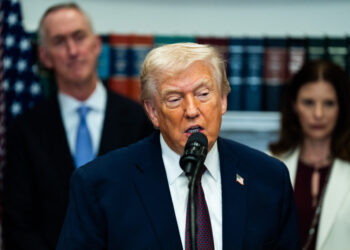
As President Trump surveyed the grand chamber of the Supreme Court on Wednesday morning, watching his solicitor general defend his birthright citizenship plan, he had reasons to be satisfied.
True, the court was likely to reject Mr. Trump’s order to end the promise of citizenship to nearly all babies born in the United States — probably by a lopsided vote, one whose majority might well include all three of his appointees.
But the court treated what had until recently been viewed as a frivolous fringe theory as worthy of respectful consideration. And there were reasons to think the justices would deal his efforts just a setback rather than a death blow.
In so doing, legal experts said, the court seemed to acknowledge the power of motivated reasoning and intellectual entrepreneurship, in which politicians, interest groups and scholars join forces to elevate ideas that once had scant support.
“Constitutional arguments move from the crazy to the plausible, or from off-the-wall to on-the-wall, when influential and powerful people and institutions get behind them,” said Jack M. Balkin, a law professor at Yale who has written about the process of bringing outlying legal theories into the mainstream.
He said the president and his party supported the birthright citizenship proposal with the help of conservative legal intellectuals who honed arguments designed to appeal to justices who were themselves products of the conservative legal movement.
All of this, he added, may not be enough to achieve victory. But it may be enough to achieve respectability. “Only a few years previously,” he said, “the same arguments would have been laughed out of court.”
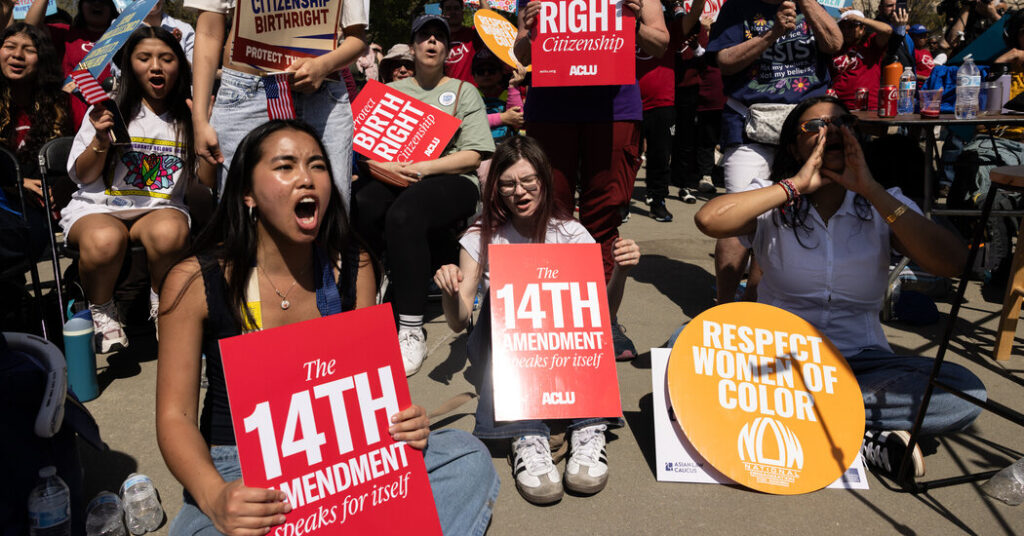
Most of Wednesday’s argument was focused on whether Mr. Trump’s executive order limiting birthright citizenship violated the first sentence of the 14th Amendment, which says that “all persons born or naturalized in the United States, and subject to the jurisdiction thereof, are citizens of the United States.”
For generations those words have been understood to guarantee citizenship to essentially all babies born in the United States, with exceptions for the children of diplomats and invading troops.
But now the Trump administration argues that the provision excludes the children of people in the United States unlawfully or temporarily. The original meaning of “subject to the jurisdiction thereof,” the administration and its allies say, encompassed concepts like permanent domicile and national allegiance.
John Eastman, a lawyer with the Claremont Institute, a conservative think tank, and a former law clerk to Justice Clarence Thomas, was one of the first to promote the idea that the 14th Amendment, adopted in 1868 after the Civil War, in fact was intended to grant citizenship only to the children of freed slaves. He said the amendment was meant to reverse the Supreme Court’s 1857 decision in Dred Scott v. Sandford, which had held that Black people of African descent were not and could not become U.S. citizens
On Wednesday, Mr. Eastman seemed ready to accept being taken seriously as a partial victory.
“I think it just proves that it’s not a radical fringe idea — that it’s a very significant originalist debate, and we’ll see how the court rules,” he said in an interview outside the court.
(Mr. Eastman is also known for having pushed a plan to block congressional certification of the 2020 presidential election. The legal ideas behind that proposal were almost universally considered entirely outside the mainstream, if not lawless, when he advanced by them. Now President Trump and a broad swath of the Republican Party have embraced them.)
Wednesday’s argument, which was mild and dominated by competing citations of snippets of quotations from historical figures, surprised some observers who had expected fireworks — potentially a sign of how seriously the court was considering Mr. Trump’s theories.
“Quite sleepy,” Jason Mazzone, a law professor at the University of Illinois, called them, saying he had been expecting far more aggressive questioning of both sides. “I kept waiting for it, but it never came.”
“Indeed,” Professor Mazzone added, “I kept having to remind myself that I was listening to a Supreme Court oral argument rather than presentation of papers at an academic conference before a polite audience of scholars willing to engage with whatever eccentric idea was being presented.”
There are other examples of legal theories that traveled from off-the-wall to on-the-wall, Professor Balkin said.
One was Bush v. Gore, the 2000 case that settled the presidential election that year. It was based on novel equal protection principles pressed by conservative lawyers that the court’s conservative majority had in other contexts disdained.
The unsigned majority opinion embraced the argument, but it did so tentatively, including a passage that said the decision was good for one ride only.
“Our consideration is limited to the present circumstances,” the opinion said, “for the problem of equal protection in election processes generally presents many complexities.”
Professor Balkin’s second example was the challenge to the Affordable Care Act, President Barack Obama’s 2010 health care law.
Conservatives argued that the law’s requirement that people obtain health insurance was unconstitutional, contending that the commerce clause of the Constitution did not authorize Congress to impose such a mandate. The clause, which allows Congress to regulate interstate commerce, had previously been understood quite broadly.
The Supreme Court in 1942 upheld a federal law, for instance, that told a farmer how much wheat he could grow on his family farm and made him pay a penalty for every extra bushel.
While the court was considering the Affordable Care Act case in 2012, Professor Balkin wrote in The Atlantic that even three years earlier, the idea that the Constitution might disallow the mandate had been “in the view of most legal professionals and academics, simply crazy.”
But that view ended up commanding five votes when the case was decided that year. The mandate survived — but only because Chief Justice John G. Roberts Jr. voted with the court’s four liberal members to sustain it under Congress’s power to levy taxes.
There were signs on Wednesday that the court might rule against Mr. Trump in the birthright citizenship case without rejecting his main arguments about the Constitution.
Those signs came in scattered references to a 1952 federal law that says essentially the same thing as the 14th Amendment. Justice Brett M. Kavanaugh noted that the court does not ordinarily reach constitutional questions when it can decide cases on statutory grounds.
The presence of that exit ramp could explain the tepid questioning, Professor Mazzone said.
“My conclusion from the content and tone of the argument is that there is a majority — possibly even nine justices — already persuaded that the executive order violates the 1952 statute,” he said, “and so the 14th Amendment argument didn’t need the sort of probing that would be required in another case that turned solely on a constitutional issue.”
If the court rejects the executive order by finding it violates the statute, Mr. Trump could ask Congress to pass a law saying that the children of undocumented immigrants and temporary U.S. residents are not citizens. That would, at a minimum, continue to keep the issue alive as a political matter. If he were to succeed, it would set up a new constitutional clash for the Supreme Court to decide — once again testing what the 14th Amendment actually means.
Michael C. Dorf, a law professor at Cornell, predicted in a post on social media that the Supreme Court that the justices would rule against Mr. Trump, perhaps by an 8-to-1 or 7-to-2 vote, an outcome he said would be a “gift” to the court.
“By rejecting an outlandish position,” he wrote, “it will earn credibility as apolitical, even as the Overton window” — the range of acceptable mainstream discourse — “moves far to the right.”
Amy Qin contributed reporting.
Adam Liptak is the chief legal affairs correspondent of The Times and the host of The Docket, a newsletter on legal developments. A graduate of Yale Law School, he practiced law for 14 years before joining The Times in 2002.
The post In Birthright Case, Trump’s Likely Loss May Not End the Fight appeared first on New York Times.