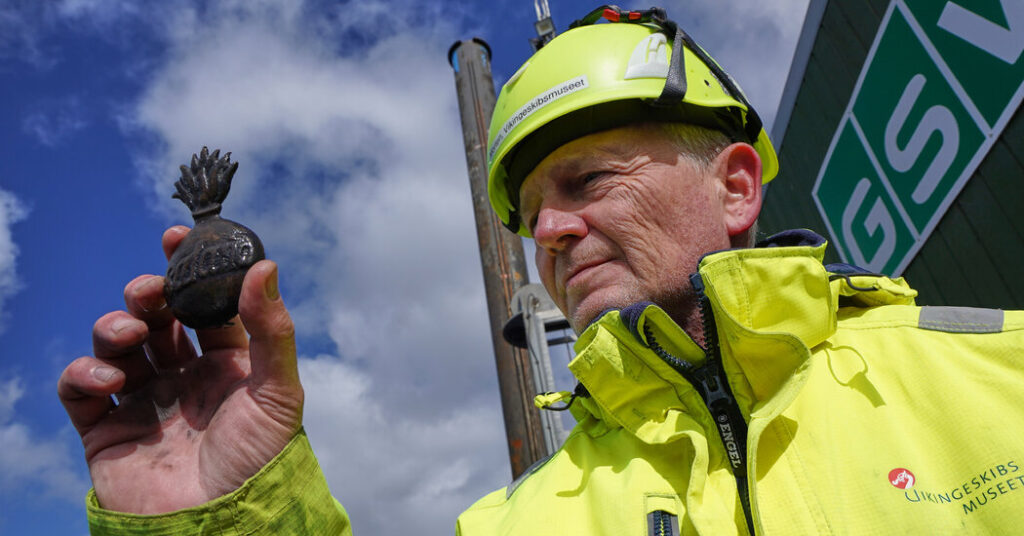
A Danish warship that Admiral Horatio Nelson and the British naval fleet sank in the Battle of Copenhagen more than 200 years ago has been discovered, Denmark’s Viking Ship Museum said on Thursday.
The museum announced the discovery exactly 225 years to the day after the battle, saying it had discovered the wreckage of the Dannebroge at the bottom of the Copenhagen harbor. The wreckage was identified by its ballast and its timber.
Museum officials said the discovery of the wreckage gives added resonance to a pivotal moment in Danish history.
“The defending of the Battle of Copenhagen becomes a heroes’ story,” said Morten Johansen, the museum’s head of maritime archaeology.
In Britain, the battle is remembered as one of Lord Nelson’s great victories. It also entered the history books for another reason: it’s believed to be the origin of the saying “to turn a blind eye.”
On April 2, 1801, a heavily armed British naval fleet sailed close to the Danish capital. During the Napoleonic Wars, Britain, already at war with France, saw the alliance between Denmark, Sweden, Prussia and Russia as an anti-British pact that could threaten supplies from the Baltic. In an act of aggression, British ships sailed to try to break up the alliance.
Outgunned, the Danish fleet lined up to create a “floating fortress” of so-called blockships, stripped of rigging but heavy with cannons, just outside Copenhagen’s harbor, the Danish museum said. The Danes could do little but hold the line, with 833 guns against the 1,270 carried by the British fleet. Fisherman and artisans joined the fight with only a few hours training, fearing that Danish sovereignty was at stake.
The British fleet pummeled the Danish line. Admiral Nelson homed in on the Dannebroge as his primary target.
The ship, with a crew of approximately 375 men, was at the center of Denmark’s defense, and it carried the Danish commander, Olfert Fischer. Two British ships continued to fire at the Dannebroge, quickly wiping out its upper deck and setting the vessel ablaze. Other ships in the line were also wrecked.
Still, the Danish line managed to inflict some damage on the British fleet.
During the Battle of Copenhagen, Admiral Nelson was second in command to Admiral Sir Hyde Parker, who took a more cautious approach.
Fearing Britain was suffering too many casualties, Admiral Parker issued a signal with the order to withdraw, but Admiral Nelson ignored him. According to battle lore, Admiral Nelson raised a telescope to his blind eye and said, “I see no signal.” Today, that moment is believed to be the origin of the phrase, “to turn a blind eye.”
About six hours into the battle, with a British victory in sight, Admiral Nelson sent a message to Crown Prince Frederik demanding his surrender. He warned that if the Danes failed to the accept defeat, the British fleet would set fire to the Danish ships with the sailors on board, according to the Viking Ship Museum. Denmark surrendered, and the Dannebroge, which was still aflame, sank shortly after.
Admiral Nelson was elevated to the status of a lord and is still celebrated as one of Britain’s greatest war heroes.
Denmark may have lost the battle, but in Danish history, the defense of Copenhagen was seen by the Danes as a something of a victory, said Mr. Johansen. Today, the site of the battle will form part of Lynetteholm, an artificial island off the city’s coast and one of the most ambitious construction projects in modern Danish history. The site will serve as a new residential area, but developers say it is also part of a new battle for Copenhagen, which faces rising tides resulting from climate change.
As part of the construction project, maritime archaeologists have been dispatched to excavate the seabed. When the digging began, the area, about 15 meters below the water’s surface, was covered by darkened harbor mud. “As soon as we moved, it would be a cloud of black in the water,” Mr. Johansen said.
Last year, the museum’s archaeologists discovered a medieval cargo ship, dating back to 600 years ago, whose large size showed the scale of Denmark’s medieval trade. The excavation will end in the next few weeks, and the island will be built over it.
The discovery of the Dannebroge has also shed light on the lives lost during the Battle of Copenhagen. Archaeologists discovered bone fragments, which scientists they could match to descendants today, Mr. Johansen said. They also found the “worn-out shoes of the cannoneers,” but fewer boots that would have belonged to officers.
“That tells us there were a lot more casualties among the privates, the normal sailors,” he said.
Bringing the ship up to the surface will be impossible, he said. About 50 years after the battle, and after Copenhagen had been rebuilt, harbor authorities broke the ship up so that it would not be an obstruction in the busy, peacetime port.
Lynsey Chutel is a Times reporter based in London who covers breaking news in Africa, the Middle East and Europe.
The post Danish Warship Sunk by Britain’s Lord Nelson 225 Years Ago Is Found appeared first on New York Times.