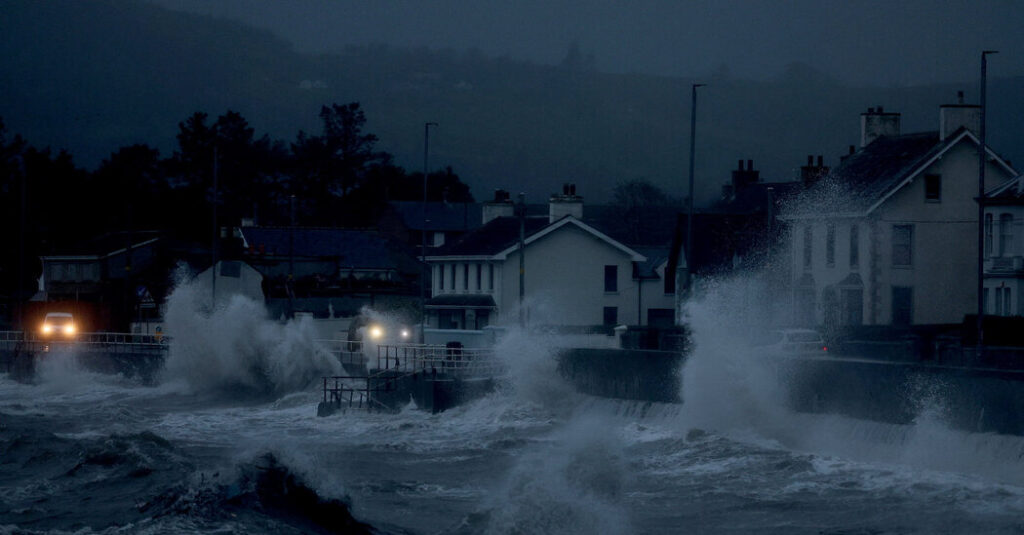
In the coming days, Dave is set to make a mess of things in Britain.
The storm, which was given its name by the Met Office, the United Kingdom’s weather service, is predicted to bring snow and very strong winds to the north of the United Kingdom over the weekend.
The weather system’s name has generated outsize attention in the United Kingdom and abroad.
“I do not want to be killed by storm Dave,” one person on Reddit wrote. “Classic Dave,” another wrote..
But how, exactly, do we end up with storms named Dave?
The name was carefully selected by the Met Office through a decade-old program in which the office solicits names from the public. Dave was submitted, the service said, by a spouse who wanted to honor “my beloved husband who can snore three times louder than any storm!”
Around the world, naming storms is generally a meticulous process, elevating names that are simple, memorable and easy to say.
Those objectives, however, can be complicated by a mishmash of rules, regional differences and language barriers.
How do storms get their names?
In the United States, only hurricanes and tropical storms receive official names.
For Atlantic hurricanes, a list is assembled by meteorological services across North America and the Caribbean at an annual gathering.
The list, which is maintained by the World Meteorological Organization, contains men’s and women’s names, which are reused every six years.
Elsewhere, the public is asked to help, like in the United Kingdom, which often leads to suggestions for names of family members, local heroes and pets.
This year, the most popular “I” name submitted was Isla, and included “many submissions about little girls who leave chaos in their wake,” the Met Office said.
The name Oscar is also set to be used for a storm this year, in honor of a cat described as “a good boy, but crazy when he gets the zoomies,” the office said.
The public’s suggestions are winnowed down by Met Office employees, who then produce a list that is shared with the Irish and Dutch weather services, who add their own names, said Andrea Bishop, a spokeswoman for the Met Office.
How do other countries name storms?
In Asia, the naming process is particularly complex.
In the Northwest Pacific, 14 countries including China, Japan, Thailand, Malaysia and the United States contribute to a list of names that are assigned to storms by the Japanese Meteorological Agency.
The list is made up of words from Asian languages, mostly names of flowers, animals, trees and foods. It’s not uncommon for a country to be hit by a typhoon with a name in a language not spoken by the locals.
The Philippines, however, declines to use the regional names and names typhoons itself. Hong Kong uses a numbered system in tandem with the names to indicate a storm’s strength and how close it is.
Different regions in Europe have their own systems. Countries including Spain, Portugal, France, Belgium and Luxembourg work together to name storms, with an ear toward words that can be easily pronounced across languages, said Rubén del Campo, a meteorologist and spokesman for Spain’s national weather service. For consistency, storms generally keep their names no matter where they travel.
Ensuring that names work well across borders was a lesson learned during Storm Jorge (pronounced Hor-hay) in 2020, which was named by the Spanish but also hit the United Kingdom, where it was difficult for some to pronounce and caused confusion, Mr. del Campo said.
“That name was removed,” he said. “In recent years, they’ve been easier, more or less.”
Why do we name storms?
Before naming storms became widespread, they were given cumbersome labels based on latitude and longitude or Greek letters.
In the late 19th Century, Clement Wragge, an Australian forecaster, began giving proper names to tropical cyclones, including the names of political figures he disliked. In the 1950s, the U.S. Weather Bureau, the federal agency for forecasting weather that later became the National Weather Service, adopted a system that used women’s names for storms. In the 1970s it included men’s names as well.
The naming method had advantages over older methods, chiefly that proper names are easier to understand and remember.
“What might seem as something quite simple, and to some a gimmick, can actually make a big difference in helping communities stay safe,” said Ms. Bishop, of the Met Office.
Are there rules around what names can be used?
Yes, lots.
Most countries try to choose names that are short. They should also be easy to pronounce and not used in other regions, according to guidelines from the World Meteorological Organization.
In the United States, names that begin with Q, U, X, Y and Z are not used because there are few options and because they are not easily understood in some languages, according to the National Oceanic and Atmospheric Administration.
The World Meteorological Organization stresses that storms on their list are never named after an actual person. In the United Kingdom, names of famous people or politicians are avoided, Ms. Bishop said.
Names are also retired if they are associated with particularly damaging storms. Retired names in the Atlantic include Irma and Maria, which stuck the Caribbean in 2017; Sandy, which barreled up the East Coast of the United States in 2012; and Katrina, which devastated the southern United States, particularly New Orleans, in 2005.
Can I have a storm named after me?
Maybe.
The United Kingdom, Ireland and the Netherlands take suggestions using this form. But the World Meteorological Organization, which maintains the storm name list for the United States, does not have a similar system. The same goes for most other countries.
You can, however, put your name on a high- or low-pressure system — for a cost.
The Free University of Berlin has an “Adopt-a-Vortex” program where people can pay about 290 euros (or around $345) to have their name attached to one of the weather systems.
The funds are used to finance student weather monitoring programs and the names are used in weather reports by the German Weather Service.
Jonathan Wolfe is a Times reporter based in London, covering breaking news.
The post Storm Dave Cometh. But Why Is It Called That? appeared first on New York Times.