The premiere of the new Danish series “Generations” this week (on MHz Choice) is a reminder that Denmark, with a population that is less than 2 percent that of the United States, punches well above its weight when it comes to television drama.
The markers of Danish shows include a focus on nature, chic but practical clothing, introversion, racial homogeneity, a love of choral singing and bicycles, so many bicycles; the hallmarks also include rigorous plotting (even when the story lines are supernatural or luridly sensational) and attention to the nuances of their characters’ psychologies.
At a time when Denmark and the current leadership of the United States find themselves at odds, it is worth noting that Denmark has a single, publicly funded broadcaster, DR, which produced each of the four shows featured here. It’s as if PBS had produced “Twin Peaks,” “The Wire,” “The West Wing” and “This Is Us.”
Here, in reverse chronological order, are some highlights from the Danish catalog.
‘Generations’
The uniformly prickly members of a Danish family, from matriarch to great-grandchildren, navigate secrets and lies — lots and lots of secrets and lies — while nature goes haywire all around them: Birds drop from the sky, mysterious spirals appear in the landscape and Covid-19 begins to shut down the country. (The series, broadcast last year in Denmark, is set in 2020.)
This solemnly loopy, handsomely produced, very Scandinavian mix of family melodrama and ecological-spiritual spook show focuses on the travails of the aging head of the clan and her daughter and granddaughters. Many of the story elements are family-soap standards: a risky pregnancy, a one-sided open marriage, a drunken night that leads to sexual shaming.
But the great-grandmother, Martha (Ulla Henningsen), does them all one better. When the body of a newborn child is found stashed in the attic of her apartment building, she calmly invites the police in for coffee and confesses to having killed the baby. The other plot strands weave around this central mystery — did she do it and if so, why? — which pulls in all the generations and sets them against one another.
The show goes silly toward the end, when the supernatural elements are ramped up. But Anette Stovelbaek, as the daughter; Rikke Eberhardt Isen and Alice Bier Zanden, as granddaughters; and Henningsen (who was in the cast of the venerable Danish TV drama “Matador”), as the dreamy but gimlet-eyed matriarch, are all excellent. (Streaming on MHz Choice.)
If you like “Generations”: “Seaside Hotel” is a crowd-pleasing, postcard dramedy set at a hotel on the Skagerrak channel from the late 1920s through World War II, and one of the most popular TV shows in Denmark through its 10 seasons. (Streaming on PBS.org.)
‘Borgen’
This smart political melodrama premiered in 2010, four years after “The West Wing” ended and three years before “House of Cards” began. It sat between those shows in its portrayal of the political process, as well — idealistic, but without the Camelot optimism of “The West Wing”; pragmatic, but without the cynicism and sensationalism of “House of Cards.”
The series centers on the pragmatic idealist Birgitte Nyborg (Sidse Babett Knudsen), the leader of a small centrist party who bluffs and brokers her way into becoming Denmark’s first female prime minister. (She preceded the actual holder of that distinction, Helle Thorning-Schmidt, by a year.) Across four seasons — the last came in 2022, after a nine-year hiatus — Nyborg’s fortunes rise and fall; she becomes a hardened political operator without completely shedding her principles.
“Borgen” can be didactic to a slightly annoying degree — a continuing primer on parliamentary democracy is sprinkled into the story. But there’s enough sex, death, ambition and avarice to keep things percolating. In the final season, Nyborg is serving as foreign minister when oil is discovered in Greenland, and she represents Denmark in negotiations over how to exploit this new resource. The United States is a player in the story — at one point American fighters roar overhead while Nyborg tries to give a speech — but so are Russia and China, and no one is threatening to take over, which seems quaint at this point. (Streaming on Netflix.)
If you like “Borgen”: In “Dicte,” the Danish star Iben Hjejle (“High Fidelity”) plays a divorced crime reporter who returns to Aarhus, her hometown. (Streaming on Viaplay at Amazon Prime Video.)
‘The Killing’
Titled “Forbrydelsen,” or “The Crime,” when it premiered in Denmark in 2007, this icily addictive mystery was renamed “The Killing” when it was shown in Britain four years later and became a national obsession. The Danish original never had a major impact in the United States, but its U.S. remake, also called “The Killing,” was briefly a hit. Together they helped move Nordic noir, which had been known primarily as a literary genre, into the mainstream of American movies and TV.
The indispensable Danish actress Sofie Grabol stars as Sarah Lund, the testy, taciturn police inspector who is about to retire and move to Sweden when she takes on the case of a missing young woman. The ensuing investigation plays out as a largely conventional crime drama, but with a grim tension and a virtuosic deployment of plot twists that, if you are susceptible to the style, will keep you wholly absorbed over its 20 episodes.
Grabol, whose eyes radiate intelligence and skepticism — she’s as expressive when she’s silent as she is when speaking, perhaps more so — generates considerable sympathy for the quietly obsessive Lund. (The detective’s practical, shapeless Faroe Island sweaters, which became a cult object among fans, also helped to define her.) In the initial story line, Grabol is nicely partnered by Soren Malling as the more demonstrative Inspector Jan Meyer; Malling would go on to play a tenacious news director in “Borgen.”
The two subsequent seasons of “Forbrydelsen” (each 10 episodes long) are more topical and less thrilling, though Grabol is still a pleasure to watch. (Streaming at MHz Choice. Also available at the library-linked sites Hoopla and Kanopy.)
If you like “The Killing”: In the overstuffed category of Nordic noir, the other landmark Danish series (actually a Danish-Swedish co-production) is “The Bridge,” which also features a high-intensity female cop, Saga Noren, played by Sofia Helin. (Streaming on MHz Choice and Amazon Prime Video.)
‘The Kingdom’
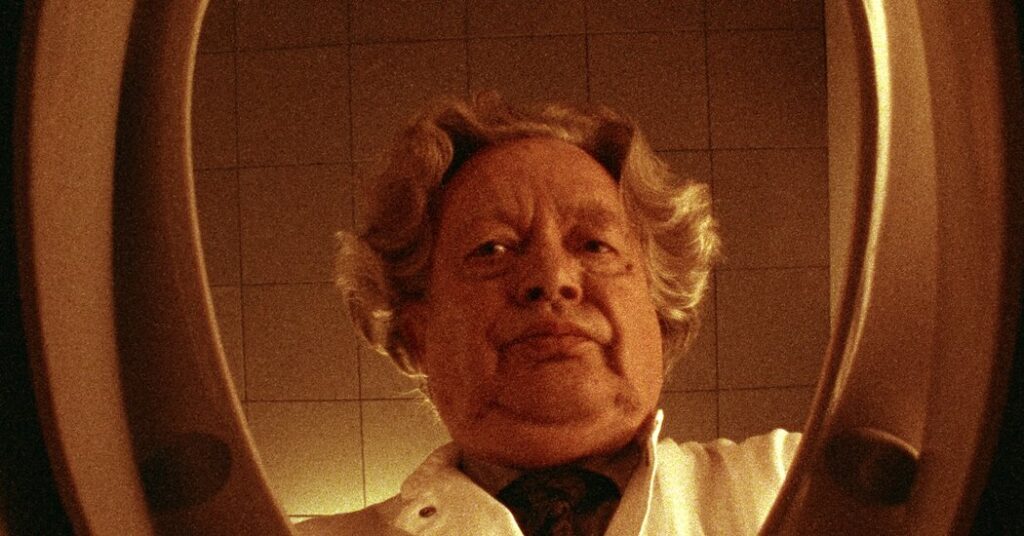
Lars von Trier the entertainer holds his own against Lars von Trier the provocateur and lecturer in this comic-supernatural gloss on a hospital drama, which premiered in 1994, two years before his film breakthrough with “Breaking the Waves.” Created by von Trier and Tomas Gislason, it remains the only TV series von Trier was fully involved with; he is credited as a writer and director on all 13 episodes across three seasons. (There was a 25-year gap before the third season, “Kingdom: Exodus,” in 2022.)
“St. Elsewhere,” also set in a big, crumbling city hospital, had run for six seasons in the 1980s, but the series von Trier copped to as an influence was “Twin Peaks.” The specters in “The Kingdom” — a nickname for the actual Copenhagen hospital where the show is set — come not from the subconscious but from the land, and from history. The doctors in residence have turned their backs on the ancient ways, with predictably eerie results.
“The Kingdom” does not approach, and does not really aspire to, the languorous, lacerating terror of “Twin Peaks.” It is a showcase for von Trier’s sardonic, raucous sense of humor, which is trained on the arrogance, self-absorption and eccentricity of the staff; that comic sensibility is what is lacking in Stephen King’s 2004 American adaptation, “Kingdom Hospital.”
Ambulances pull up to the emergency ward but disappear before unloading any patients. A ghost impregnates a surgeon. In one of the furthest, and funniest, departures from hospital-drama norms, a pair of dishwashers with Down syndrome and ghostly inside knowledge discuss the activities of the spirits and doctors, cheerfully serving as audience surrogates. (Streaming on Mubi and Amazon Prime Video.)
If you like “The Kingdom”: Another Danish director with a bad-boy reputation, Nicolas Winding Refn, made the mini-series “Copenhagen Cowboy,” about a young woman with psychic powers prowling the dicier precincts of Copenhagen. (Streaming on Netflix.)
Mike Hale is a television critic for The Times. He also writes about online video, film and media.
The post Danish Shows to Watch While We’re Still at Peace appeared first on New York Times.