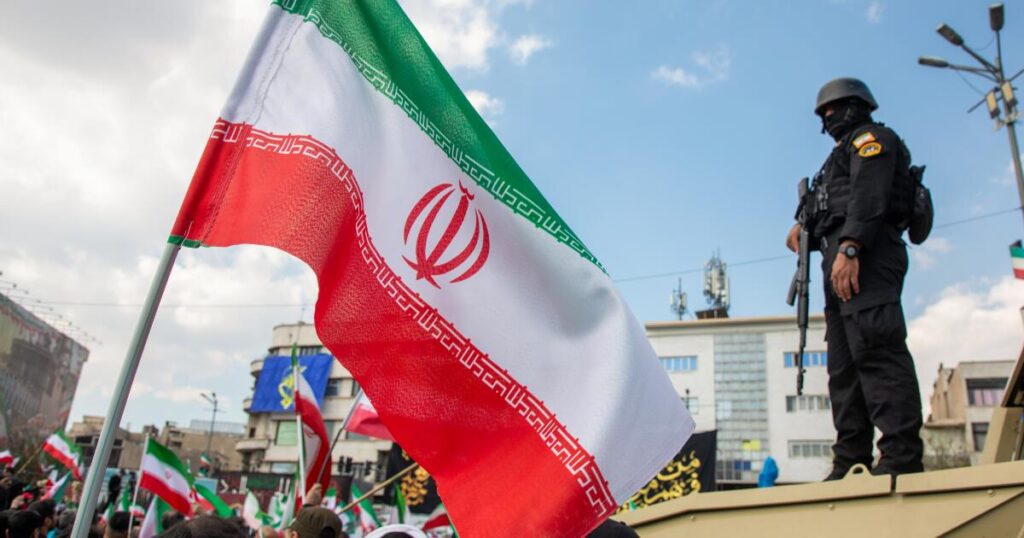
A month into the Iran war, the United States has offered a 15-point plan to end the hostilities, which includes a broad range of demands on Iran’s nuclear and missile programs, and guarantees on freedom of navigation in the Strait of Hormuz. The U.S. is also insisting on Iranian commitments to stop funding and supporting its network of proxies, including Hezbollah, Hamas and Houthi militants in Yemen, recognizing that these terrorist groups have been one of the major driving forces behind the chaos that currently exists in the region.
While the U.S. is right to press Tehran hard on the proxy front, they should minimize expectations that this decades-long problem will be solved in the near term.
First, don’t count on Iran agreeing to the U.S. conditions. During his 37-year reign, the late Ayatollah Ali Khamenei made it one of his highest priorities to build and strengthen Iran-backed militias and terrorist groups that could extend the regime’s influence and project its power across the Middle East. That legacy is likely to outlive Khamenei. Furthermore, while these proxies still rely on Iranian support, particularly Hezbollah, they have also all developed their own global, independent terrorist, procurement, financial and logistical networks. The threat these groups pose to both the region and beyond is unlikely to disappear regardless of how the Iran war ends — and the U.S. and its partners should be prepared.
Consider Hezbollah, Iran’s most loyal and longest operating partner. Over the decades, Hezbollah developed terrorist networks and infrastructure around the world that operates independently of Iran. Hezbollah terrorist activity has been uncovered and disrupted in Cyprus, Peru, Colombia, Thailand, London and the U.S., among many other locales — demonstrating its threat well beyond the Middle East. And while Hamas has never carried out a successful terrorist attack outside of Israel, the West Bank or Gaza, recent criminal cases in Germany and Denmark reveal that Hamas had contingency plans prior to the Oct. 7 attacks for strikes in Europe, stashing small arms for its operatives in multiple European countries. This is a dangerous trend well worth watching.
Hezbollah and the Houthis have also established their own robust international procurement networks to obtain cutting edge communications, electronics and other dual-use and weapons technology. All this has been critical for building Hezbollah’s and the Houthis’ own drone forces — which are now central to their battle plans. To disguise their hands, both Hezbollah and the Houthis have created numerous front companies, run by individuals without known ties to the groups. These fronts have been particularly active in China and the United Arab Emirates, though they have also sourced supplies from Europe, elsewhere in Asia and even the U.S.
In some cases, the sellers are well aware of who they are dealing with and are willing to help evade detection. For example, two Chinese companies sanctioned by the U.S. Treasury Department in 2025 — Hubei Chica Industrial Co. and Shenzhen Shengnan Trading Co. — allegedly helped the Houthis falsify shipping documents to facilitate the transactions. According to the Treasury Department, Hubei supplied the Houthis with “bulk quantities of chemical precursors” for “ballistic missiles, explosives, and other advanced weapon systems,” while Shenzhen Shengnan provided electronic equipment used in drones.
This past summer, European authorities disrupted a large-scale Hezbollah procurement network operating in Spain, Germany, France and the U.K. According to media reports, front companies linked to Hezbollah were obtaining drone components (including engines, chemical compounds and electronic systems) for use in targeting Israel. Criminal charges were brought against suspects in all four countries.
Hezbollah, Hamas and the Houthis all can raise funds independently of Iran. For the last several years, the Houthis have found a surprising new profit center: selling weapons to Al Shabab, the Al Qaeda-linked terrorist group in Somalia. This partnership not only demonstrates the Houthis’ fundraising creativity but their apparent surplus of weapons in Yemen. The Houthis also tax and extort money from the local population and engage in smuggling and other means of raising funds.
Hamas has an even more extensive overseas financial infrastructure. Hamas has established so-called charities and other nongovernmental organizations to raise its funds. Europe has been a particular hotbed for this type of Hamas activity, according to the Israeli government. The U.S. estimated that Hamas was raising $10 million a month from these sham charities in the lead-up to the Oct. 7 attacks, rivaling what it received from Iran. Given Hamas’ successful Gaza fundraising campaigns post-Oct. 7, these figures may well have even increased since the attacks.
While Hezbollah relies far more on Iran for its funding than Hamas and the Houthis do, the Lebanese militia also has its own fundraising mechanisms. Hezbollah has long-established networks in South America and West Africa that generate funding for the organization. This includes funding from licit and illicit businesses owned and operated by Hezbollah financiers and donations from supporters in the large expatriate communities throughout these regions. This funding alone would not sustain Hezbollah or let it rebuild from the Israeli attacks. But Hezbollah could likely call on these networks to generate more funding if Iran were unable or unwilling to sustain its past levels of resources.
Cutting the ties between Iran and its proxies would certainly be a major step forward, though the selection of the ayatollah’s hard-line son Mojtaba as the new supreme leader is a strong indication that Iran is not moving in a better direction.
But don’t assume that even if Iran cuts off its support, it would eliminate the threat. Even as it works to secure promises from Tehran, the U.S. should also press its partners around the world to maintain pressure on the proxies’ independent networks, particularly in the locales where Hezbollah, Hamas and the Houthis have been most active. If the international community fails to aggressively crack down on these networks, the late ayatollah might have the last laugh.
Michael Jacobson is a former director of strategy, plans and initiatives in the State Department’s Counterterrorism Bureau. Matthew Levitt is a former deputy assistant secretary for intelligence and analysis at the Treasury. They are senior fellows at the Washington Institute.
The post How Tehran’s proxy network could outlast the Iranian regime appeared first on Los Angeles Times.