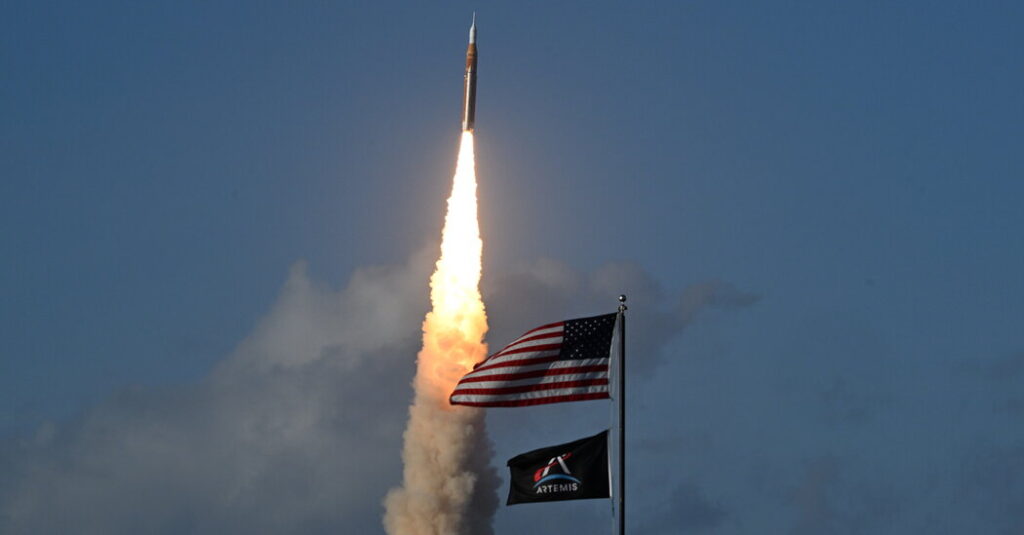
A towering orange-and-white NASA rocket blasted off from Florida on Wednesday evening, lifting four astronauts toward space and transporting spectators’ imaginations to a future in which Americans may again set foot on the moon.
As they did during the heyday of the Apollo program, which first put men on the lunar surface, spectators squeezed onto the beaches along Central Florida’s Space Coast. The crowds cheered when the powerful rocket launched into the clear sky at 6:35 p.m. Eastern time. It traveled eastward, over the Atlantic Ocean, on a journey that will take astronauts around the moon but not land there.
“We have a beautiful moonrise and we’re headed right at it,” said Reid Wiseman, the NASA astronaut who is the commander of the mission, as the crew headed into space.
Tens of thousands of excited spectators exclaimed and hugged along Cocoa Beach and surrounding communities as the rocket shot into the sky on a column of fire and a long white vapor trail.
“The contrast against the blue sky was absolutely remarkable,” said Anthony Rodriguez, 35, of Orlando. “It’s just an unforgettable sight.”
The flight aboard a spacecraft named Integrity is taking Mr. Wiseman, Victor Glover, Christina Koch and Jeremy Hansen on what is expected to be a round trip of more than 695,000 miles to clear a path for more exploration, a new lunar landing, eventually a sustained human presence on the moon, and journeys farther out into the solar system.
The last time astronauts traveled that far was Apollo 17, in December 1972.
“After a brief 54-year intermission, NASA is back in the business of sending astronauts to the moon,” Jared Isaacman, the NASA administrator, said during a news conference after the launch.
The mission, known as Artemis II, is the 21st century equivalent of Apollo 8, when NASA astronauts Frank Borman, James Lovell and William Anders captured the attention of the world. When they launched in December 1968, it was the first time that astronauts rode on top of the mighty Saturn V rocket.
For that mission, instead of just a short test flight around Earth, the space agency audaciously decided to send the crew all the way to the moon and back, the first time humans reached another celestial body.
While many were elated with the Artemis II mission and its progress, others shrugged or continued their Wednesday, oblivious to the countdown.
In New York City, Maxime Kryvian, 37, a business owner, came to Times Square to see if any screens were broadcasting the launch. To his surprise and disappointment, none of them were.
“I was expecting to see hundreds of people crowded around to watch the launch,” he said, listening to the broadcast through earphones as it played on his own phone screen.
Mr. Kryvian said people had lost interest in space exploration. “We’ve lost a sense of shared achievement,” he said. “We keep looking at our small screens instead of the big one.”
At Tom’s Watch Bar in downtown Houston — also known as Space City and the home of NASA’s mission control for human spaceflight missions — locals were slowly packing in, but not to watch the Artemis II astronauts fly to the moon. Instead, they were looking forward to watching the Houston Rockets later in the evening.
During the launch, most of the televisions in the sports bar were tuned in to a Yankees-Mariners baseball game. A couple of the smaller screens showed NASA’s live broadcast of the mission.
During the news conference, Mr. Isaacman said he thought that when the rocket lifted off, “a lot of people would be paying attention. I suspect when some of the imagery starts to maybe come back from the moon, that’s going to further bring people into this story.”
And at the beginning of his address to the nation on Wednesday night, President Trump congratulated NASA and the astronauts for the successful launch.
“It was quite something,” he said. “These are brave people.”
Mr. Trump then quickly changed the topic to the war with Iran.
Like Apollo 8, Artemis II aims to check that the spacecraft can safely make the journey and keep its crew alive during trips to and from the moon. This particular mission will conclude with a splashdown in the Pacific Ocean on April 10.
Unlike the Apollo astronauts, who were all white men, this mission sets a number of firsts: Mr. Glover of NASA will be the first Black man to venture into deep space and Ms. Koch of NASA will be the first woman to do so. Mr. Hansen of the Canadian Space Agency will be the first person on a moon mission who is not an American.
Prime Minister Mark Carney of Canada spoke with Mr. Hansen in a video call before the launch. “It fills me with pride, but it also sends a real message to Canadians,” Carney said in a clip posted on social media. Hansen added, “The fact we’ll be the second country in the world to send a human into deep space says a lot.”
In the 1960s, NASA was racing to beat the Soviet Union to the moon. This time, it does not want to fall behind the space ambitions of China, which is aiming to land its astronauts on the moon by the end of 2030. But the goal is not to win the sprint. It is to establish a continuing presence on the lunar surface, building an outpost over the next decade.
Mr. Isaacman, a billionaire entrepreneur who became the NASA administrator in December, has made major revisions to the Artemis program and rallied a work force that was battered by uncertainty and downsizing last year to focus on putting new footprints on the moon by the end of 2028.
“It’s the opening act,” Mr. Isaacman said of Artemis II, and the lessons learned from this mission will be applied to the ones that follow.
During the countdown, leaks of helium and hydrogen that scuttled plans to launch in February and March did not recur. But other technical glitches did pop up.
First, engineers resolved a problem with the rocket’s flight termination system, which destroys the rocket in the event that the crew capsule is ejected during flight. Then, late in the countdown, NASA said it was working on a problem with a battery in that crew capsule ejection system, but it concluded the problem lay with the sensor and not the battery itself.
Those issues pushed back liftoff by 11 minutes.
But then the engines ignited, lifted upward the 322-foot-tall rocket, weighing 5.75 million pounds, generating a low, loud rumble that rolled across East Central Florida.
After liftoff, another technical glitch prevented mission controllers from hearing what the astronauts were saying even though the astronauts could hear the commands from the ground. Communications were restored after a few minutes.
There was also an undisclosed problem with the spacecraft’s toilet, prompting the crew to plan to use “backup waste management capabilities” until it could be resolved.
The first few hours in space were busy, with two firings of the upper stage of the rocket that placed the spacecraft in a large looping orbit that swung out more than 43,000 miles.
The Orion spacecraft separated from the upper stage of the rocket. Mr. Glover manually flew the spacecraft, nudging it close to the discarded stage. That mimicked the maneuvers that will be used during later missions for docking with lunar landers.
“That is a good-looking American flag,” Mr. Glover said after a maneuver brought the rocket stage with a painted flag on its side into view of the capsule’s docking camera.
On Thursday, Orion will fire its engines to push it on a path toward the moon. On Monday, it will reach the moon and swing around, passing over the far side. The astronauts will spend hours making observations of the lunar surface, including portions of the far side that have never been seen by human eyes before.
As it passes behind the moon, Artemis will set a distance record for the farthest that any humans have traveled from Earth: 252,799 miles, or 4,144 miles farther than the Apollo 13 astronauts traveled when they had to make an emergency return to Earth.
Although the mission seemed to be mostly going well so far, most of the mission still lies ahead. “We will hold our celebration until this crew is under parachutes and splashes down off the west coast of the United States,” Mr. Isaacman said.
Katrina Miller contributed reporting from Houston, Ashley Ahn and Stella Raine Chu from New York, Vjosa Isai from Toronto and Dan Simmons from Cocoa Beach, Fla.
Kenneth Chang, a science reporter at The Times, covers NASA and the solar system, and research closer to Earth.
The post Artemis II Successfully Kicks Off 10-Day Lunar Mission appeared first on New York Times.