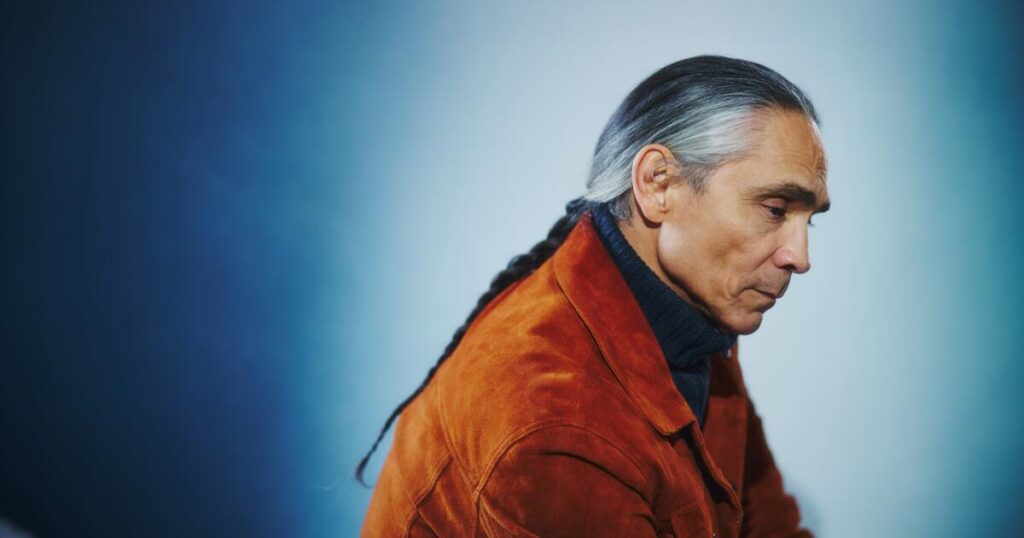
I started thinking seriously about Zahn McClarnon the moment I realized he was appearing simultaneously in two similar, yet dissimilar roles, as tribal police officers in both AMC’s “Dark Winds” and in “Reservation Dogs,” on FX. I had seen the actor before, to be sure, but I hadn’t extracted the player from the part, as it were, until then, playing variations on a Theme in Khaki — an Indigenous Gary Cooper in the former show, a period procedural set on a Navajo reservation; a Native Don Knotts in the latter, a community comedy based in Muscogee Nation territory in northeastern Oklahoma. More than a demonstration of the actor’s art, it felt like an act of magic.
At 59, McClarnon has ascended from guest parts to recurring roles (“Westworld,” “Longmire,” “The Red Road”) and, finally, with “Dark Winds,” which premiered in 2022, overlapping “Reservation Dogs,” to “No. 1 on the call sheet.” (Its Season 4 finale premieres Sunday.) He won’t call himself a leading man, but he has all the right qualities — good looks, poise, relatability — and in “Dark Winds,” as police Lt. Joe Leaphorn, he walks the laconic walk of a classic screen lawman. (“It’s all in the cowboy boots,” he’ll say.) Soft-spoken, private about his life, free with his thoughts, he can inform the most troubled or troubling character with a sweetness and dignity that seem his own — even Hanzee Dent, the complicated killer he played in the second season of “Fargo.”
“Seventeen, Robert, he took out 17 people,” McClarnon pointed out with a kind of pride, when I spoke to him recently over Zoom. (This tally did not hinder him from describing Hanzee as a hero.) He was in Santa Fe, N.M., on the last day of pre-production for the fifth season of “Dark Winds” — where he’s also producing and directing — with shooting beginning the next day. “It’s been pretty hectic the last couple of weeks,” he said.
Son of a Hunkpapa Lakota mother from the Standing Rock Sioux Reservation in North Dakota and an “Irishman” from Denver, Colo., who worked for the National Park Service, McClarnon moved around a lot as a kid but did much of his growing up in Browning, Mont., near the Blackfeet Indian Reservation, where his maternal grandparents lived. “It was a border town thing. Back in the ‘70s — as well as today — there’s racism. It was hard growing up having mixed ethnicity because I didn’t really fit into either one. ‘Where are you from?’ and ‘What tribe are you?’’ The other side was, like, ‘Are you Hispanic?’ ‘What are you, Vietnamese?’ I grew up with that fighting within myself — where do I belong?”
The family eventually landed in Omaha, Neb., where McClarnon graduated from high school. He was attracted to the arts without any sense of how he might be into them. “Carl Anderson who played Judas in the movie of ‘Jesus Christ Superstar’ had a big influence on me, just the way he sang and was able to express himself on film — seeing someone’s soul through that was a big inspiration, and I wanted to do the same thing,” he said. “I didn’t know how I was supposed to do that. I picked up the trumpet, the guitar in elementary school, I sort of lost interest in that; I didn’t have any discipline at the time, I was always searching for some way to express myself as a kid.”
He took drama in high school, just “to hang out with my friends. I thought it would be an easy A. It didn’t do much me for me — was very self-conscious at that age and had a very difficult time getting up in front of people — I still do. I really do. The drama teacher, Mrs. Peggy Stommes, wanted me to audition for plays and get up and do exercises and I kind of refused to, because I was so in my head.”
After high school, McClarnon moved to Phoenix, living with an aunt and attending a “refrigeration and electrical school, one of those cram-course, six-months trade schools you see advertised on TV.” Life as an apprentice electrician didn’t appeal in the end; he began visiting Los Angeles with friends, and finally stayed. “It was ’85 I think the first time I went there, ’86. You had the big music scene going on — Sunset Boulevard, Gazzari’s, the Rainbow, the Roxy. It was very attractive to me. So I ended up just kind of hanging out for a couple of years, having fun and doing what young men do.”
Moving back to Omaha in his early 20s, he was, “floundering” and “kind of looking for something to do” when, “on a whim,” he tried out for a community theater production of “Jesus Christ Superstar” (“my favorite musical”) in Council Bluffs, Iowa, just across the Missouri River. “I love this album, I love this play, I love the music, I know all the lyrics, I’m going to audition and see what happens,” McClarnon said, adding with a cackle, “I can’t sing. But I was hired as one of the apostles, kind of like a background extra.”
It was a transformative experience. “I felt part of a community. There was a purpose that I had during the day; I had to show up for rehearsal at a certain time,” he said. “But when we went live is when I caught the bug — there was a spark there. ‘Oh, this is fun.’ And then you get a standing ovation, the adulation of people standing and clapping for you. It was a turn-on for me, it really was.”
He visited a local talent agent, John Jackson, an actor himself who had returned to Omaha from Los Angeles. “I say, ‘Hey, I want to be an actor,’ and he looks at me and goes, ‘Do you have a picture?’ ‘No, I don’t have a picture.’ ‘Do you have a resume?’ ‘No, I never worked before.’ It started off badly.”
It got better. McClarnon booked some local commercials and suddenly, “I didn’t feel aimless; I had something to pursue, something I actually enjoyed.” “Dances With Wolves” was coming out “and I thought, ‘There’s possibly opportunities in Hollywood for Native actors — maybe I’ll go back to L.A. and see if I can pursue this thing.’”
Jackson connected him with an agent here, and once again McClarnon arrived without a resume or head shot. “They almost threw me out of the office, but they allowed me to read for them and said, ‘OK, we’re going to put you in the kids department’ — I could still play under 18. I got a couple of interviews — people were interested, I’m assuming just because of the unique look I had,” he said. “There’s not a big pool of Native actors in Hollywood. So I started getting callbacks immediately. That’s when the agency said, ‘We’re going to introduce you to the adult department, and I read for them and she really really liked what I did — her name is P.J. Jordan.”
McClarnon went silent for a several seconds. “Sorry. Sometimes talking about these people that started me in this business chokes me up a little bit.”
McClarnon joined other actors in a group called the American Indian Registry for the Performing Arts, where casting agents would come to find Native talent. Through the 1990s and the first decade of this century, he was “working as a young actor in Hollywood, booking major guest star roles on major network television shows,” including “Baywatch,” “Walker, Texas Ranger,” “Dr. Quinn, Medicine Woman,” “NYPD Blue,” “Chicago Hope,” “Medium” and “Castle.” “But in between those jobs I started studying with different teachers, and I fell in love with acting, with the process — sitting in a classroom and doing characters that were non-Native, the discipline of becoming an actor, learning lines, being able to play these parts and getting outside of who Zahn was,” he added.
From 2012 to 2017, McClarnon had a significant recurring role as Cheyenne reservation police Lt. Mathias on A&E’s new western procedural “Longmire.” “Reservation Dogs” and “Dark Winds” put him back in uniform a few years later. “Reservation Dogs’ co-creator and showrunner Sterlin Harjo had him originally tapped for a different character, Uncle Brownie, ultimately played by Gary Farmer, before “things got switched around” and he took the part of Big, the town’s semi-competent, dreamy police presence, obsessed with conspiracies and Bigfoot.
With Big and Joe Leaphorn going about their police business at the same time — quantum-entangled at a distance, one might say — “I was definitely concerned about how I was going to pull this off — the audience not buying it, et cetera. But I think it turned out OK. The comedy versus the drama is the main thing; the freedom on ‘Reservation Dogs’ to improvise and go bigger than usual was important. Big was based more on characters I grew up around; Joe was based more on the character from the books [by Tony Hillerman, on which “Dark Winds’ is based], that foundation was already laid out … In the end I think that all three, Mathias, Big and Joe have similar values, especially regarding their culture.” He added, “People joked about it — ‘You’re in a cop uniform again.’ But I think those characters are very distinct.”
I told McClarnon that perhaps my favorite thing about “Dark Winds” are the domestic details, the ordinary life the series portrays apart from the thriller.
“I’m so happy that you see that in the show,” he responded. “That’s definitely the positive thing, the peak thing, that audiences are seeing Native people as regular people; I think the heart of the show is that relationship between Joe and Emma [Joe’s wife, played by Deanna Taushi Allison]. We’re in an awesome time for Native representation, we’re finally telling some of these stories, breaking those stereotypes and humanizing and normalizing a culture, [showing] the humor in the community, the traditions. It’s allowing young Native kids to see themselves in a nonstereotypical way that might inspire them to pursue their dreams and goals. It can lead to more people getting involved politically, economically, environmentally. I don’t carry it around like a backpack or anything like that, but all that stuff’s important to me.”
How is it, I asked, becoming a leading man in your mid-50s?
“I never considered myself a leading man,” he replied. “I don’t really consider myself a star. I’m very grateful, though, to be in the position I’m in, especially at this time of my life, and with the state of television and the film business right now; it’s good to be employed, and I really take that responsibility seriously … and putting everything I can into my work. …
“But I think any profession I would have chosen, I would have done the same. My father instilled those values in me. I watched” — and McClarnon goes silent as he chokes up again. “Sorry, I have long days, sometimes I get emotional, especially talking about my pops. I watched him start out as a trash truck driver for the National Park Service and work himself up to a fairly high position in the federal government over 40 years; that definitely inspired me; the underlying foundation of wanting to pursue something in the arts fundamentally was wanting my father to be proud of me. My father was an artist at heart.
“I’m glad this happened later in my life, I really am,” he said. “I don’t know that I would have handled it as well. We grow as individuals; I’m in a strong, stable part of my life and I feel good about myself.”
As to the future, “I’m an actor, and I certainly want to expand my horizons — I’m getting old in the tooth, you know. I don’t have a lot of time.”
The post Zahn McClarnon is No. 1 on the ‘Dark Winds’ call sheet, where he deserves to be appeared first on Los Angeles Times.