Molly didn’t want to go that way. The bushes were too thick, the slope was steep and a waterfall roared nearby. But her owner’s hand coaxed her to keep going on their hike in the New Zealand rainforest last week. Suddenly, with a cracking of branches, the hand was gone.
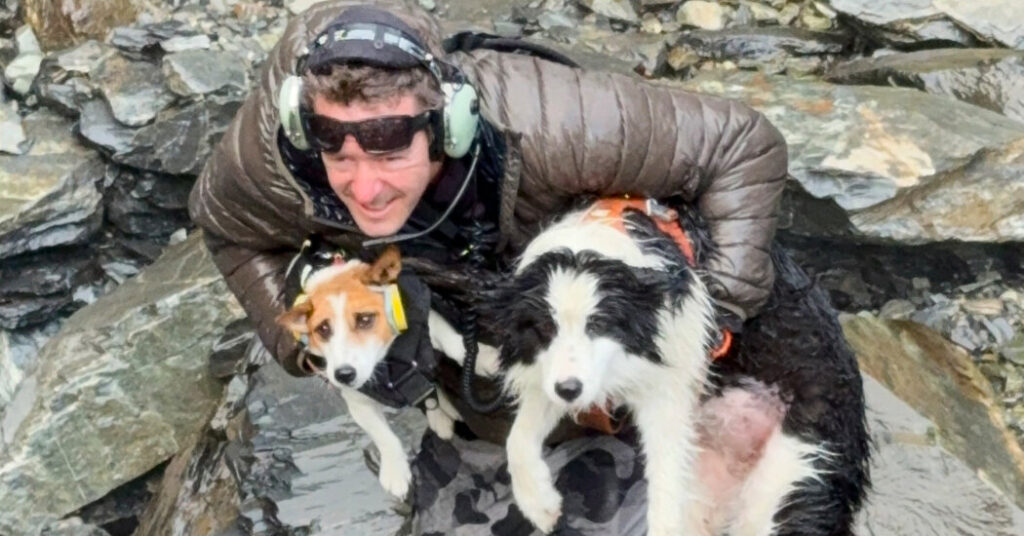
Seven days later, a helicopter crew, a thermal camera, 160 strangers in a fund-raising campaign and a Jack Russell terrier named Bingo had come together to return Molly, a black-and-white Border collie, to the hands of Jessica Johnston on Tuesday.
Ms. Johnston had been hiking with Molly in New Zealand’s South Island on a backcountry route in the Arahura Valley on March 24 when she slipped at the edge of a cliff and fell about 180 feet into the base of a waterfall, according to Lilly Newton, a helicopter pilot who helped rescue Molly.
Ms. Johnston floated 65 feet downstream before she could stop herself, scramble out of the water and press the button on her personal locator beacon. She was bruised and bleeding from head to toe, and her elbow was sliced open, though she did not break any bones.
However, while rescuers airlifted Ms. Johnston to safety, Molly was nowhere to be seen.
New Zealand’s emergency services focus on rescuing humans, often leaving animal rescue to others. This left Ms. Johnston with no immediate way to find Molly.
Ms. Newton, who runs a helicopter tour company with her parents near where Molly went missing, said she started thinking of ways to help after hearing about the pair from a volunteer rescuer who is a mutual friend with Ms. Johnston.
“If it were anywhere else, people would have just gone out on foot,” Ms. Newton, 28, said. “But because of where she was, it was going to be a multiday hike into some of the most gnarly terrain in the world.”
Ms. Newton said that her father, Matt Newton, flew a helicopter three separate times over the valley but did not see Molly. Still, Ms. Newton said she wanted to keep looking.
“I had a gut feeling that Molly was still alive,” she said.
But a search flight costs about $1,370. The small family business could not keep absorbing the bill, which was exacerbated by the global rise in fuel prices caused by the war in the Middle East.
She then turned to Facebook to ask for help and donations to support the rescue effort. In one day, about 160 people donated a total of about $6,600, Ms. Newton said. People called, offering to volunteer.
Two volunteers proved crucial. Georgina Du Val, 34, a thermal imaging specialist from Christchurch who is trained in veterinary nursing and flying helicopters, said she saw Ms. Newton’s post and thought of her own golden retriever, Tenzing.
Ms. Du Val drove more than four hours with her hand-held thermal camera to meet Ms. Johnston in Greymouth, about 35 miles north of where she had fallen and lost Molly.
“I said, ‘We’re going to do everything we can, use all the equipment we have to bring Molly back,” Ms. Du Val recalled telling Ms. Johnston. Ms. Du Val also said she tried not to express too much hope in a delicate situation. “I think she didn’t really want to think about the horrible possible outcome,” she said of Ms. Johnston.
A helicopter crewman involved with Land Search and Rescue, a volunteer organization in New Zealand, also joined the search after seeing the call for help on Facebook, Ms. Newton said. He brought his terrier, Bingo, reasoning that a frightened dog might respond more readily to another dog than to a human.
Rain kept them grounded for several days. Finally, at 8:20 a.m. on Tuesday, the two volunteers and Mr. Newton took off in an Airbus H120 while Ms. Newton coordinated from the base. The morning chill was better for thermal imaging, giving a sharper backdrop for spotting a warm body.
They found her in about 30 minutes, Ms. Newton said. Ms. Du Val was scanning the base of the waterfall with her thermal camera when a shape appeared on the screen.
The helicopter flew closer. “When we could see that it was her, we were all crying,” Ms. Du Val said.
Molly was soaking wet, shivering and sitting almost directly beneath the falls, near where Ms. Johnston had fallen a week before, Ms. Du Val said. They could not tell whether she fell down with her owner or found her own way there. They don’t know what she lived on — perhaps, Ms. Newton said, she hunted possums.
Mr. Newton hovered the helicopter over a ragged slab of rock, and the helicopter crewman climbed out with Bingo under one arm. He walked to Molly, gave her a piece of dog sausage, then picked her up and climbed back into the helicopter, Ms. Newton said.
Mr. Newton sent a message by satellite phone, Ms. Newton recalled: “‘We have found Molly.’”
Back at the base, Ms. Newton came outside when she heard helicopter’s rotors. She saw a small, furry shape in the back of the helicopter.
“I just couldn’t believe it,” she said. “I was so happy.”
Ms. Johnston, who arrived later, got out of her car and had to sit down because of the swell of emotions, Ms. Newton said
“She was all over her, wagging her tail,” Ms. Newton said. A vet later found that she was uninjured and healthy. “It was beautiful to see,” she added. “It all paid off.”
John Yoon is a Times reporter based in Seoul who covers breaking and trending news.
The post Volunteers in Helicopter Rescue Hiker’s Dog After a Week in the Wilderness appeared first on New York Times.