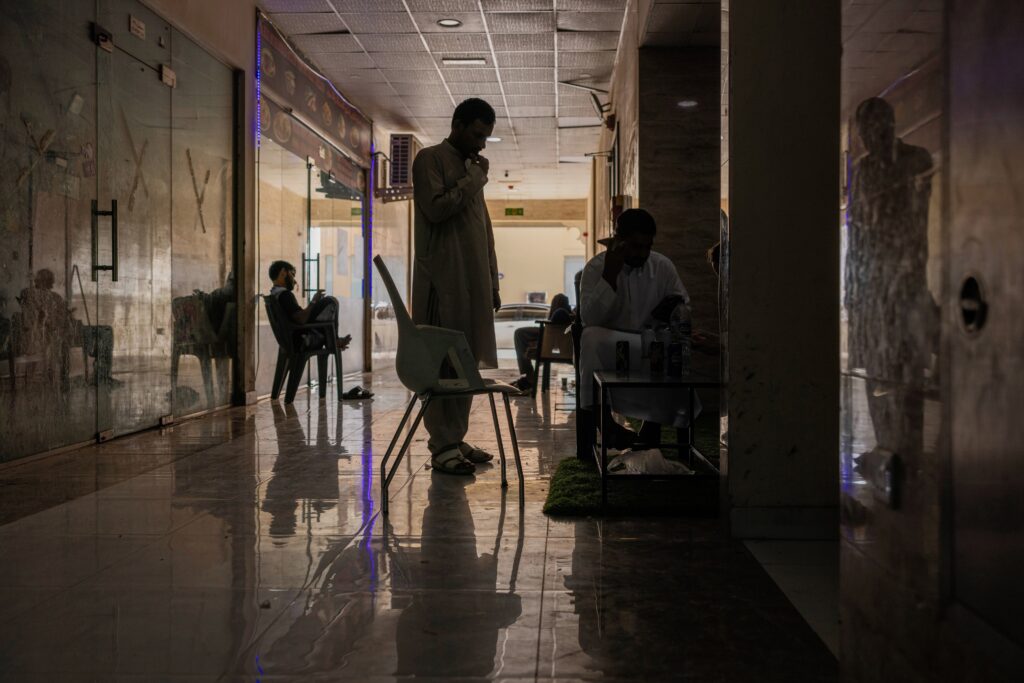
DUBAI — Muzaffar Ali Ghulam traveled here four years ago at the invitation of his cousin, hoping to build the house of his dreams back in Pakistan for his young family.
The 27-year-old worked 12-hour days as a driver in Dubai, sending most of his salary home to his wife and three children, said his cousin, Masood, who spoke on the condition that only his first name be used because of security concerns. When Iran started firing missiles and drones at the United Arab Emirates a month ago, Masood said, there was no discussion of fleeing Dubai. There was no way they could afford it.
Shrapnel from an Iranian strike hit Ghulam’s car March 7, Emirati officials said, killing him instantly.
“I miss him every day, and I still don’t believe he is gone,” Masood said in an interview in Al Lisaili, an area where the city gives way to desert and many migrant workers live. “Sometimes I think he is still here with us.”
Ghulam was one of more than a dozen civilians killed across the Persian Gulf since the United States and Israel began pummeling Iran with strikes Feb. 28 and Iran began retaliating by striking wealthy Gulf nations that for years had been heralded for their stability.
The majority of the deaths have been among migrant workers like Ghulam, whose labor has quietly turned cities such as Dubai into global business hubs — and who, in turn, have counted on the city to transform their prospects in their home countries.
As many of Dubai’s wealthier residents fled amid four weeks of strikes, those workers have remained. The war has increased visibility of the role they play in the city — and the precariousness they face, with their lives and jobs more at risk than those who can pay for a flight out or work from home.
In recent days across this city of 4 million, where streets have been unusually devoid of traffic and beach clubs are seeing a fraction of the usual crowds, a maintenance worker from Uganda watched as a drone streaked across the port area where he worked. An electrician from Ghana said he feared death when missile alerts went off — but mostly because of what it would mean for his family’s finances back home. An Egyptian waiter put on a smile at work each day, saying he hoped Dubai would remain the place that allowed him to build his dreams.
Sitting in the rundown shopping center in Al Lisaili, dozens of miles from Dubai’s gleaming skyscrapers, Ghulam’s friend, Ali, said that Ghulam had loved cricket and joking with his friends when he wasn’t working.
Mostly, he dreamed of what his kids might achieve, his cousin said, noting that his oldest daughter wanted to become a doctor. As Masood spoke, a shrill missile alert rang out from his phone. His light brown eyes were vacant as he looked at the screen, where a message warned the men to take shelter.
“I am scared,” he said, adding that he would consider going home, “but it is not possible.” He was still working to pay off a debt in Pakistan.
Masood said that he had been talking often with his sister, who was Ghulam’s wife. She was inconsolable, he said, unable to stop crying or to start eating, and still struggling to understand why her husband had died.
“We try very hard, but at the moment, we cannot comfort her,” he said.
In the market near Dubai Creek, the oldest part of the city, a group of young spice traders said they came from Afghanistan, Pakistan, India and Iran. They all shared the business, they explained, and usually made enough money to support their families back home.
Dubai, they said proudly, had been the type of city where such a melting pot was possible, where such business success was the norm. But Mohammad Anwar, 34, from Afghanistan, said that the war that President Donald Trump had launched now threatened all of their futures.
Anwar looked at the mostly empty shops and sidewalks and shook his head. “He needs to stop this thing and let us do business,” he said.
The spice traders said they were not scared and trusted the UAE government to protect them. Their main concern, the men said as they scanned the skies for planes overhead, was that the tourists return.
With the war a month old, Mohammed Shahbaz, 28, was worried about business. Shahbaz, from Pakistan, said he was used to making a good living in Dubai’s largest fish market, sending about half of his $500 monthly earnings home to his family.
“But now we don’t have money,” he said, looking at the sparse collection of kingfish in front of him — a fraction of the typical haul, much of which usually came from Iran. Since the U.S. and Israel started the war, trade between the two nations had stopped. The price of fish roughly doubled.
“War has brought too many problems,” Shahbaz said. “Everything is expensive — vegetables and fruit and meat and fish.” He added: “When the war finishes, everyone will be happy.”
Outside the fish market on a recent morning, Jibril Mukalaz, 30, who arrived in Dubai from Uganda six months before, was walking with his cart full of cleaning supplies. Mukalaz, soft-spoken, said he was terrified as he watched a drone fly across the fish market where he works as a cleaner and heard the booms of interceptions.
Mukalaz works 12-hour days for the equivalent of about $270 a month, sending about $55 home to his family and wishing he could send more. His contract is for two years, including housing, transportation and one ticket home when the contract ends. He doubts he’ll see his family before then, he said, because he cannot afford the flight.
When his wife and his mother call from Uganda, worried after watching the news, he said he tries to reassure them. But the truth, he said, is: “I was very scared. … I am very scared.”
“And I have no choice,” he said. “I have to stay.”
In the industrial Al Quoz neighborhood in Dubai where many migrant workers live, laundry hangs on clotheslines outside small apartments in low-rise buildings. Delivery drivers, office cleaners and restaurant workers chat in a mix of languages outside a roadside stall serving Afghan rotis fresh from the fire.
Frank Ankomah, 27, from Ghana, said that life has gotten easier over his three years here. He has adjusted to Dubai’s unbearably hot summers, he said, and is now able to send about half of his $500 monthly earnings as an electrician home to his parents and child.
When the war started, he said, he was not as scared for himself as he was for his family. “If I die, then my family would not have money,” he said. “If I went home, my family would not have money.”
As the sun set on a recent weeknight at African Queen, a beachside club in an upscale strip off Jumeirah Beach, most of the tables were empty. Patrice Gouty, the operations director, said that despite the financial challenges, he and the club’s investors had decided to keep paying all his staff. Many other bars and restaurants, he said, made a different choice, cutting staff as soon as the first drones and missiles hit.
Ahmad Mustafa, the head waiter, who came from Egypt 13 years ago, said that Dubai had allowed him to build the future he wanted, working in hospitality but also starting his own furniture business.
The missile alerts that at first alarmed him and customers quickly became routine, he said, and he was no longer scared. But he is nervous for Dubai’s future.
“It is our home,” said Mustafa, 37. “Whatever happens to Dubai happens to us.”
The post Migrant workers keep Dubai running but can’t afford to flee Iranian strikes appeared first on Washington Post.