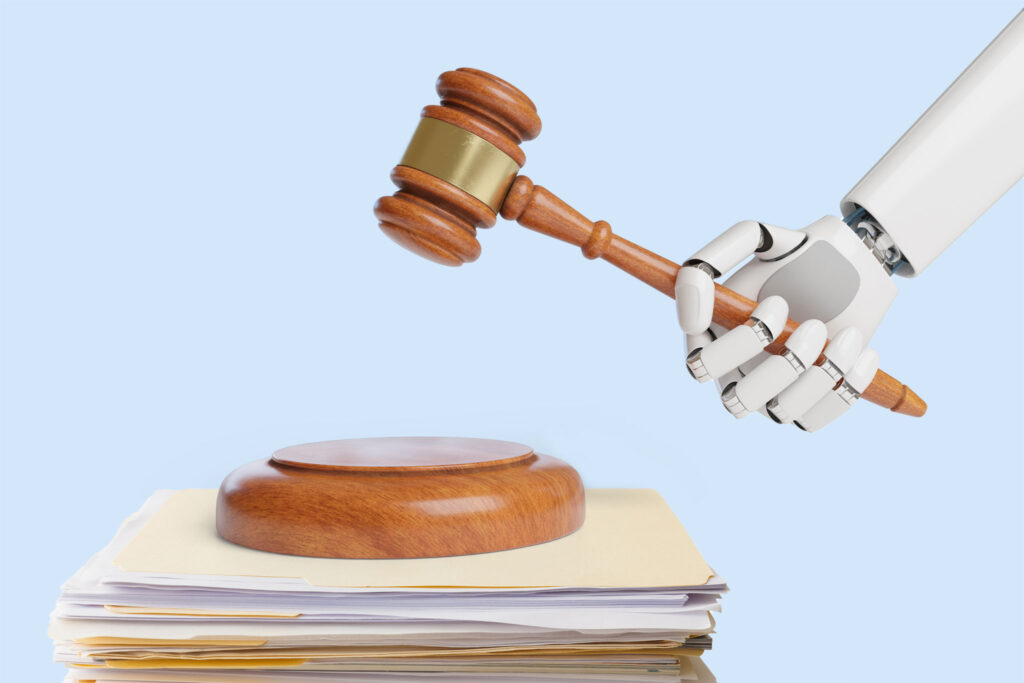
When Xavier Rodriguez, a Texas-based federal judge, prepares for a hearing, he usually begins by turning to artificial intelligence. He feeds the relevant court filings into an AI tool that quickly produces a timeline of the case and the claims that parties are making for him to review.
“My law clerks would be wasting 30, 45 minutes, an hour, developing a chronology of events,” Rodriguez told The Washington Post. “This thing does it instantaneously.”
Before a hearing, Rodriguez might also ask AI to suggest questions to ask an attorney or identify weaknesses in a plaintiff’s argument. In an area of law in which he feels particularly well-versed, Rodriguez sometimes — after deciding on his judgment — uses AI to draft the ruling he will issue.
“I’m doing my own preparation,” said Rodriguez, who has served for over 20 years in the U.S. District Court for the Western District of Texas. “I’m not strictly relying on an AI tool. … It’s just an extra set of eyes.”
AI use in court has made headlines for a stream of fabricated citations and other mistakes in filings that have embarrassed attorneys. But adoption of the tools among legal professionals now extends to the highest stewards of the judicial system. A Northwestern University study published this week, co-authored by Rodriguez, that surveyed 112 federal judges found more than 60 percent reported using one of a set of popular AI tools at least once in their judicial work. Around 22 percent of the judges said they used AI daily or weekly in their duties.
Courts are also pursuing partnerships with legal vendors developing AI tools for judicial work. The Los Angeles County Superior Court announced a pilot program in March with Learned Hand, a legal start-up that develops an AI tool for judges. Learned Hand’s AI is also being used in trial courts in 10 states and the Michigan Supreme Court, the company said. Legal research companies Thomson Reuters and LexisNexis have contracts to provide AI tools to the federal judiciary.
Judges say they’re aware of the risks, even as some experts worry that AI’s unreliability could compromise their authority.
“Judges, they’re responsible for making decisions that are very important to people and resolving disputes that are very significant,” said Eric Posner, a law professor at the University of Chicago. “They just can’t gamble with a technology that is not fully understood and that is known to hallucinate.”
The upside, proponents say, could be a more efficient judiciary better equipped to process heavy caseloads.
“We’re very cautious about this, obviously,” said Christopher Patterson, chief judge of Florida’s 14th Circuit Court. “We’re just trying to learn the AI tool — is this right for us, and is it accurate, and is it saving [time]?”
“I will tell you that the preliminary results are very positive,” Patterson added.
It is hard to determine exactly how many judges across the United States’ vast legal system are using AI in their duties. Not all AI use is disclosed publicly, and courts and judges have often decided on adoption on an individual basis.
“AI adoption is real, but it’s early,” said Michael Navin, a consultant at the National Center for State Courts who studies legal AI use. “I don’t get a sense that there’s an overwhelming use of AI by judges, but it is there.”
Judges who have been early adopters of AI said they employ the tools across their workflow, from reviewing a new case to drafting a final ruling. Samantha Jessner, a Los Angeles County Superior Court judge who is testing Learned Hand, said she uses its AI tool as a research aide.
“I may say to the tool, ‘I need to know what the controlling authorities are in California with regard to this subject,’” Jessner said. “If I need to know more about a particular area of law … you can interface with the tool and ask the tool pretty specific questions.”
Judges also said they used AI to analyze parties’ court filings to assess if claims are backed by law or identify areas for further inquiry. Most legal AI tools link directly to the laws or cases they cite, they said, allowing judges to look up the relevant laws and double-check the AI response.
“When we say, ‘Analyze the law based on these pleadings,’ it’ll come back and it’ll tell us, ‘Yes, this is supported good law,’ or ‘This is not good law,’” said Patterson, the Florida judge.
Rodriguez, from Texas federal court, raised the example of reviewing a motion for summary judgment, where a party asks a court to resolve a case before trial. Those motions can be accompanied by volumes of evidence, such as deposition transcripts, that can be time-consuming to sort through, he said.
“I’m uploading everything,” Rodriguez said, describing how he would use AI to begin reviewing a summary judgement request in a hypothetical age discrimination case. “And then I’ll ask, ‘Identify any potential statements made in this age discrimination case that appear discriminatory.’”
Jessner, Patterson and Rodriguez said they also use AI to assist in drafting rulings and orders. All the judges said that they do not rely on AI to decide how they will rule in case, but the tools can provide a starting point — not unlike a template that judges or clerks might use when writing routine orders — that they can then edit.
“If you’ve got a draft, then you can go back and you can plus it up with relevant facts and additional case law or findings that you want to make,” Patterson said. “That always reduces the time, as opposed to starting from scratch.”
Some judges and court administrators say the time saved by AI tools can be helpful for an overworked judiciary swamped by cases, especially in courts where judges don’t have a team of clerks to assist with research.
“Court filings continue to increase,” Patterson said. “We’ve got to find a way to meet that need in an ethical, responsible way.”
The stakes are high. Judges have not been immune to the AI-generated errors plaguing courtrooms. Hallucinations appeared last year in the court filings of two federal judges overseeing a federal securities class-action lawsuit and a challenge to the Mississippi education board’s educational policies. Henry T. Wingate of the Southern District of Mississippi and Julien Xavier Neals of the District of New Jersey’s filings included citations to nonexistent cases, false descriptions of a plaintiff’s allegations in their complaint and false quotes attributed to plaintiffs, which they attributed to a clerk and an intern using AI, The Post reported.
Attorneys alerted the judges to their mistakes, and they hastily corrected their filings. The Senate Judiciary Committee blasted the judges for their mistakes, and Neals instituted a written policy in his chambers prohibiting the use of generative AI in legal research or drafting court filings.
Developers of AI tools designed for the legal community say their models are less likely to hallucinate because they source answers from databases of court cases and other legal documents. Their reliability has still been challenged — a 2024 Stanford University study found that LexisNexis and Thomson Reuters’ legal AI tools were more reliable than general-purpose chatbots but still made mistakes in between 17 and 33 percent of queries.
LexisNexis and Thomson Reuters said in statements that their tools have improved significantly since the study and are designed to link back to cases in their answers so that users can verify the information they cite.
Some courts and judges stressed they were still evaluating the effectiveness of AI tools and would make decisions on further use as time progresses. The Los Angeles County Superior Court’s pilot program with Learned Hand will last a year and the tool’s use is limited for now to certain civil motions, the court said. Patterson, of Florida’s 14th Circuit Court, said his court was also treating its use of AI as a test run and is testing AI tools with both old and active cases.
There has been no suggestion, from courts or the legal vendors selling to them, of letting AI tools take over the role of judges.
“It’s the human oversight that we just can’t do away with,” Patterson said. “That’s the message that I’ve got to my judges, to my staff attorneys. Don’t let [AI] substitute your judgment for the tool’s judgment.”
“You can’t let that happen.”
The post Judges are increasingly using AI to draft rulings and prepare for hearings appeared first on Washington Post.