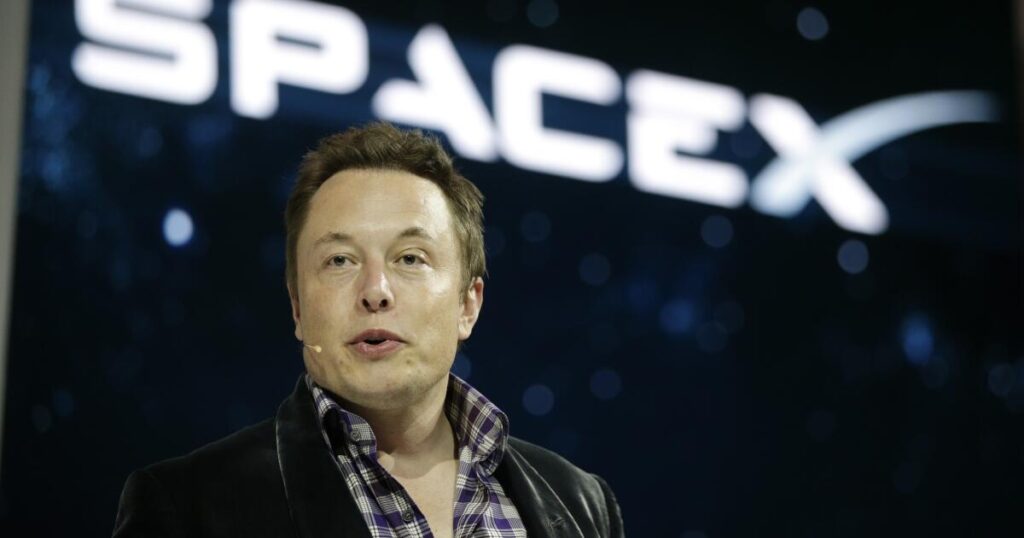
When the first American crew since 1972 orbits around the moon this month, SpaceX’s stylized logo will be nowhere to be found — but it might as well be plastered everywhere.
Elon Musk’s rocket company is preparing what is expected to be the largest initial public offering in history, and it has as much, if not more, riding on NASA’s Artemis program as Boeing and the other contractors that built the SLS rocket that will blast the astronauts into space and the Orion capsule carrying them on their mission — a fly-by of our closest celestial neighbor.
Radical changes announced in February by new NASA Administrator Jared Isaacman to speed up the country’s return to the moon could make the program more reliant on SpaceX on future launches.
That includes using its massive Starship rocket to ferry crews and construction materials to the moon, where Isaacman said NASA now plans to build a research and exploration station as it faces competition from a joint China-Russian team.
SpaceX, which maintains a large presence in Southern California’s burgeoning aerospace sector, is readying an initial public offering possibly for this summer that is expected to be the largest in history, perhaps raising as much as $75 billion. It follows Musk’s merging of his xAI artificial intelligence company into his rocket company in February.
The funds would help pay for Musk’s equally giant if quixotic plans: building his own Moonbase Alpha colony, manufacturing millions of driverless cars and robots, and putting artificial intelligence data centers into space, using satellites that use solar energy to do AI computations.
Here’s what to know about what this means for SpaceX, which has large operations in Hawthorne and launches its workhorse Falcon 9 rockets from Vandenberg Space Force Base in Santa Barbara County.
How important is it for SpaceX that NASA is returning American astronauts to the moon?
Wedbush analyst Dan Ives calls the Artemis launch a “watershed” event for the company, which he expects will be a leader in the new space economy where trillions will be spent on artificial intelligence, space infrastructure and related businesses.
“The moon ultimately represents the golden goose for Musk and SpaceX,” he said. “It’s a fourth industrial revolution and we just happen to live in it.”
What plans does SpaceX have for the moon?
Musk has long said that his life’s ambition is to colonize Mars, but in February the world’s richest man posted on X that his company first planned to build “a self-growing city on the Moon, as we can potentially achieve that in less than 10 years.”
What would be the purpose of such a city?
A moon outpost would solve some of the same technological challenges a Mars colony would face without the same level of cost and risk, given how much faster and less expensive it is to reach the moon. Musk also has sketched out a futuristic vision of building AI data centers on the moon with the help of the company’s Optimus robots and catapulting them into space.
Catapulting data centers into space from the moon sounds like science fiction. How is that even possible?
At a February presentation, Musk said that the lower gravity of the moon would allow the satellites to be shot into space using a magnetic accelerator — what he called a “mass driver” — radically reducing the cost compared with Earth launches, in which rockets expend tons of fuel to escape gravity. “I want to just live long enough to see the mass driver on the moon, because that’s going to be incredibly epic,” he said. That timeline doesn’t even consider that SpaceX has yet to launch a data center satellite from Earth.
How does this fit into NASA’s plans?
In March, Isaacman announced the government’s own highly ambitious plans to spend $20 billion to start building a sustained human presence on the moon within seven years. While the SLS rocket would still lift the Orion capsule into Earth’s orbit, Artemis could now rely on the Starship rocket, still in its testing and development phase, to dock with the capsule in Earth’s orbit and ferry astronauts to the moon, where it would land the crew and building materials. A spacecraft being developed by Jeff Bezos’ Blue Origin could serve as another moon lander given the vast payload needed for a moon colony. The first crewed mission to the moon’s surface is planned for 2028.
How does this tie in to SpaceX’s IPO?
SpaceX has confidentiality filed for an IPO expected later this year sources told Bloomberg on Wednesday. It could value the company at $1.75 trillion, which would allow it to sell just a fraction of its shares yet still raise more than twice as much as the current largest IPO on record: Saudi Aramco’s $29.4-billion oil-and-gas offering in 2019. Given its massive size, SpaceX is in talks with at least 21 banks to sell the securities to investors, Reuters reported.
The company has a massive need for capital if it is going to pull off Musk’s dreams, which he said rely on vast numbers of AI chips. In February, he announced the construction of a giant chip fabrication plant in Austin, Texas, because of a lack of supply from existing chipmakers.
How are financial markets reacting to Musk’s plans?
The IPO has drawn huge attention given its size and SpaceX’s prospects for growth.
“As an investor, I’m excited. As a human being, I’m excited. It’s just opening a whole different world, a universe, essentially, that we were not exposed to before. We went to the moon over 50 years ago, and that was it. Nothing has happened really since then,” said Mike Alves, founder of Pasadena’s Vida Vision Fund, which has a stake in Tesla that accounts for 45% of his AI and robotics fund.
An analysis of the IPO by PitchBook assigns no revenue to Musk’s AI data centers or his Moonbase Alpha plan but estimates that the company earned $7.5 billion in profit last year on nearly $16 billion of revenue from its Starlink satellite network, commercial launch services for third parties and other businesses.
It estimates that growth from the company’s Starlink internet, launch and nascent satellite phone service could boost profit to $60 billion and revenue to $150 billion by 2040 — making an IPO that values the company at $1.5 trillion “expensive but not irrational.”
Are there skeptical voices about SpaceX and its IPO?
Yes, plenty. There are technological hurdles for SpaceX to carry out its plans. Most immediately, the Starship rocket that NASA is relying on — even bigger than Apollo’s Saturn V — has suffered some bad test flights. SpaceX also must master a key technological hurdle: refueling the rocket while it’s in Earth’s orbit so it has enough fuel to carry out its flight to the moon, land there and return to Earth. Beyond that, Musk’s plans to manufacture millions of chips and robots aren’t close to becoming a reality.
“There is an AI-hungry market at the moment and there’s a lot of investors waiting for those opportunities to happen,” said Igor Pejic, author of “Tech Money.” “But you face the likelihood that it might never happen, or it might happen in three years, five years, 10 years from now.”
The post What SpaceX and its record IPO have riding on the new race to the moon appeared first on Los Angeles Times.