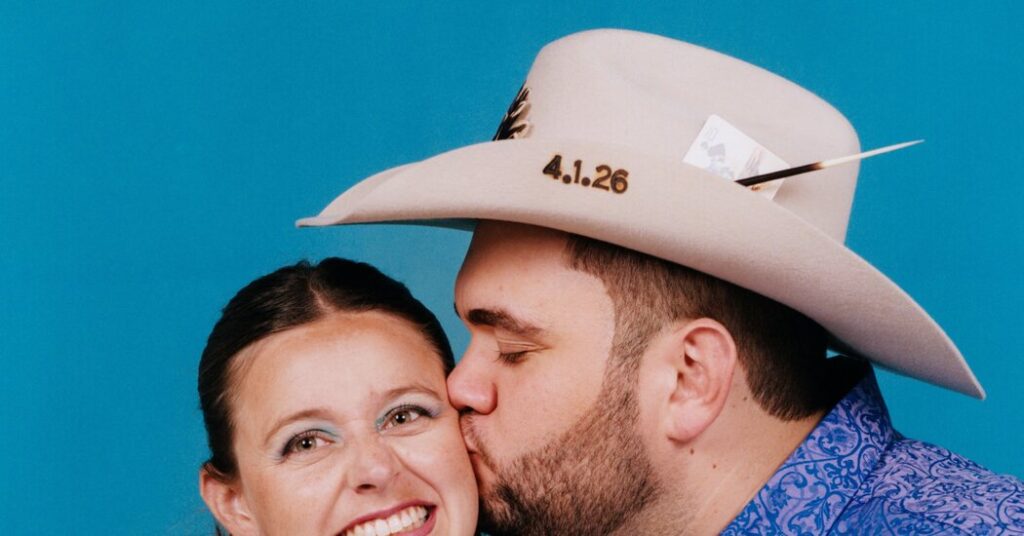
Tyler White and Madison Marilla are on their third date at the Marilla family home on Florida’s Anna Maria Island. The scene, in an episode of Season 3 of the Netflix docuseries “Love on the Spectrum,” is Tyler’s first time meeting the Marillas. Moments after walking in the door, Tyler tells Madison’s brother and parents that he loves her. “Awesome,” Madison’s father, Brennan, says, in what appears to be jocular shock.
Almost immediately following this declaration, the couple begin making out, feet from Madison’s family, with just a kitchen island between them. “Holy moly!” Madison’s mother, Jenny, says. During a break in the action, Madison’s parents start asking about Tyler’s dating history, which is not extensive, and the couple begin kissing again. Brennan says, seemingly to himself, “It’s OK.” Like Madison’s parents, we are witness to this moment, on the perilous edge of heartwarming and excruciating.
The show’s co-creator and director Cian O’Clery remembers watching Tyler and Madison kissing and feeling dueling emotions. The producer part of his brain thought, This is amazing. The interaction had as much pathos and humor and romance as one could ever imagine a reality show capturing. Another part of O’Clery’s mind was fretting as the scene intensified. One of the show’s producers had to step out of the room to take a deep breath and steel himself for the rest of the filming. “I hope the parents aren’t finding this too awkward,” O’Clery remembers worrying. “Are they going to be OK with this?”
The scene encapsulates the balancing act of “Love on the Spectrum,” whose fourth season premiered this month. By depicting the triumphs and travails of dating among neurodivergent people, it has become one of Netflix’s most popular shows. On social media, millions of people follow the cast members, scrutinizing their posts for hints about the status of their relationships between seasons. Ariana Grande and Rachel McAdams are fans.
This popularity might feel counterintuitive, considering the prurient delights of most reality dating shows; “Love on the Spectrum” is totally unlike its genre peers. O’Clery does not torment his cast members by asking them to compete for the affections of the same person or by putting them up for public votes. The show follows mostly young people with autism as they face everyday vicissitudes: not knowing the right thing to say, or whether another person will accept them and their flaws, or the vagaries of intimacy. But they do all of this while also navigating the particular challenges that autism presents, which can include intense and dedicated interests, along with sensitivity to sensory input and difficulty with perspective-shifting.
“Love on the Spectrum” shows the myriad ways autism can manifest. Take Dani Bowman’s four-season arc, which follows her pursuit of a relationship that is both romantic and sexual. She is an animator who owns her own company and initially wanted to date only someone who shared that passion. She also has apraxia, a neurological disorder that can cause her speech to become what she calls a “word salad” unless she writes her thoughts down and memorizes or reads them. Her long-thwarted quest to “get laid,” as O’Clery puts it, features comedy (she makes an animated video to propose that she and her boyfriend consummate the relationship) and heartbreak (Dani sobs when she and her partner break up after he tells her he’s saving himself for marriage).
The show is honest in portraying its cast members’ vulnerable moments. Before Madison met Tyler, she went on a date with a man named Brandon who had a sensory issue related to certain sounds. The production had cleared out half the restaurant to make him more comfortable, but when a baby on the other side of the room started crying, Brandon folded forward onto the table, eventually covering his ears with headphones. “We really questioned whether we should include that,” O’Clery says. They eventually decided it was crucial for the audience’s understanding to see what “sensitivity to noise” actually looked like.
In a scene that typifies the show’s tone and highlights the candor of many cast members, Season 4’s Dylan Aguilar asks whether his date has seen all of the “Despicable Me” films or only one of them. Waiting for a response, he whispers, “Please say all of them, please say all of them.”
This marriage of relatability and empathetic specificity resonates among neurotypical viewers as well as neurodivergent ones. Who hasn’t asked a date something while hoping that the answer would reflect their own desires? Who doesn’t want to feel comfortable in a physical space, or be sexually compatible with a person who is into the same things they are?
Perhaps this is why “Love on the Spectrum” has won seven Emmy Awards and has spent several weeks on Netflix’s global Top 10 list: It is profound to hear people be so aware of and forthcoming about their hopes, and poignant to hear them baldly articulate what we all crave — companionship and acceptance. As much as the series focuses on neurodivergent experiences, it illuminates the universal experience of seeking connection and withstanding disappointment. Its cast members’ bald articulation of their desire for companionship and acceptance gives us a gift: the opportunity to see ourselves in these unlikely stars.
The idea for “Love on the Spectrum” came to O’Clery when he was working on “Employable Me,” an Australian documentary series about people with disabilities seeking and being coached on obtaining meaningful, well-paid work. There were many organizations offering these services, along with autism and social groups, and a casting pool soon emerged from them. Since many people who receive government support for their disability are on the spectrum, “Employable Me” featured a sizable number of autistic cast members. O’Clery kept hearing the show’s subjects express a wish to learn how to do something for which there seemed to be no training: dating. “So many of them were looking for love,” O’Clery says, “and to be honest, it was kind of more important to a lot of people than finding a job.”
O’Clery had spent years working in a variety of roles in reality TV, on the kinds of shows that didn’t exactly portend the sensitivity of “Love on the Spectrum” (“Married at First Sight Australia,” “I’m a Celebrity … Get Me Out of Here!” and “Outback Truckers”) but which did give him a feeling for the rhythms of serialized personal narratives and the patience to wait for the moments when the banal suddenly yields something TV-worthy. “I’d always wanted to make a dating show that was kind of really real and truthful,” O’Clery told me. He went to Karina Holden, the executive producer of “Employable Me,” and pitched the idea for what would become “Love on the Spectrum.” The variances in autism, he told her, meant there were so many stories to tell. She agreed.
O’Clery describes his approach to making two seasons of “Love on the Spectrum Australia” in 2018 and 2020 as “learn as you go.” The small production team found potential cast members similarly to how it cast “Employable Me”: through local autism groups, many of which were initially leery of the exploitative potential of a dating series. “That’s a good thing that they were,” O’Clery says. He shared their skepticism of reality dating shows, which can include amoral and even cruel production practices. In the wrong hands, a reality series about autistic people could position its subjects as objects of amusement for neurotypical viewers. O’Clery had to convince institutions that he had the opposite intention: He wanted this to be a supportive, compassionate show.
Once O’Clery and Holden sufficiently assuaged anxieties about their intentions and found the show’s main cast members, the production team set up dates and filmed the entire process, from prep to post-mortem, with O’Clery checking in throughout. (Psychologists were available before, during and after filming.) If a meeting went well, producers set up another one for the budding couple. The cast members agreed not to contact one another outside of the first few show-facilitated dates, after which point they were free to continue seeing each other on their own, with the unspoken but never promised possibility of the series following their ongoing love story in the next season. If it wasn’t a fit, they’d pair a cast member with someone else. After an acclaimed first season, Netflix licensed the show in 2020, then commissioned a version set in the United States.
Abbey Romeo was one of the first two people the team considered casting on the American series. When O’Clery saw her perform with a band at an arts program for adults with autism, her magnetic un-self-consciousness made it obvious that she was compelling enough to be on TV. Abbey’s autism impacts organizational thinking, auditory input of speech and conversational and expressive language, but she frankly and vividly describes the difficulties of living inside her head. She often turns to metaphors involving Ariel from “The Little Mermaid”: Like Abbey, Ariel was at one point unable to communicate in words the way she wanted to. As we sat talking in the Sherman Oaks, Calif., home that she shares with her mother, Christine, Abbey knit with shocking speed and talked about what it was like growing up on the spectrum.
“I wanted to be with typical kids,” Abbey told me. Her envy, she said, would manifest as imitation. Her yearning not to be on the spectrum was so strong that if a neurotypical person nearby sneezed, Abbey would pretend to sneeze as well. If she did the same thing, she reasoned, then she would be neurotypical. “I would copy them and make them uncomfortable,” she says. “I was angry at my brain.”
When O’Clery asked if they could film Abbey, she had to decide whether being on television was something she wanted, while Christine assessed whether Abbey — who knew little about reality TV — could participate in the way she’d be expected to. “She can tell me yes and no,” Christine told me, “but the nuances or the deeper meanings are sometimes hard for her to process or express.” Eventually, after watching and loving the Australian version of “Love on the Spectrum,” Christine told O’Clery that she didn’t think Abbey was right for the show. His response surprised her. “We want more diversity of the spectrum,” Christine remembers him saying. “We want to tell her story.” Christine began to reconsider. Didn’t she want people to know Abbey’s story? Would she be perpetuating the lack of understanding about autism if she kept her daughter off the show? In the end, she trusted O’Clery enough to take the risk.
She regretted this decision during the first day of production, when Abbey sat down with O’Clery and the team for a formal, direct-to-camera interview about her life and what she was hoping to find in a partner. Things didn’t go well: Abbey yawned in O’Clery’s face, told him she was bored and asked to leave. Christine could hear all this through the door. “I started to cry in the other room,” she told me. “I thought, What have I done for her to put her in a situation where she can’t really express herself?”
Christine assumed that was that, but O’Clery came back the next day and encouraged Abbey to move around as she normally would while he and the director of photography stood as far away as possible with two small, long-lens cameras. The sound producer monitored the audio from afar, and Abbey started being Abbey, ebulliently blunt and often transitioning into song. “Just allowing people to exist in their own space and forget that there’s a crew filming them is great if you can get to that point,” O’Clery says. “People say, ‘Oh, I forgot you were there.’ And that’s the best thing I can hear.” Abbey was totally natural shucking corn and showing off her stuffed animals, which include several warthogs and many, many lions.
Wild animals are one of Abbey’s special interests, which are crucial to cast members’ comfort. They include the American Girl dolls that Madison organizes by historical era and the vast library of movie and television dialogue that Connor Tomlinson, who joined the show in Season 2, quotes to express his inner life. It is something that can “transport you to a time and place where you can know the social rules, understand what it takes to fit in,” Jennifer Cook, the show’s dating coach, who is herself autistic, told me.
The show’s producers work very deliberately to set up the cast members for success on their dates. Cook helps them learn communication strategies with concrete items that demonstrate the more abstract mechanisms of connection: a ball that clients can roll back and forth when they speak to show that conversation should flow both ways, or a scale that she and her clients try to balance with marbles as they ask each other questions. “They are all wanting to be put in a position where they feel more secure,” Cook says. “Having somebody give you a little guidance, a little insight, is a little like ‘Here are the secret rules.’” Being autistic, she says, “is a bit like playing the game of life without having the set of directions that everybody else seems to have showed up with.”
Some people on the spectrum have a negative association with their own autism because behavior that comes naturally has been corrected by neurotypical people. “Love on the Spectrum” is a celebration of being authentically neurodivergent, with whatever challenges that entails. It’s the distillation of something O’Clery feels about people generally and sees as a miracle of the “Love on the Spectrum” cast members. “A lot of people are quite performative,” O’Clery says. “I’m really sensitive to people feeling like they’re not being themselves. I don’t feel that when I’m filming the show.”
As on any reality show, the casting team looks for people who are comfortable being on camera and exude charisma. That some “Love on the Spectrum” cast members possess this quality is often not news to them. Abbey is a performer, and Season 3 participant Pari Kim says she “always wanted to be a star somehow.” (She adds, “I knew this would be a good opportunity also to really get to tell my story and to inspire others and break barriers — it’s not like every day you get to see a queer autistic train lover out there.”)
Others, like the new cast member Logan Pereira, are less aware of their “it factor.” When I spoke to him in March, he was in the liminal space between joining the show as a fan and potentially becoming a fan favorite himself. He wondered how his life might change once the season premiered, unaware that he had already developed a following among the show’s creative team: Holden’s office features a still of Logan posing with his hand behind his ear because he didn’t know quite what to do with his body when his date arrived. “How can you not find humor in Logan?” says O’Clery. “He’s just such a fun person. The way he talks, the way he delivers a line. I mean, it’s like he’s a comic genius without knowing it.”
The interpersonal connections that surround cast members are also crucial. They allow participants to feel safe, and let viewers relax as they watch, knowing that the stakes of an encounter are not the existential possibility of being alone, but the possibility of a future meet-up after a nice dinner, if both parties are amenable. The families and friends of cast members are fixtures on the show: encouraging them, responding to their anxieties, giving them gentle advice, teasing them, dealing with their own feelings about their autistic loved one’s growth. Cast members have rich social worlds that they are impacted by and that they impact. These communities support their relationships if they continue, and support them if a date is not a success.
When people are cast on the show, producers consider what they have said they want from a partner, overlapping hobbies, cultural backgrounds and the general “wavelength” they seem to be on. Then the team maps out on a whiteboard their possible matches and starts to debate; an unspoken rule is that the daters should at least seem as if they could be friends. After speaking with Madison, for example, casting producer Sean Bowman says, “We had a really good idea of what she was looking for in a guy and also what she was not looking for. Tyler was outgoing, super involved in the autism community and then just had that Southern accent and cowboy hat that I had a feeling Madison might like.” He was correct.
During the dates, O’Clery hangs back to give cast members the illusion of privacy while still offering support. Viewers can often hear his Australian-accented “You all right?” during any moment of visible upset. They stop filming whenever participants need a break. They have chosen not to air certain moments out of concern for how cast members would feel about watching themselves later.
Still, some viewers question the ethics of depicting moments like Brandon’s adverse reaction to noise while on his date with Madison. But Brandon was unperturbed by how the audience might judge his response. “He was really proud of himself, and his mom was really proud of him,” O’Clery says. “He felt really good about the fact that he actually did it and put himself out there.” The show had managed to translate Brandon’s discomfort to viewers in a way that forced them to ask themselves what they were really bothered by: Brandon’s potential embarrassment, or their own? Likewise, a small portion of neurotypical fans have displayed an aversion to people with autism expressing their sexuality, which they often offer as concern for the show’s participants. “If somebody wants to have sex, they should be able to bloody well have sex,” O’Clery says. “Having a disability doesn’t mean that you have to be some innocent, nonsexual being.” Deciding to talk about such things on television and potentially receiving blowback about them offers cast members what Holden calls “the dignity of risk.”
That risk has paid off for Abbey, who was eventually matched with David Isaacman. He had always talked about having a girlfriend — someone with whom he imagined he would text and talk about animals (but not invertebrates; he doesn’t like them). When he got back from his first-ever date at the zoo, his family had no insight into how it had gone and no whiff that it would lead to a five-year relationship. “All you know is that you have your child, as a parent, they come back and they’re so incredibly happy,” David’s mother, Debbie, says. “And so there is something that is unleashed that, as a parent, you’ve never seen before because you’ve never had this experience.”
During Abbey’s time on the show, her understanding of what she wants from a relationship has evolved. In the first episode of the series, she tells O’Clery she’s looking for love because, she says, “I want to be like a princess, like Cinderella going to the ball.” After actually experiencing long-term partnership, she now doesn’t want to just dress up and be chosen by a prince. Abbey realized that she wants to live life alongside someone who is funny and talented. “He has to be brave like me,” she says.
Abbey’s relationship with her own autism has also changed. “I’m more confident,” she says, breaking into a bar of Demi Lovato’s song about the quality. Activities that once seemed impossible, like going out to karaoke with friends, are now regular occurrences. While partaking in the pleasures of life, Abbey says, “I felt like an average person, but still in the neurodivergent world.”
Still, Abbey’s experience may not be quite typical — Miley Cyrus, a fan of the show, shouted her out at the taping of the recent “Hannah Montana” anniversary special. But Abbey seemed more interested in talking about a different type of admirer. She imitated for me the people who come up to her on the street: “Oh, my God, it’s Abbey from ‘Love on the Spectrum’!” she screamed at the distinct pitch of the thrall at a BTS concert. Many of the young women who approach her are neurotypical. The kind of people whom Abbey once mimicked, desperate to be like them, are now her fans.
Anna Peele is a contributing editor at Vanity Fair. “Enter the Villa,” her book about the reality dating show “Love Island,” will be published in May.
The post The Unlikely TV Show Restoring Everyone’s Faith in Dating appeared first on New York Times.