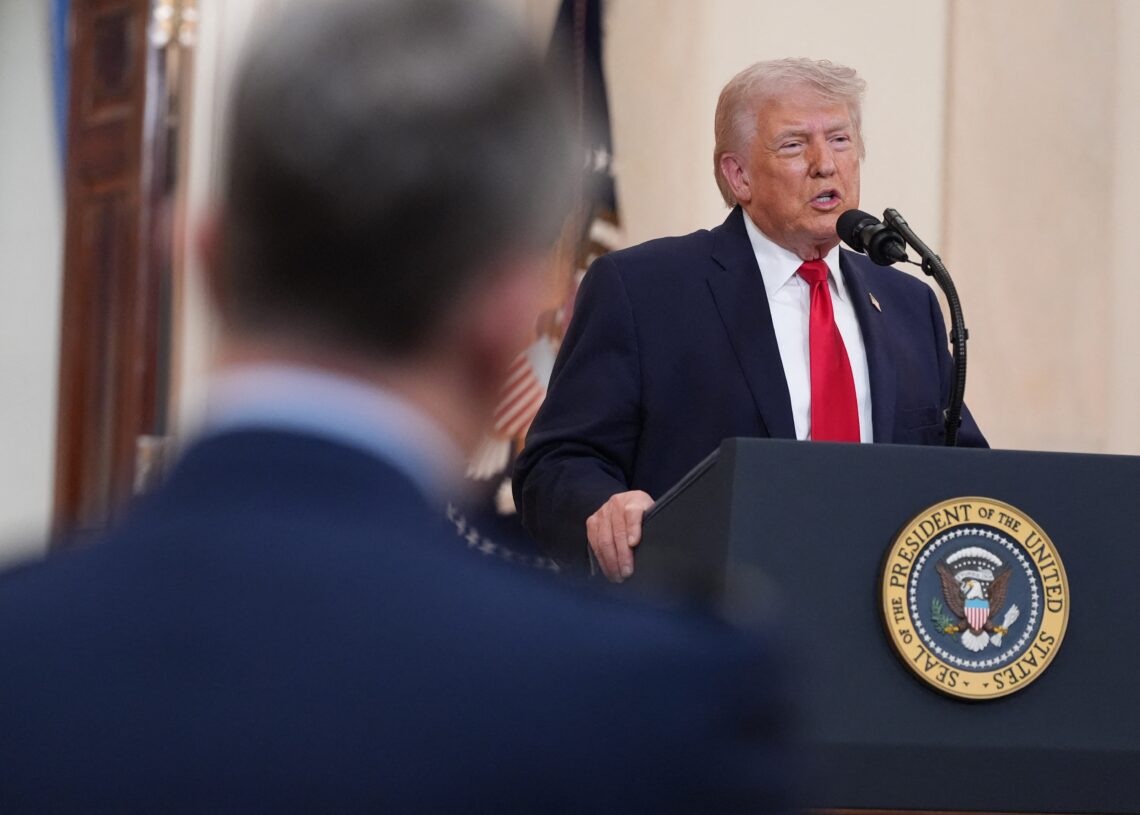
Facing economic and political headwinds a month after launching a surprise attack on Iran, President Donald Trump defended the increasingly unpopular conflict Wednesday night but assured the nation that the military operation in the Middle East was “nearing completion.”
In a speech from the White House, Trump said the United States was on track to complete all of its military objectives “shortly, very shortly” but first there would be a period of military buildup: “We’re going to hit them extremely hard,” he said. “Over the next two to three weeks, we’re going to bring them back to the stone ages.”
The president’s defense of his actions, and his direct entreaty to the American people, comes as the White House tries to contain the consequences of a conflict that has sent gas prices soaring and soured Americans’ feelings about Trump and the economy, six months before the midterm elections.
Trump sought to assure Americans wary of rising gas prices that the spike in fuel costs was “short term.” But he did not offer specifics on how the White House would address voter concerns, suggesting only that prices would “rapidly come back down” once the conflict is over.
He also tried to clear up contradictory statements about the competing objectives of the bombardment launched on Feb. 28, saying it was a continuation of political promises he’s made for years: to deny Iran a nuclear weapon.
“From the very first day, I announced my campaign for president in 2015, I have vowed that I would never allow Iran to have a nuclear weapon,” Trump said. “They were right at the doorstep for years. Everyone has said that Iran cannot have nuclear weapons, but in the end, those are just words if you’re not willing to take action when the time comes.”
While he said discussions with Iran were ongoing, Trump made no mention of the list of 15 demands he has sent to Tehran or what he said earlier Wednesday was Iranian President Masoud Pezeshkian’s offer of a ceasefire.
The Iranian government denied such an offer had been made and has made its own demands, including control over the Strait of Hormuz and war reparations for destruction by U.S. and Israeli airstrikes.
Over the past month, the administration has given shifting explanations about the goals of the conflict, and Trump and Secretary of State Marco Rubio have spent recent days promising to end the war while at the same time threatening to escalate it.
And some contradictions remained Wednesday. Trump simultaneously claimed to have “obliterated,” “beaten” and “completely decimated” Iran, achieving all objectives, even as he said operations would continue, and even increase, until all U.S. goals were achieved.
Trump has sent thousands of additional ground forces to the region, but despite threats of ground attacks on various Iranian targets, he did not share any details about whether or where he plans to use them. Military planning for those operations could take weeks to complete, if he approves them. And while he said the U.S. will hit power grids, he pulled back from naming desalinization plants as a target, something that was widely decried as a potential war crime.
Trump also appeared to suggest that the U.S. would not need to retrieve the highly enriched uranium that is believed to be buried at the Iranian nuclear sites the U.S. attacked last year.
“They’ve been hit so hard that it would take months to get near the nuclear dust,” Trump said.
The Pentagon had drafted risky plans at Trump’s request for a U.S. ground operation to seize the nearly 1,000 pounds of highly enriched uranium that experts believe is buried deep beneath the surface at one or two Iranian nuclear facilities. But in his remarks, Trump appeared to suggest the U.S. could monitor the location of the nuclear material with “intense satellite surveillance.”
The U.S.-Israeli attack on Iran is the second major military action by the U.S. in as many months, following an operation to capture Venezuelan President Nicolás Maduro. Iran’s supreme leader and more than a dozen other leaders were assassinated in a matter of days in what the president said would be a surgical operation.
But the toll — in dollars, global economic turmoil and casualties — has continued to mount. Iranian leaders blocked off the Strait of Hormuz, a choke point for 20 percent of the world’s oil and liquefied natural gas. Tanker traffic has diminished to a trickle and the average cost of a gallon of gasoline in the U.S. shot past $4.
Trump’s words Wednesday night did not immediately promote faith in the global economic outlook.
Asian stocks fell, and oil prices jumped following Trump’s address. Stocks in Japan and South Korea, two nations that rely on oil shipped via the Strait of Hormuz, sank steadily while the president spoke. South Korea’s KOSPI index closed more than 4 percent lower, while Japan’s Nikkei 225 index dropped more than 2 percent. Markets in Taiwan and Hong Kong fell by about 1 percent.
On Thursday morning, major European markets fell about 1 percent, and premarket futures trading on Wall Street dropped. Brent crude, the global benchmark, topped $107 per barrel, up 6.5 percent.
American allies have become exasperated by the out-of-the-blue conflict that is causing global economic fallout, even as the U.S. uses their airspace and military bases to launch additional attacks. Thousands of U.S. service members have been sent to the Middle East, and 13 have been killed.
Some Republicans and Trump supporters also have argued that the military action in a country 7,000 miles away goes against the noninterventionist ethos that has marked Trump’s “America First” agenda for the past decade.
Nearly 6 in 10 Americans oppose the conflict in Iran across five recent surveys interviewing over 10,000 Americans, according to a Washington Post analysis of polls. A Pew Research Center poll in mid-March found 59 percent said they believed the U.S. made the “wrong decision in using military force in Iran,” while a Fox News poll found 58 percent oppose “the current U.S. military action against Iran.” And 65 percent of Americans say the Trump administration has not adequately explained the purpose of the conflict.
In arguing for the necessity of the military action Wednesday, Trump leaned into the humanitarian benefits of the toppled Iranian regime. Trump has encouraged the Iranian people to overthrow their government and pledged that “help is on the way” to Iranian protesters who had been assailed by their leaders. On Wednesday he said that 45,000 Iranians had been killed by government forces in protests this year, a jump from his previous estimate of 32,000, though he did not expound on where the number came from.
Iran has continued to attack both civilian targets and U.S. military installations, including an attack on Prince Sultan Air Base in Saudi Arabia that destroyed at least two U.S. military aircraft and injured U.S. troops.
“Regime change was not our goal,” Trump said, although he has previously claimed credit for wiping out two “regimes” since “all of their original leaders … are all dead.”
“The new group,” Trump added, “is less radical and much more reasonable,” although the same president is still in office and the supreme leader, killed in an Israeli strike on the first day of the war, has been at least nominally replaced by his equally hard-line son.
While he is approaching his original deadline of several weeks for ending the war, Trump attempted to offer “perspective” by noting that U.S. involvement in World War I lasted “one year, seven months and five days,” while World War II and the Korean War were significantly longer and “the Vietnam War lasted for 19 years, five months and 29 days.”
Cat Zakrzewski, Dan Lamothe, David Lynch, Adam Taylor, Susannah George, Tara Copp and Victoria Craw contributed to this report.
The post Trump says Iran war is ‘nearing completion’ as he seeks to calm economic worries appeared first on Washington Post.