
Two days before the new year, I hopped on a video call with the French conceptual artist Sophie Calle. She was spending the holidays in her home in the South of France. I got the email notification when she signed on five minutes early, which I took as a sign of her professionalism. When the video came into focus, she peered down at the camera in her tinted, green-rimmed glasses. I thanked her for her time, told her I was a fan of her art and she gave me a smile. I jumped to the point, as I sensed she wanted me to, and proposed two ideas for how we might collaborate on a piece for the magazine, in light of her traveling retrospective, “Overshare,”that was about to open at the UC Irvine Langson Orange County Museum of Art. First, I said, she could write or make something — but before I carried on, she cut me off: No. She simply didn’t have the time. In 2026 alone she had several exhibitions, a new book and so forth. Calle, as people like to say, is very French.
I was, however, pleased that Calle preferred to move forward with the second idea, the one that allowed me to continue an exchange with her. I told her that in studying her body of work over recent weeks, I noticed for the first time the recurring presence of California. I wasn’t interested in writing a profile on Calle (primed by her open distaste for profiles). Perhaps, I said, we could do something less traditional in which we had an open-ended conversation over email about these works and her relationship to California — she could respond with images, in English or in French — and I would write about the experience of that conversation. Calle accepted but countered that we have “a fake but real exchange.” I was thrilled upon hearing this and swiftly wrote the phrase down. It was a sign that this could be what I’d hoped for: that together we might create something, have a conversation that was an extension of her work rather than about it.
Calle, who is now 72, is known for peeking into the intimate lives of others. She has worked as a hotel chambermaid and photographed guests’ possessions in the bedrooms. She has invited people to sleep in her bed, interviewed them about their sleeping habits and photographed them once they’ve fallen asleep. She has followed a man from Paris to the floating streets of Venice and documented his every move. Most of her projects take the form of books and pair photographs with words. I gravitated toward Calle as a writer first, loving her writing the way writers do — wanting to bounce off it, be a part of it. My call with her was my naïve attempt at just this.
Immediately, Calle set off on our fake but real exchange. In other words, we would not have an actual back and forth. Instead, she would send me some paragraphs she’d already written — unpublished and published — and I would respond to them in my own time. If necessary, she would respond to questions if I had them down the line. She told me that just yesterday she had written something about her first memory of California. She emailed it to me while we were still chatting. It began with the avant-garde playwright Robert Wilson, her love for his productions and her desire to join his theater company. At 23, she tracked him down in Avignon, in the hopes to meet him. “He was talking with Philip Glass; I followed them, wanting to interrupt them,” the email read. “Before I could say a word, Bob turned and yelled at me.” It didn’t work out, but it was because of Bob that she met Kathy Ray, a member of his company, who took Calle back with her to Bolinas, Calif., where she went to a cemetery and photographed the graves — her self-proclaimed first works of art. Forty-eight years later, Calle would go back to Bolinas and buy a grave plot for herself in that same cemetery. “Bob was part of my life, whether he liked it or not.”
The memory ended with Calle receiving the Praemium Imperiale prize in 2024 in Tokyo, where Wilson was also in attendance. “At the beginning of 2025, I learned that he had contacted the prize committee to obtain my phone number,” she wrote, matter-of-factly. “It had taken him [49] years. And shortly afterward, he died.”
Calle told me this memory was part of her new series called “Too Late,” about the things she once wanted to do, but now are too late to happen. She wrote one for the architect Frank Gehry, a close friend who had died at his home in Santa Monica just three weeks before our conversation — another California connection. She also emailed it to me, together with a note that Gehry wrote for her on a napkin:
TOO LATE. Frank Gehry
I met Frank Gehry for the first time in Los Angeles in 1984, and he met me for the first time that same year in Nîmes. This disagreement became our favorite quarrel. Later, at my request, Frank created a telephone booth on the Pont du Garigliano in Paris, the number of which I was meant to dial regularly in the hope that someone would answer. After the structure was completed—his smallest commission in terms of square meters—I approached him with an even more humble project: a funerary stele for my cat. Apparently without thinking, or out of friendship, he said yes. Then he began to drag his feet; he kept putting it off, and I kept insisting. One day, he wrote out a list of places I could stay during my next visit to the US, and at the same time he renewed his promise of a tombstone, with one condition: that we’d keep disagreeing forever. Frank died on December 5, 2025: breakdown of negotiations. Deadlock.
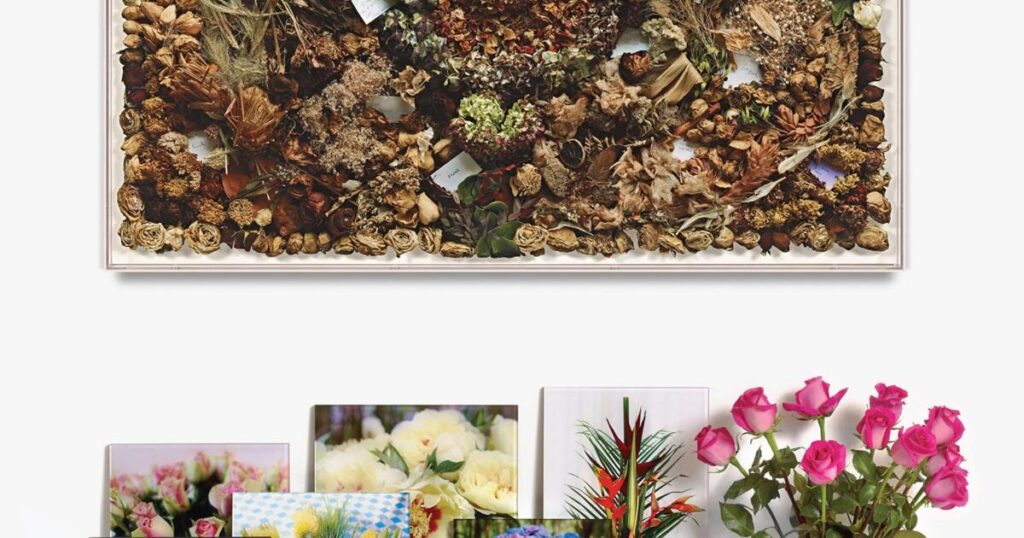
The bright pink and red telephone booth that Frank Gehry designed for Calle peels open like the petals of a flower, a nod to the bouquets he sent Calle on every opening night of her exhibitions, no matter where in the world, during the 40-plus years of their friendship. They met in 1984, when Calle came to L.A. to do a project for the Olympics, for which she asked artists like Gehry and Ed Ruscha, “Where are the angels in L.A.?” (Gehry’s unequivocal response: “In my house. They are my wife, and my children. I live for them. That’s all.”) Gehry introduced Calle to her first gallerist, Fred Hoffman, helping to launch her international career. Calle kept and dried the bouquets that Gehry sent her. In 2014, she photographed them, an image that is now on display in her exhibition, and nestled among the browned flowers are the notecards reading “Love, Frank.”
Calle emailed me two additional photos: one of the last flowers that Gehry ever sent her, in September 2025, of orange roses and hydrangeas, and another of them laughing and embracing on a boat off Santa Monica.
The night before our call, I stumbled upon a photo of Calle and Gehry on Facebook, playfully kissing each other on the lips, from 2017. Wow, what a pair! The commenters said. They deserve a sweet kiss!
Regarding Gehry, Calle was quick to state: She would only share things about him that connected back to her work. I said of course, ready to honor our real but fake, or fake but real, exchange. I was with the persona, not the person.
“Overshare,” originally organized by the Walker Art Center, centers on this idea of “exposure” — how Calle presents herself, what she chooses to disclose and not disclose, what is “fictive” versus “authentic.” But the question of what is true or not is futile, even if Calle deliberately provokes this curiosity. A story, however based in life, is constructed. The real becomes fake, the fictive authentic.
I wonder if the cliché of California appealed to Calle: the invitation to reinvent yourself, a place where you can make up who you want to be. It seems fitting that it’s where she felt free to become an artist. I email her, a month after our call: “Do you think California as a place inspired your decision to be an artist? Did being here give you some sense of permission? Why do you think California is a recurring place in your work? What does California (and/or the U.S.) mean to you?”
Two days later, she responds: “I am sorry but I can’t answer your questions […] California has not inspired me more than New York, Mexico etc….”
Perhaps I am inventing a story about Calle that is too fake to be true. Perhaps it is my own love for California that I am projecting — my own belief in its openness and playfulness, in how refreshingly unjudgmental it can be.
On our video call, we had broken down her California story into parts, like chapters in a book. I like to think I was experiencing her process of creating a work, with clear constraints and no analyzing — just laying out the facts on the table. She had a pen in hand and was writing down the parts as we remembered them.
I brought up the 27-year-old man in San Francisco who, in 1999, in the aftermath of a breakup, wrote to Calle and asked if he could spend his “mourning/grieving period” in her bed in Paris. “Should we have this experience, perhaps we could each use it as artistic fodder,” he wrote. In what I now observe as a pattern, she accepted the experience but countered: She would ship her bed to him, and he would sleep in it alone for a few months. There would be no “we.”
Seven years before, in 1992, Calle released the movie “No Sex Last Night,”which she made with her then-boyfriend, Greg Shephard, on a road trip from New York to California. For the film, they each recorded their private thoughts over the course of the trip. Shephard, who suggests he’s mostly lost interest in Calle, speaks of his initial attraction toward her, how he knew about her art before they met, and how he wanted to “reinvent” himself like she did. This road trip, which he reluctantly goes on, is his chance to make something with her, to step into her process. But he soon finds that he has no say in her “games,” and has no choice but to play them — including, amazingly, getting married at a Las Vegas drive-through.
Like these men, I am eager to co-create something with Calle but find that it isn’t possible in the way I had imagined it. She sets the rules. Who do we think we are to steer her art?
When we spoke, Calle mentioned that she was going back to the grave plot she had purchased in 2011, in Bolinas, next year. She wasn’t sure yet what she would do there, but it would be similar to an installation she did at Green-Wood Cemetery in Brooklyn, for which she invited visitors to store their secrets inside a tombstone.
Surely, California must mean something to Calle if it’s the place where she bought her grave plot, where she is presumably going to be buried. I ask her in my email: “Why is it important to you to be buried there? Does it matter to you that it is in California, not France?”
And here she says something that must remain between us. It concludes our fake but real exchange.
Not every artist’s first work is that revealing or interesting, but in Calle’s case, it’s all there, in her photos of the Bolinas gravestones, bearing the words mother, father, daughter. The most “real” thing about Calle’s work lies not within the mutable facts of life, but the indisputable fact of death.
Calle talks about how her work has helped her to create “distance” from difficult topics — like losing parents, lovers and friends. When she’s happy, she wants to “live the story” and “be inside” it, as she once said in an Art21 interview. It’s only when the story is “about death, about absence” that she finds the need to record it.
The parts or chapters in Calle’s California story, spanning from 1978 to this day, mostly revolve around loss — a missed connection, a breakup, a deceased friend, her own death. I can see how California just happens to be the setting, as these themes repeat elsewhere in her art. Still, California has been a steady and consistent background character, or a reliable interlocutor, willing to engage her games.
The second-to-last room of “Overshare” is devoted to Calle’s works explicitly about death. At the center is a video she made of her mother dying. She lies motionless and with her eyes closed, while a hand rests in front of her nose to check if she is still breathing. This is the only work Calle ever made of her mother, and when she set up the video camera by the bed, her mother’s reaction was to say, “Finally.” She had always wanted to be a subject, to play a real part in her daughter’s art, but Calle hadn’t heeded her requests.
What is it about Calle that makes us want to participate in her art, to be inside and witness it? Maybe it’s that her work is all about interactions with others — mostly strangers — that people, including myself, presume they can just slip in. She makes us feel like we are already her subjects and that she’ll simply bounce off daily encounters as they happen. But Calle, like any writer, sketches her characters and frames their destinies. She is the only author of her stories, the fake and the real.
The post My fake but real exchange with the artist Sophie Calle appeared first on Los Angeles Times.