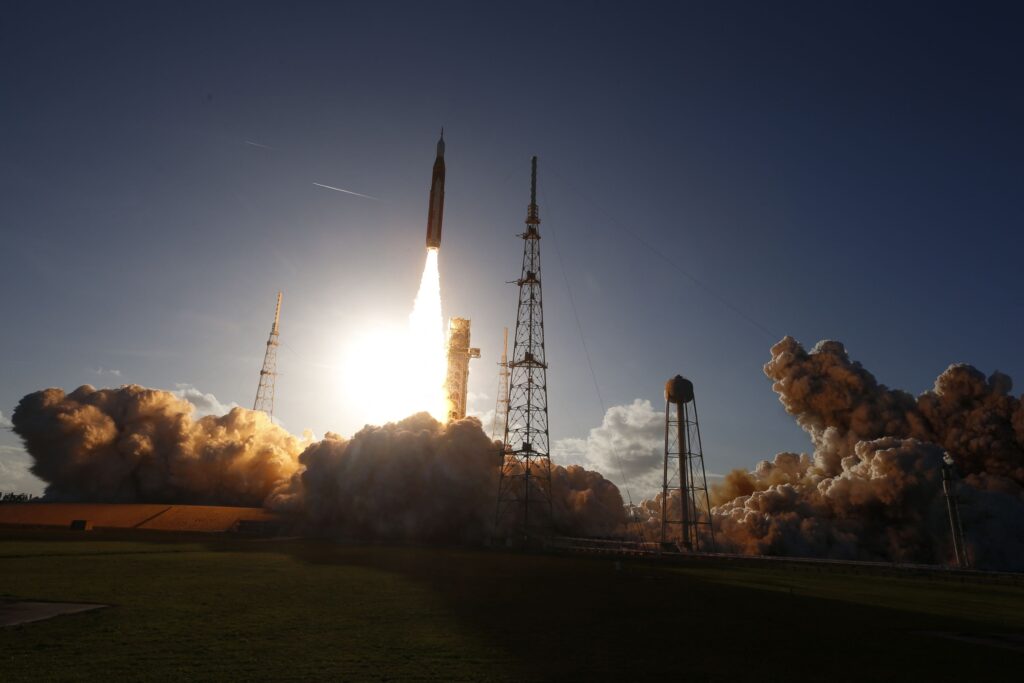
Four astronauts lifted off before sunset Wednesday, starting a historic 10-day journey to fly by the moon and propel people farther into space than they have ever gone before.
The Artemis II mission is scheduled to loop around the moon for the first time since the Apollo era. It is a crucial first chapter for an ambitious and risky program to eventually return people to the lunar surface, build a base there and use it as a stepping stone to push deeper into the solar system.
The liftoff depended on a rocket and capsule that have never transported humans before. The rocket cleared the tower and began the journey toward low Earth orbit at 6:35 p.m. The astronauts will circle the Earth, testing life-support systems and making final checks before making the decision Thursday whether it is safe to burn their engines to head toward the moon.
“We have a beautiful moonrise, and we’re headed right at it,” Reid Wiseman, the mission commander, said minutes into the flight.
The Artemis II launch marks a risky, expensive, technically challenging landmark — the formal reopening of human ambition to explore deep space. Human spaceflight may almost seem familiar and humdrum these days, with astronauts living at the International Space Station for prolonged periods and a commercial spaceflight industry regularly sending people into low Earth orbit. But going to the moon is inherently more dangerous. It means going farther and faster, relying on hardware that has never been used to transport humans anywhere, much less the moon.
“I think this is right up there with the first launch of the space shuttle in 1981. That was the first launch of a new launch vehicle, and it had a crew on board, which was kind of a daredevil move,” said Todd Harrison a senior fellow at the American Enterprise Institute who follows space policy. “This is a capsule that’s only flown once. It had problems the first time it flew. And now we’re sending it with a crew out to the moon.”
In an era of private and commercial space contracts, this is a traditional mission, drawing on a heavy-lift rocket and capsule developed by NASA over more than a decade.
“This is a test mission for sure. No crew have ever ridden this before,” NASA administrator Jared Isaacman said at a post-launch news conference. The mission is expected to wrap with the astronauts splashing into the Pacific Ocean next week. “We’ll keep gathering data over the next 10 days. We’ll share updates. But we’ll call success when they’re in the water safely.”
The Artemis II mission astronauts are expected to travel 252,799 miles from Earth, shattering the Apollo record by more than 4,000 miles. The mission is a step toward returning to the moon’s surface in the future.
“We’re ready to go out to the moon and Mars and the rest of the solar system. We have enough knowledge now to hopefully have reduced the risk, and so really this is the first step of that path of humans through the solar system,” said Pamela Melroy, a former astronaut and deputy NASA administrator under President Joe Biden. “I think I could hardly miss it. If you go back, one of the things I’m most envious is when someone said they saw an Apollo launch.”
The astronauts aboard NASA’s Orion spacecraft — Wiseman, Victor Glover, Christina Koch and Jeremy Hansen of the Canadian Space Agency — will first go to low Earth orbit. If all systems are go, they will begin their journey to the moon, arriving six days after launch, following a figure-eight pattern that peaks at more than 4,600 miles beyond the far side of the moon.
The excitement — and tension — in the space community is high. Shortly after launch, there was a partial loss of communications with the spacecraft. It has been fixed, but NASA engineers are still trying to understand what caused it. When Artemis I flew in 2022, with no people aboard, the heat shield that protects the capsule upon its fast and fiery reentry into Earth’s atmosphere was damaged, a problem NASA has worked to fix but will face its most crucial test upon reentry.
Melroy sees this mission as an exciting step toward exploring the solar system, but described the big differences between traveling to low Earth orbit and going beyond.
“You have to prepare the vehicle structurally; it has to be stronger and the heat shield needs greater levels of shield,” Melroy said. “It’s not like anything we’ve built or operated since Apollo, and there’s been some learning on that.”
Jack Kiraly, director of government relations for the Planetary Society, pointed out that the rocket and capsule have never flown with human cargo. “It still kind of feels like a new vehicle a little bit, so every moment is going to be exciting,” Kiraly said.
This mission will be a crucial test for the Artemis program, estimated to have cost $107 billion by the Planetary Society. Artemis III, planned for 2027, will test operations and systems to dock with landers being made by SpaceX and Blue Origin. Artemis IV in 2028 is expected to be the first time humans will set foot on the moon again. (Jeff Bezos, the founder of Blue Origin, owns The Washington Post.)
In late March, Isaacman announced a plan to build a $20 billion lunar base.
“I’m excited [about] going to the moon. I’m excited about establishing a presence there,” Jeff Spaulding, test director with the Exploration Ground Systems program at Kennedy Space Center, said at a briefing Tuesday afternoon. “It’s part of the reason that I’m actually still here is to continue to put humans into space, and to get us back into this launch mode, so that we can continue to explore and establish a moon base, and then continue to work towards getting to Mars.”
The post NASA’s Artemis II launches on historic journey to the moon appeared first on Washington Post.