China’s Aiming for the Moon, and NASA Is Looking Over Its Shoulder
The U.S. space agency launched a lunar flyby Wednesday, but Beijing is pursuing its own space program with formidable focus. Here’s what we know about it, in photos and videos.
More than half a century after the United States put humans on the moon, it is once again locked in a space race. This one is with China.
NASA sent astronauts on a lunar flyby on Wednesday, a milestone toward grander ambitions. Both the United States and China want to build outposts around the moon’s south pole and hope to tap frozen water, hydrogen and helium there. Both countries plan to build nuclear reactors to power lunar bases from which they can launch missions into deep space.
It is a new frontier, and whoever gets there first will have a big say in setting the rules.
NASA’s program, known as Artemis, has hit repeated snags. The United States wants to be back on the moon by 2028, two years ahead of China’s target, but even NASA acknowledges that it may not win.
“They may be early,” Jared Isaacman, the NASA administrator, said last week. “And recent history suggests we might be late.”
China is pursuing its lunar ambitions with a singular, formidable focus. Its program has several advantages over its American rivals.
Experts say China’s edge lies in its centralized control, which allows it to plan and fund projects for decades at a time. Its robotic space missions have already gone where the United States has not.
China is the only nation to land on and retrieve samples from the far side of the moon, the hemisphere that always faces away from Earth. This summer, China’s seventh robotic mission, Chang’e 7, will explore the lunar south pole.
It helps China that its immediate ambition is leaner. Chinese astronauts plan to land on the relatively accessible near side of the moon. That’s where Neil Armstrong took “one small step for a man, one giant leap for mankind” in 1969.
American astronauts are aiming for the moon’s south pole.
A recent program overhaul could speed Artemis along. The new plan includes more launches to test components, gain confidence and lower risks, Mr. Isaacman said. After returning astronauts to the moon, NASA plans to launch missions every six months and sustain a presence there.
“This time the goal is not flags and footprints,” Mr. Isaacman said. “This time the goal is to stay.”
China is pursuing similar goals through two programs that will likely merge: Crewed missions under the military’s purview, and civilian robotic missions.
Both programs rely on components built mainly by the China Aerospace Science and Technology Corporation, an enterprise that combines industry and military expertise. That means they share key technologies.
NASA relies more heavily on private vendors.
Yuqi Qian, a lunar geologist at the University of Hong Kong who works on China’s lunar missions, said that because China’s first crewed mission is treading some of the same ground covered by Apollo missions long ago, scientists have more freedom to experiment. Chinese exploration programs will keep moving at a cadence set years earlier, regardless of what Artemis does, he said.
“There is actually no burden on the Chinese side,” Dr. Qian said in an interview. “We are doing this more freely.”
“I don’t think China regards this as a race,” he added.
Here’s what we know about China’s crewed lunar mission, and how its components compare to their NASA counterparts.
The Launcher
China plans to use a government-built rocket, the Long March 10, for the moon landing. It is about as tall as a 30-story building and has seven engines at its base, the section known as the first stage.
In initial tests, Chinese scientists fired up the rocket’s engines while it was tethered in place. Then, in February, they fired five of the seven engines and launched the first stage to a height of just over 65 miles.
It splashed down in the sea, where scientists retrieved it.
China is behind the United States on rocket technology, a gap that has slowed its bid to compete with SpaceX’s Starlink satellite network in low-earth orbit. China does not have a reusable rocket to match SpaceX’s Falcon 9.
Parts of the Long March 10 may eventually become reusable, but that matters less for lunar missions, which are less frequent than launches to put satellites in orbit.
The American launcher — the Space Launch System — is a marked improvement on the system that first sent astronauts to the moon. It is a powerful and complicated rocket cobbled together from components made by NASA and multiple contractors.
The rocket has not been used many times, but on Wednesday, it blasted off for its first crewed mission against a backdrop of a clear blue sky. It was a big win for NASA and more frequent launches in the new Artemis plan are expected to work out any remaining kinks.
“It’s a big celebration in launch control for the rocket guys,” Amit Kshatriya, the NASA associate administrator, said after the launch.
“The rocket guys can go out and play now,” he said.
The Spacecraft
China is developing a new spacecraft called the Mengzhou or “Dream Boat” that can carry up to seven astronauts. It is designed for both lunar missions and trips to the Chinese space station, about 280 miles above Earth.
The spacecraft will carry astronauts to a lunar orbit. Once there, it will rendezvous with a lander that will take the astronauts to the moon’s surface. China is planning to conduct the moon mission with two launches, in part because it does not have a big enough launcher.
China will test the Dream Boat’s ability to rendezvous and dock with the Chinese space station later this year. Similar in-orbit meet-ups have already been tested in robotic missions to the moon.
Dream Boat passed its most recent test, in February, when it demonstrated its ability to abort within the first minutes of a launch. The spacecraft successfully detached from a rocket under maximum pressure conditions, according to government media.
The American spacecraft, Orion, was first tested in 2014 and is farther along in its development. Orion carried the four astronauts on the Artemis II mission on Wednesday. NASA will test its life support and environmental control systems during this mission.
The Lander
Anyone who has watched footage of the Apollo 11 mission will remember the lander — a scientific wonder that looked like a janky assemblage of golden foil and flimsy metal.
China’s version of the lunar lander, called Lanyue or “Embracing the Moon,” incorporates decades of improvements.
According to the mission design, after the astronauts hop aboard in orbit, the lander will head to the lunar surface. There, it will serve them as a temporary home, data center and energy source.
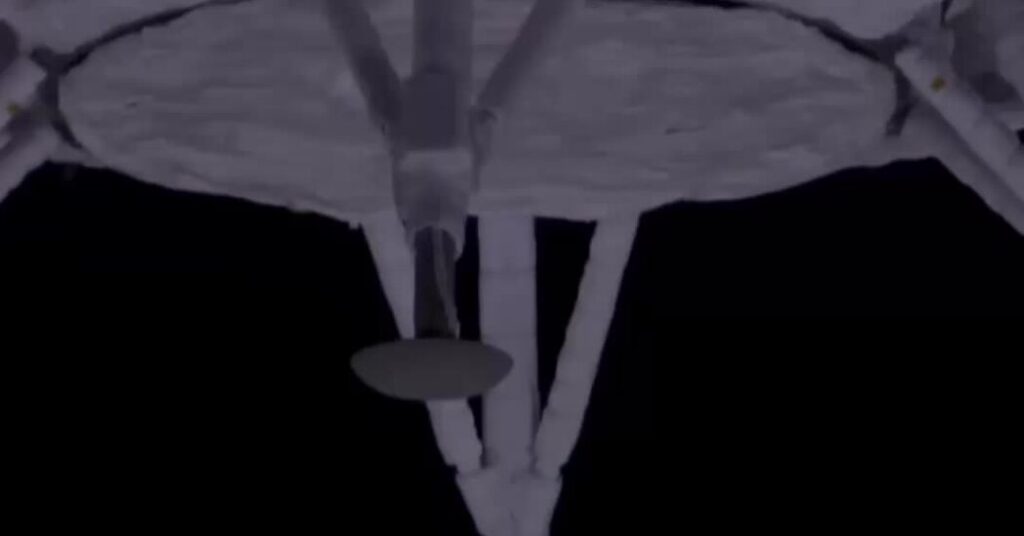
For the astronauts’ return, the lander will take off and rendezvous with the spacecraft in the moon’s orbit .
China tested a prototype in August, navigating to a surface that was built to imitate the moon’s craters and bumps.
The U.S. does not have a lander yet, in part because of the complexity of its planned mission. SpaceX is developing its version, Starship, and will test it again in April. Blue Origin is developing another lander.
NASA plans to launch a mission called Artemis III next year that will test the landers’ operation closer to Earth. The agency will go with whichever lander is ready first, according to Lori Glaze, a NASA official.
The Spacesuits
Chinese astronauts will be fitted with spacesuits called Wangyu or “Gazing into the Cosmos” for their spacewalks.
Wangyu suits will be slimmer versions of the spacesuits used on the Chinese space station. They will have an anti-glare visor, a camera on each side of the helmet and a control consol on the chest.
The suits’ design will echo traditional armor to make the astronauts look “more spirited and imposing,” one official told government media. The spacesuits are expected to undergo more testing this year.
The United States will upgrade its suits to make them more flexible and provide greater protection from the harsh environment on the moon. NASA has contracted for spacesuits that can support astronauts for up to eight hours outside their vehicle.
Kenneth Chang and Alastair Pike contributed reporting. Produced by Tina Zhou. Videos: Chinese state media.
Selam Gebrekidan is an investigative reporter for The Times based in Hong Kong.
The post China’s Aiming for the Moon, and NASA Is Looking Over Its Shoulder appeared first on New York Times.