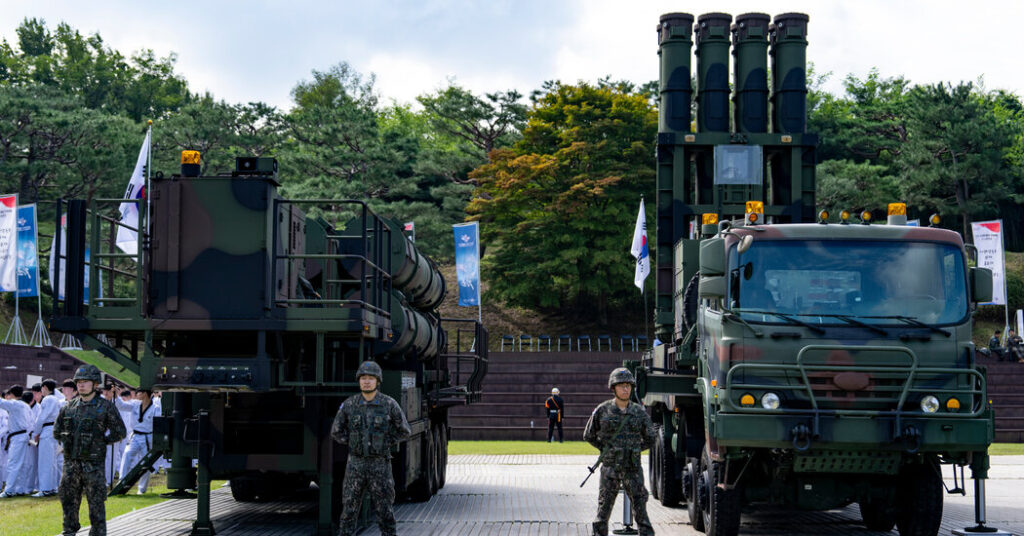
The Cheongung-II, an air defense system made in South Korea, had never been tested in combat until Iran launched waves of ballistic missiles at the United Arab Emirates last month.
It reportedly shot down 29 out of 30 missiles and drones it targeted, according to South Korean news media and a government official.
Although it was only a small fraction of the missiles and drones intercepted during the first month of the war, the success drew praise from politicians and military analysts from Dubai to Seoul.
The strong debut of the Cheongung-II — which translates roughly to “Heaven’s Bow”— is the latest sign that South Korea’s defense manufacturers have become important players in the global arms market.
Several nations are looking for additional options as American defense manufacturers have struggled to keep pace with demand. Some countries have waited years for air defense systems because of a backlog for American systems.
South Korea is now the second-largest supplier of weapons systems to NATO countries in Europe, after the United States, according to a report by the Stockholm International Peace Research Institute, which keeps a database of arms transfers. South Korea’s president, Lee Jae Myung, has said he intends to build the world’s fourth-largest defense industry by 2030.
Since the Russian invasion of Ukraine in 2022, demand in Europe for air defense systems has surged. Lockheed Martin and Raytheon are already running at or near capacity, although both have pledged to ramp up manufacturing in the coming years.
There is a clear opening for weapons that are cheaper and more readily available, said Jerry McGinn, a director of the Center for the Industrial Base at the Center for Strategic and International Studies. “And the Koreans are starting to fill it.”
Revenue for LIG Nex1, the company that makes the Cheongung-II, has grown in recent years as countries have built up their air defenses amid new threats from drones and missiles. In its 2021 fiscal year, export sales were 82.6 billion won, or about $55 million. By 2025, those sales totaled 921.8 billion won, according to company filings. In that time, the company secured major defense contracts with the Emirates, Saudi Arabia and Iraq.
Other South Korean defense manufacturers have experienced similar growth. In recent months, Hanwha Aerospace, which builds the Chunmoo multiple-launch rocket system and makes parts for the Cheongung-II, has signed a spate of new deals. The company agreed to help Spain develop self-propelled artillery systems and broke ground on an armored vehicle production facility in Romania.
Over the last four years, the company has signed contracts worth over $15 billion with Estonia, Norway and Poland.
Investors are enthusiastic. In the first month of the U.S.-Israeli war against Iran, shares of LIG Nex1 climbed nearly 45 percent, while Hanwha Aerospace’s stock climbed nearly 12 percent.
Shares of Lockheed Martin and Raytheon surged at the start of the war, but both ended the month down about 6.5 percent.
The appeal is straightforward: South Korean weapons systems are less expensive than their American counterparts and can be delivered far more quickly.
A Cheongung-II interceptor costs roughly $1 million versus $4 million for a Patriot PAC-3, according to Kelly Grieco, a senior fellow at the Stimson Center, a Washington think tank.
Another thing that makes South Korean defense companies so attractive, she said, is that they are willing to build weapons factories in foreign countries and share the knowledge about how to make them, while American companies jealousy guard their intellectual property.
A spokesman for Hanwha Aerospace said in a statement that the company was “committed to strengthening our allied nations’ defense sovereignty,” and that the company worked alongside allied nations to strengthen defense capabilities.
LIG Nex1 did not respond to requests for comment.
American defense contractors downplayed the threat of competition, underscoring that their products are still the most highly sought-after in the world and have access to sophisticated communications and data that other systems do not.
“Lockheed Martin is a proud strategic partner for the defense and security of America and its allies,” said the company, which makes PAC-3 missile interceptors for the Patriot system, in a statement. “Interest in our products and combat-proven capabilities remains high, and Lockheed Martin has been swiftly ramping production to support increased demand around the world.”
A Raytheon spokesman said in a statement that the Patriot had intercepted hundreds of missiles over decades, and that the company “is investing heavily to speed production in response to growing global demand.”
Although the Cheongung-II is sometimes called the “Korean Patriot,” in reference to the battle-tested air defense system manufactured by Raytheon in the United States, it is not a replica. The Cheongung-II targets threats at lower altitudes than the Patriot and Lockheed’s Terminal High Altitude Area Defense system (or THAAD), which can handle faster missiles at longer distances. In the United Arab Emirates, all three systems are deployed simultaneously.
The Emirati foreign ministry declined to comment.
South Korea’s industrial capacity traces back to decisions the government made in the 1970s. At the time, the country was facing an existential threat from North Korea and was rattled by American troop withdrawals. President Park Chung-hee set out to build a defense industry from scratch, enlisting South Korea’s big corporate conglomerates, known as chaebols, to do it.
Those companies, like Hyundai and Samsung, expanded into defense as they also developed more profitable, heavy industrial equipment for civilian use, according to Yang Uk, a research fellow at the Asan Institute for Policy Studies in Seoul.
Hyundai, well known for making cars, also produces armored vehicles. Samsung, which many consumers associate with smartphones and televisions, built radar systems for the South Korean military before Hanwha bought that division.
These conglomerates can draw on knowledge and capacity from across their operations to rotate between military and commercial production.
Western companies struggle to match the pace at which the vertically integrated chaebols produce to meet the needs of South Korea and its allies, said Mingi Hyun, the founder of K-Defense Monitor, a trade publication.
“The scale is already there,” he said. “It’s something that was built and maintained for quite a while.”
By contrast, orders for American weapons have varied so wildly that U.S. defense companies have been reluctant to invest in new factories since the end of the Cold War.
The Trump administration has pushed companies to expand their capacity. In January, Lockheed agreed to increase production of PAC-3 interceptors from about 600 a year to 2,000 by 2030. Raytheon also pledged to speed up production in its latest earnings call.
That might be easier said than done. For decades, much of U.S. manufacturing shifted to China, leaving American weapons makers dependent on a global network of suppliers that can have long lead times and face Chinese export bans on rare-earth metals needed for critical components.
It takes six weeks to assemble a PAC-3 interceptor at Lockheed’s facility in Camden, Ark., but obtaining all the necessary components has historically taken about three years, a company spokeswoman said.
Countries can be left waiting longer than that. Foreign military sales are conducted by the U.S. government, which has the final say on when deliveries are made. Last year, the Defense Department told Switzerland that the five Patriot air defense systems it had ordered would be delayed by years, because deliveries to Ukraine take priority. In February, Urs Loher, the Swiss armaments director, made his first visit to Seoul to meet with defense industry representatives, according to a Swiss government press release.
Abdul Mohammed, a contributing editor at House of Saud, a publication that covers the Middle East, speculated in a recent piece that the Iran war could be the moment when the near-monopoly that American companies have retained on air defense in the Western world for decades is broken.
“American manufacturers dismissed Japanese products as cheap imitations until those products began consistently outperforming their American counterparts” in the 1970s and 1980s, he wrote. “South Korea’s defense industry is at a similar inflection point.”
Farah Stockman is a Times business reporter writing about manufacturing and the government policies that influence companies that make things in the United States.
The post Iran War Showcases Strength of South Korean Defense Sector appeared first on New York Times.