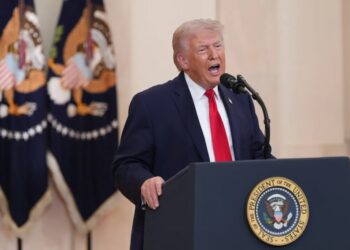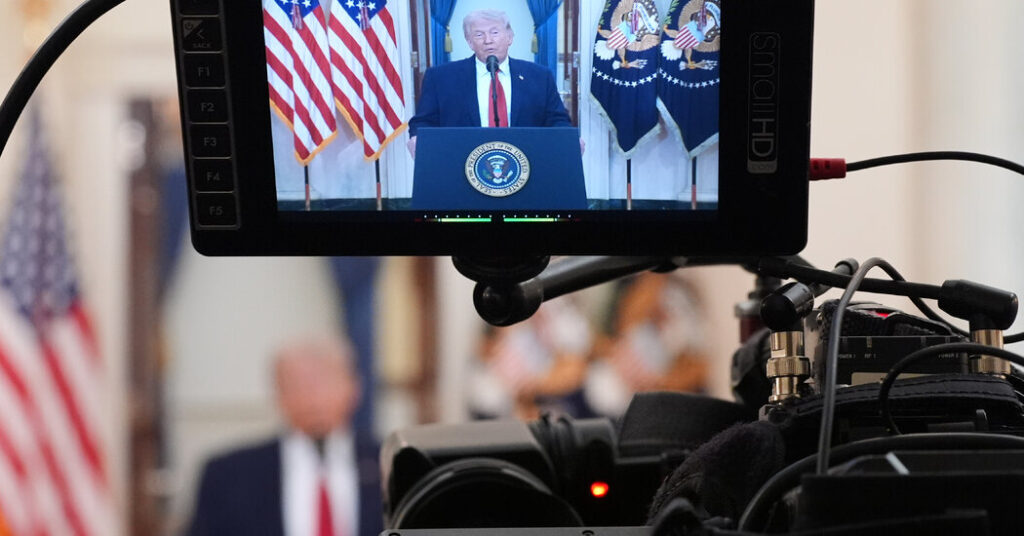
More than a month into the war in Iran, President Trump gave a prime-time address to the nation on Wednesday to make the case for why he believes the conflict is necessary.
In a 19-minute speech from the White House, Mr. Trump said Iran’s missiles and drone systems have been “dramatically curtailed and their weapons factories and rocket launches are being blown to pieces.”
Although the U.S. and Israeli militaries have destroyed many of Iran’s ballistic missiles and launchers in airstrikes, Iran continues to fire missiles in the region.
Still, Mr. Trump described the military action as a major success and called on Americans, who are uneasy about its costs, to keep things in perspective. He estimated that the war should wind down within three weeks.
Trump did not define a clear path out.
Mr. Trump oscillated between endorsing negotiations to end the war and promising an escalation of violence.
“We are on track to complete all of America’s military objectives shortly, very shortly,” he said. “We are going to hit them extremely hard. Over the next two to three weeks, we’re going to bring them back to the Stone Ages, where they belong. In the meantime, discussions are ongoing.”
Iran has said there are no direct talks with the United States, and U.S. intelligence agencies have assessed that the Iranians are willing to keep channels of communication open but not to make concessions at this point.
He urged Americans to keep the war in perspective.
Mr. Trump seemed sensitive to criticism that he has bogged the United States down in a protracted conflict that is hurting the American economy and alienating voters who want a focus on domestic issues.
He listed the lengths of World War I, World War II, Vietnam, and the Korean and Iraq wars to argue that his military campaign has been far shorter than past wars.
“It’s very important that we keep this conflict in perspective,” Mr. Trump said.
He did not explicitly empathize with the economic pain Americans are feeling, but Mr. Trump maintained that the war was worth it to eliminate what he argued was the threat from Iran.
“This is a true investment in your children and your grandchildren’s future,” he said.
He appeared to rule out a raid to capture Iran’s enriched uranium.
Mr. Trump has been weighing whether to authorize a mission to extract the highly enriched uranium that is secured under Iran’s nuclear site at Isfahan.
But on Wednesday, Mr. Trump said that Iran’s nuclear sites have been hit so hard that “it would take months to get near the nuclear dust.” He said the United States has satellites monitoring the sites and would attack if Iran made a move to retrieve the material.
It’s possible that Mr. Trump is deceiving Iran after weeks of telegraphing his interest in securing the material. If not, he will have left the nuclear material exactly where it was before the war started — deep underground, but theoretically within Iran’s reach — leaving open the question of what the conflict would have accomplished on that front.
He said the Strait of Hormuz is not America’s problem.
The president repeated his demands that the countries that import oil from the Persian Gulf via the strait take the lead in forcing Iran to reopen it.
He asserted that “we don’t need” the oil that goes through the artery off Iran’s southern coast. It’s true that the United States imports very little oil from the Gulf, but Mr. Trump’s stance ignores the economic reality that oil prices are set globally and that supply disruptions in the Middle East will filter through to the United States.
Less oil on global markets means higher gas prices for Americans. Other key commodities, like fertilizers, are also exported via the Strait of Hormuz, meaning that if Iran chokes off most shipping, the greater the risk of inflation in food prices and other goods.
He hailed the Venezuela operation as a model for Iran, again.
In the opening minutes of his speech, Mr. Trump bragged about the success of the U.S. mission to capture the country’s leader, Nicolás Maduro.
Aides say Mr. Trump sees that operation as a model for what he wants to accomplish in Iran. But the two situations are very different. In Venezuela, U.S. forces quickly dropped into Caracas and left with Mr. Maduro in custody. There were no casualties.
“That hit was quick, lethal, violent and respected by everyone all over the world,” Mr. Trump said Wednesday night. He added that the United States and Venezuela were “joint venture partners” and “getting along incredibly well.”
In Iran, the war so far has left a hostile regime in place and more than a dozen U.S. troops have been killed and hundreds have been injured.
Luke Broadwater covers the White House for The Times.
The post 5 Takeaways From Trump’s Address on Iran appeared first on New York Times.