Again and again, the Trump administration has been blocked in court over repeated attempts to force schools to bend to its will. Now, the executive branch is bringing its own lawsuits to force colleges and school districts to comply.
For the past year, the administration has tried coercing universities into adopting portions of President Trump’s agenda, opening civil rights investigations and cutting essential federal research funding until they agreed. Recently though, the pressure campaign has struggled to produce the head-turning results Trump officials envisioned.
Federal judges in California and Massachusetts have ruled that the administration’s aggressive tactics broke the law. And after the administration signed deals with six elite universities last year, there have been none in the past four months. Now, the government is testing a new strategy, filing or joining 10 lawsuits in the past five months against universities, school districts or states over education issues.
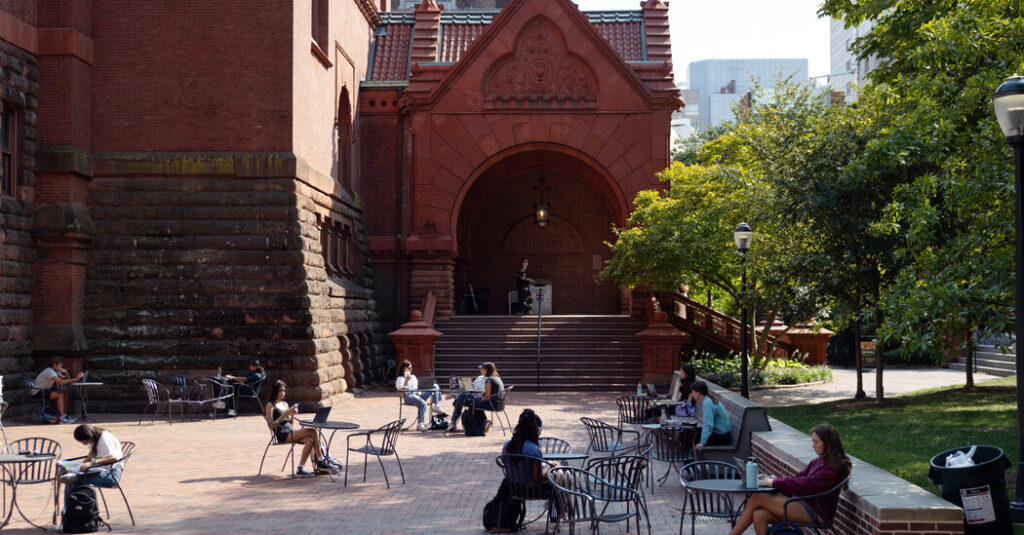
The new litigious approach delivered one major victory this week, when an Obama-appointed judge ordered the University of Pennsylvania to turn over information about Jews on campus as part of an investigation into antisemitism accusations.
Ted Mitchell, the president of the American Council on Education, said the wave of lawsuits from the government signaled that the administration was shifting from what he described as a “ready, fire, aim” approach.
Dr. Mitchell, who was a senior official in the Education Department during the Obama administration, said he preferred the Trump administration’s turn toward the courts rather than “the extortion that was the first few months of the Trump administration.” But he warned that the government did not appear to be tempering its ambition to reshape and punish the higher education system.
“They’re still looking for their pound of flesh,” Dr. Mitchell said, adding, “This is another way for them to go after that.”
Almost all of the government’s suits targeting schools or education policy are anchored in the Trump administration’s unusual twist on civil rights laws. While the landmark federal statutes were passed by Congress to help remediate generations of racism in the United States, the Trump administration has used the laws to attack programs and policies that support Black, Hispanic or other minority students.
A White House spokeswoman, Liz Huston, said the administration was relying on a “dual-track approach through executive and legal actions to protect American students and end harmful practices by universities.”
The rise in lawsuits showed that the Justice Department, which has filed most of the complaints, “is demanding better from America’s institutions of higher education and consistently leaves all options on the table to achieve satisfactory outcomes,” said a department spokesman, Gates McGavick.
The administration’s first substantial victory came on Tuesday in a lawsuit that the Equal Employment Opportunity Commission filed in November against Penn after the university refused to comply with a subpoena seeking names and contact information for members of Jewish groups on campus. The E.E.O.C. has been investigating potential workplace discrimination against Jewish employees. It has said that it is typical in such investigations to contact potential witnesses and victims.
The subpoena drew swift criticism on the Ivy League campus, however. Penn officials, students and faculty members have said the demand for lists of Jews raised First Amendment concerns, and echoed methods deployed in Nazi Germany.
The judge in the case, Gerald J. Pappert of Philadelphia’s Federal District Court, dismissed those concerns. Judge Pappert, a Republican who served as Pennsylvania’s attorney general before President Barack Obama nominated him to the federal bench, ruled on Tuesday that the subpoena was valid. He ordered the school to comply by May 1.
Penn officials said they plan to appeal the decision.
On Wednesday, a group of four Jewish graduate student groups issued a joint statement saying they feared the ruling would chill participation in Jewish activities on campus.
“The government should not be assembling a roster based on religious identity,” said the statement, issued by the Jewish Law Students Association, the Maimonides Society, the Jewish Dental Student Society and PennVet Jewish Network.
The government has also twice sued Harvard University in recent weeks after the university defeated the administration in cases last year. The Ivy League school has been the administration’s top target for investigations, funding cuts and, now, lawsuits.
One case is based on the Trump administration’s expansive interpretation of a Supreme Court ruling in 2023 that ended race-conscious admissions practices. Federal officials have argued that any consideration of race while weighing a student’s application violates the court decision. Through the lawsuit, the government is seeking to force Harvard to provide admissions it has argued it needs to prove that the school is in compliance with the Supreme Court ruling.
Harvard, which was a defendant in the Supreme Court litigation, has repeatedly insisted that school policies are aligned with the court ruling.
A second lawsuit from the Justice Department accused Harvard of violating civil rights laws by failing to combat antisemitism on campus. The university responded by saying the school has taken proactive steps to address discrimination and by describing the lawsuit as retaliatory.
Harvard was targeted with both lawsuits after Mr. Trump nixed, for the moment, a potential deal between the two sides to end the government pressure campaign. After The New York Times reported that Mr. Trump had retreated from a demand for cash from the school, he reacted with fury, publicly declaring that Harvard should pay at least $1 billion “in damages” and threatening a criminal investigation.
In January, the Justice Department asked to join a separate lawsuit against the University of California, Los Angeles’s medical school over potential discrimination against white applicants.
The Trump administration has also targeted K-12 schools. Mr. Trump issued executive orders last year aimed at enacting his strict views on gender, and has threatened the funding of school districts that don’t comply.
This month, the administration turned to the courts. The Justice Department sued the Minnesota Education Department over school policies designed to protect transgender students. And it joined a similar lawsuit in December against the school board in Loudoun County, Va., outside Washington.
The government sued the Minneapolis Public Schools in December and joined lawsuits against the Los Angeles Unified School District in February targeting district policies aimed at increasing the number of Black and Hispanic teachers.
Trump officials have also used education lawsuits in their push to limit immigration, suing several states, including California and Virginia, that allow undocumented immigrants to pay in-state tuition for state schools.
Some legal experts have suggested that while the government’s new strategy is more conventional, it still faces hurdles, including cases that scholars regard as shaky at best.
Todd Wolfson, the president of the American Association of University Professors, a group that has been involved in multiple legal battles against the administration, said the newfound fondness for the court system could still present challenges for the executive branch.
“They want to do things which tend to be illegal,” he said. “They have a penchant for illegality, so in some cases, you could be as thorough as you want, but if you want to stop freedom of speech, you’re going to have a problem.”
Michael C. Bender is a Times correspondent in Washington.
The post Lawsuits Are the New Trump Tactic in the Fight to Overhaul Education appeared first on New York Times.