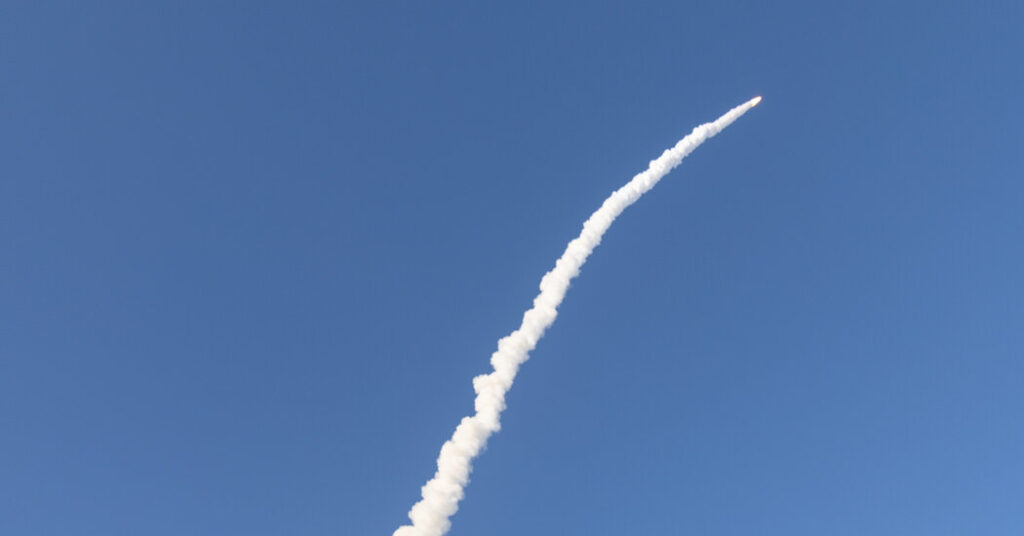
After a picture-perfect launch on Wednesday evening, Artemis II is one step closer to the moon. If the mission continues as planned, the Orion capsule will reach the moon in five days, by Monday night.
The spacecraft will orbit 43,730 miles above Earth’s surface for about 24 hours on what NASA calls a high-Earth orbit. This wide, looping path provides time to check important systems aboard Orion, including life support and deep-space communications.
The crew also plans to test Orion’s ability to execute docking maneuvers for future flights in the early hours of the flight.
If any serious problems arise while Orion is still in Earth orbit, mission managers will bring the astronauts home.
During this loop, the spacecraft’s engines will fire to give a final outward nudge. The capsule, which carries the four astronauts, will then leave Earth’s orbit and begin its journey to the moon on Thursday evening.
It will take around three days for the capsule to enter what NASA calls the lunar sphere of influence, the point at which the moon’s gravity will be stronger than Earth’s. The crew will spend the day testing their orange spacesuits, equipped with new technology to help astronauts breathe for up to six days if the capsule depressurizes in emergency situations.
On Monday, the astronauts will begin their study of the moon’s surface, which will include viewing parts of the far side that have never been seen by human eyes. At its closest, the spacecraft will still be more than 4,100 miles from the surface. The moon will be appear to be the size of a basketball held at arm’s length.
Artemis II will reach a distance of 252,799 miles from Earth, the farthest that human beings have ever traveled from Earth — 4,144 miles farther than Apollo 13 was when it needed to swing around the moon for its emergency return to Earth.
While the spacecraft heads to the moon, it will be on what is known as a “free return” trajectory. This path uses the moon’s gravity to swing the capsule directly back to Earth without needing to fire any of its engines. That means Orion could return to Earth even if there were a failure of the propulsion system.
It will take around four days to make the journey back to Earth, where Orion is expected to splashdown in the Pacific Ocean on April 10.
Ashley Ahn covers breaking news for The Times from New York.
The post When Will Artemis II Reach the Moon? appeared first on New York Times.