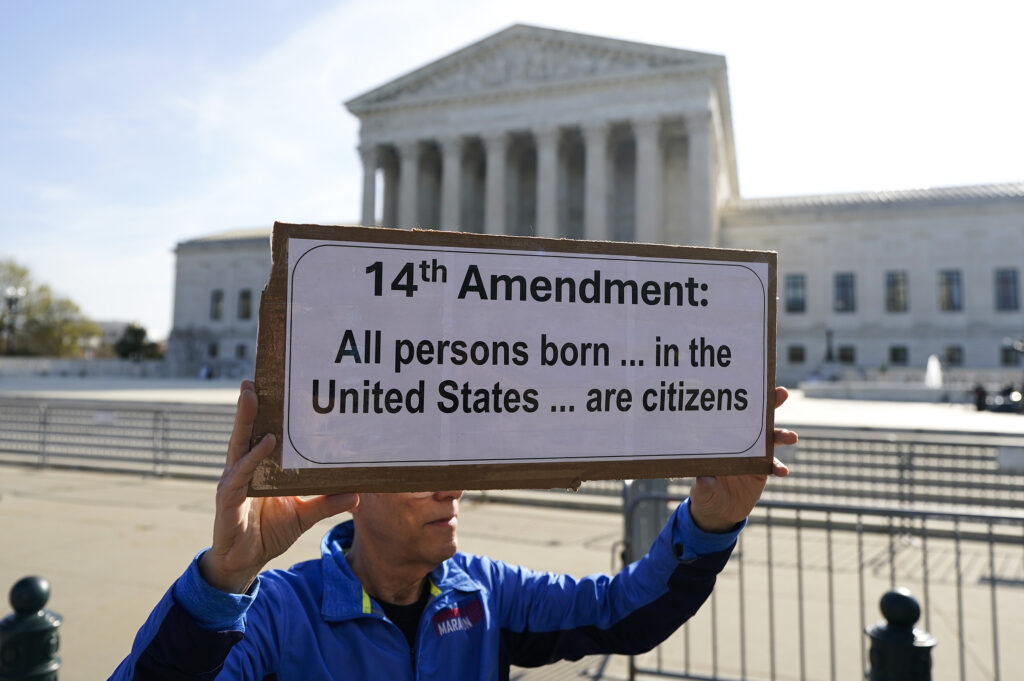
The Supreme Court heard arguments Wednesday on President Donald Trump’s 2025 executive order restricting birthright citizenship, and a majority of the justices sounded skeptical. But the court has two paths to block Trump’s order, and it matters which one it takes.
The first path is a sweeping constitutional ruling that the 14th Amendment of 1868 requires automatic citizenship for anyone born to immigrants in the country illegally, for now and all time. The second is a narrower ruling that blocks Trump’s unilateral effort to rewrite U.S. citizenship rules but leaves the door cracked for Congress to legislate on the subject in the future.
Two justices sounded potentially open to the more modest resolution. The 14th Amendment promises citizenship to anyone “subject to the jurisdiction” of the United States and born on its soil. Trump and briefs supporting him make the case that this is a term of art. Those who advocated the provision after the Civil War, they argue, meant to exclude people subject to a foreign sovereign.
But even if that were true — the evidence is apparently mixed — Congress has passed immigration law in the meantime that the Supreme Court can rely on. In particular, the Immigration and Nationality Act of 1952 uses the same phrase about “jurisdiction,” and legislators who passed that law seemed to take birthright citizenship for granted.
As Justice Neil M. Gorsuch put it, “there was a lot of water over the dam” between the 1868 amendment and the 1952 law. The Trump administration claims the modern “misreading” of the 14th Amendment took root during the Franklin D. Roosevelt years. But if the modern understanding was also the understanding when Congress legislated on citizenship in the mid-20th century using the same terms, then that is enough to invalidate Trump’s order.
As Gorsuch asked Solicitor General D. John Sauer: “Would there be an argument for reading that statute under its original plain meaning at the time — 1940, 1952 — to perhaps have a different meaning than the Constitution?” In other words: Even if the 14th Amendment doesn’t mandate unrestricted birthright citizenship, Congress might have done so.
Justice Brett M. Kavanaugh also pressed that point. The 14th Amendment explicitly authorizes Congress to enforce its provisions. “Does that give Congress room,” Kavanaugh asked Sauer, to adjust the scope of birthright citizenship?
He put the same question to Cecillia Wang, the lawyer for the American Civil Liberties Union. He proposed a hypothetical where Congress voted “435 to zero in the House and a hundred to zero in the Senate” to change birthright citizenship rules: “Your point is no, they’re closed, they’re frozen forever?”
Kavanaugh pointed out that the Supreme Court usually tries to avoid constitutional decisions if it can resolve a case based on a law Congress has passed. “Why would we address the constitutional issue,” he asked Wang, when “our usual practice — as you’re well aware, of course — is to resolve things on statutory grounds?”
Gorsuch and Kavanaugh are pointing to a potential middle ground for the Supreme Court. The justices need not define the scope of the 14th Amendment’s citizenship clause right now. They can allow the people’s elected representatives in Congress to actually debate the policy and consider whether any changes are needed.
If a decision to restrict birthright citizenship were ever arrived at through the normal democratic process, the Supreme Court could then decide if the revisions pass constitutional muster. This isn’t just a technicality. Americans’ rights are best protected when policy is made, at least in the first instance, by the legislature — not the executive and the courts.
The post The Supreme Court’s middle way on birthright citizenship appeared first on Washington Post.