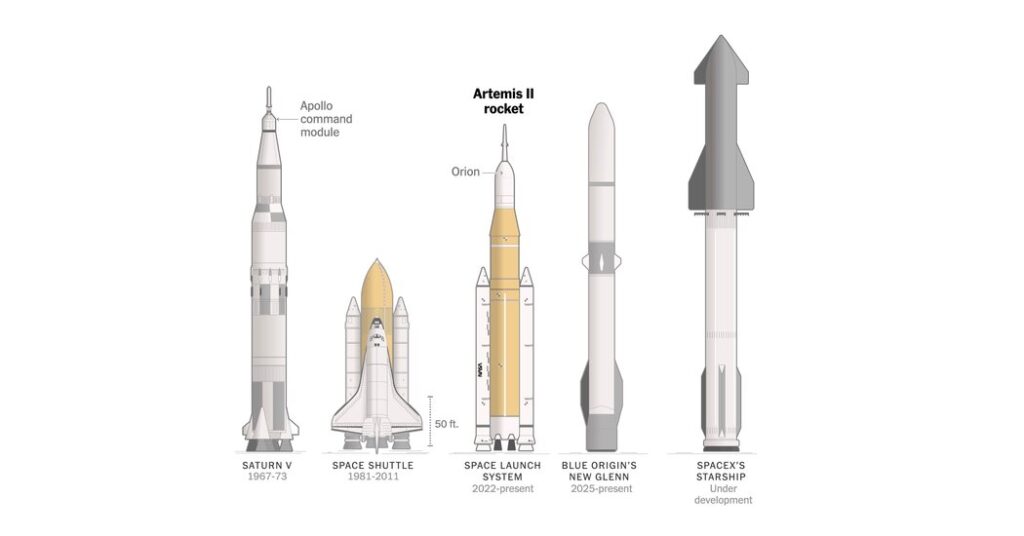
Space today seems dominated by billionaires — Elon Musk has SpaceX and Jeff Bezos owns Blue Origin, both rocket companies. But Artemis II is a throwback to an earlier era when NASA designed its spacecraft and then hired traditional aerospace companies to build them.
The Space Launch System rocket, which is being used by Artemis II, is unusual in that Congress, frustrated when President Obama canceled an earlier return-to-the-moon program called Constellation, gave detailed specifications for what it wanted NASA to build. The pieces of S.L.S. are, in large part, a remix of components of the space shuttles.
The core stage — the big orange part — was built by Boeing with engines left over from the space shuttle program.
Northrop Grumman made the smaller boosters attached to the side of the core stage. Those, using solid rocket fuel, provide most of the thrust at liftoff and then drop away a couple of minutes later. They are longer versions of those that were used by the space shuttles.
The second or upper stage of the rocket is known as the interim cryogenic propulsion system. United Launch Alliance, a joint venture between Boeing and Lockheed Martin, built this stage, which is necessary for the final push needed to reach orbit. It is a modified version of the upper stage that U.L.A. used for its now-retired Delta IV vehicles.
Lockheed Martin built the Orion capsule, where the astronauts are sitting. The service module — the cylindrical component below the capsule that houses the propulsion, communications and power systems — is the contribution of the European Space Agency to the Artemis program and was built by Airbus.
While SpaceX and Blue Origin do not play a part in Artemis II, they will have a central role in future missions, building the landers that will take NASA astronauts to the moon’s surface.
A year from now, during Artemis III, the Orion spacecraft is expected to practice docking with one or both of the landers in orbit around Earth. Attempts to land on the moon are planned for Artemis IV and Artemis V in 2028.
Kenneth Chang, a science reporter at The Times, covers NASA and the solar system, and research closer to Earth.
The post Who Made the Artemis II Rocket and Space Capsule? appeared first on New York Times.