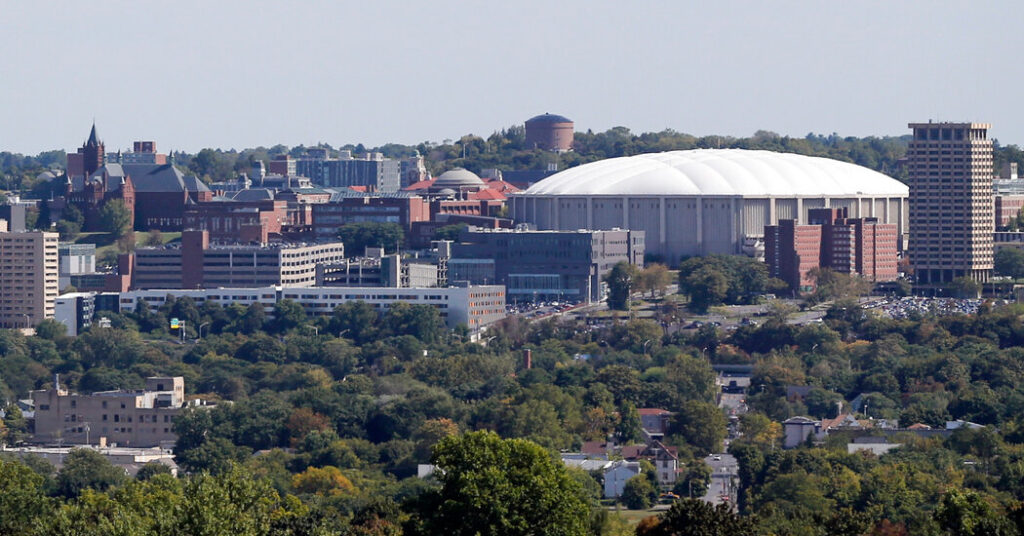
Syracuse University is closing or halting enrollment in about 20 percent of its academic programs, in a move that the school’s provost said was designed to create a university that would be “more focused, more distinctive and more aligned with student demand.”
The overhaul was revealed in a letter from the provost, Lois Agnew, that was sent on Wednesday to students and faculty members. And while the letter did not list the cuts, a spreadsheet provided by the university showed that the humanities and the fine arts represented the largest share.
Classics and ceramics are out as majors, along with a host of others that had attracted few students.
In all, 93 of the 460 academic programs at the school will be closed or paused, meaning that no new students will be able to enroll in those majors. Coursework in the areas will still be offered, and minors in many of the subjects will continue to be available.
Similar changes are happening at universities around the country, as students seek out fields that they believe will more directly translate into higher-paying jobs, a recent analysis by the American Enterprise Institute showed. College administrators, following the market, have been reducing humanities offerings.
Among the 17 majors ending in the College of Arts and Sciences are the undergraduate degrees in classical civilization, classics, German, Italian, Middle Eastern studies and Modern Jewish studies, the spreadsheet showed.
In the College of Visual and Performing Arts, it will no longer be possible to major in ceramics, jewelry and metalsmithing, sculpture, painting or art video, though coursework in those areas will remain. Instead, students will be channeled into a broader bachelor of fine arts degree that will offer those fields as concentrations.
Sarah Scalese, a university spokeswoman, said that the consolidation and closure of programs was more of a “program inventory clean-up” than a broad restructuring. No students were majoring in 55 of the closing programs, including photography, sculpture, digital humanities and Modern Jewish Studies, she said.
In all, only 258 students, of the more than 20,000 at Syracuse, were enrolled in the programs that are ending, the provost’s message said.
“A university carrying nearly twice the number of programs as peer institutions is not a sign of strength; it is a sign that regular, honest assessment is overdue,” Ms. Scalese said. “This review reflects the kind of disciplined stewardship that students and families deserve from us.”
The changes emerged from an academic portfolio review that began last summer. Though Syracuse, like all American universities, has financial challenges, the goal of the restructuring was not to cut costs, and no positions had been identified for elimination, the message from the provost said.
At Syracuse, the most popular majors include psychology, information science, economics and sports management. In all, 80 percent of students are enrolled in about one-third of the school’s majors.
Still, some faculty members and students were upset and said that the cuts were a sign of a reduced commitment to the humanities and could lead to even fewer students being interested in those areas.
“One of the wonderful things about Syracuse is that we were able to offer these quirky and fabulous combinations of fields, and then you attract students who are drawn to those ways of thinking,” said Romita Ray, the director of undergraduate studies in art history, a field that survived the cuts. “Will we actually be hurting ourselves in the long run with not being able to offer that kind of robust, prismatic curriculum?”
As part of its portfolio review, Syracuse paused admission to 18 majors in the College of Arts and Sciences last September. Programs needed to show that they had roughly 20 students who were seeking degrees in the major to continue, faculty members said.
African American Studies, which has about 11 students who have declared majors, made it through, but the program has been told it will have to “re-envision” itself. It has three years to increase the number of students in the major, said Herb Ruffin, an associate professor in the department and former chair.
“Humanities used to be central to the curriculum, but now it is central in a service type of way,” he said, as a source of general education courses for students majoring in pre-professional fields. He said that the department was down several faculty and being asked to do more with less.
“People are walking around with pitchforks,” he said of the overall reaction among the arts and sciences faculty. “Folks ain’t happy.”
Programs are also being cut in other Syracuse schools, including seven in the College of Engineering and Computer Science, nine in the School of Education and nine in the Maxwell School of Citizenship and Public Affairs.
But some of these, Ms. Scalese said, eliminate duplicative programs. For example, there were two types of undergraduate degrees offered in the fields of electrical and computer engineering; now there will be one.
For programs that are ending, students who are currently enrolled will be permitted to continue until graduation, in a process known as sunsetting.
“I want to reiterate that sunsetting a major does not mean closing a program or abandoning an intellectual tradition — it means sustaining that tradition in the form that best serves our students today,” Behzad Mortazavi, the dean of the College of Arts and Sciences, wrote to faculty members in an announcement on March 20 about the changes.
Like other universities, Syracuse is confronting a decline in enrollment of international students. Two years ago, 12 percent of the freshman class was from abroad; in September, international enrollment dropped to 5 percent. Chancellor Kent Syverud, who has led the school since 2014, said last September that the drop was attributable mainly to challenges in students getting visas. That represents a significant revenue hit because most international students pay the full $66,580 tuition.
“We have been making, and are continuing to make, tough choices to shore up our financial position,” Mr. Syverud said, adding that the university remains on firm financial footing.
Mr. Syverud’s final day as chancellor will be May 10, the same day as commencement. He will start the next day as the president of the University of Michigan. Mike Haynie, Syracuse’s current vice chancellor for strategic initiatives and innovation, will take over as chancellor.
Sharon Otterman is a Times reporter covering higher education, public health and other issues facing New York City.
The post At Syracuse, Classics, Ceramics and Italian Out as Majors in Overhaul appeared first on New York Times.