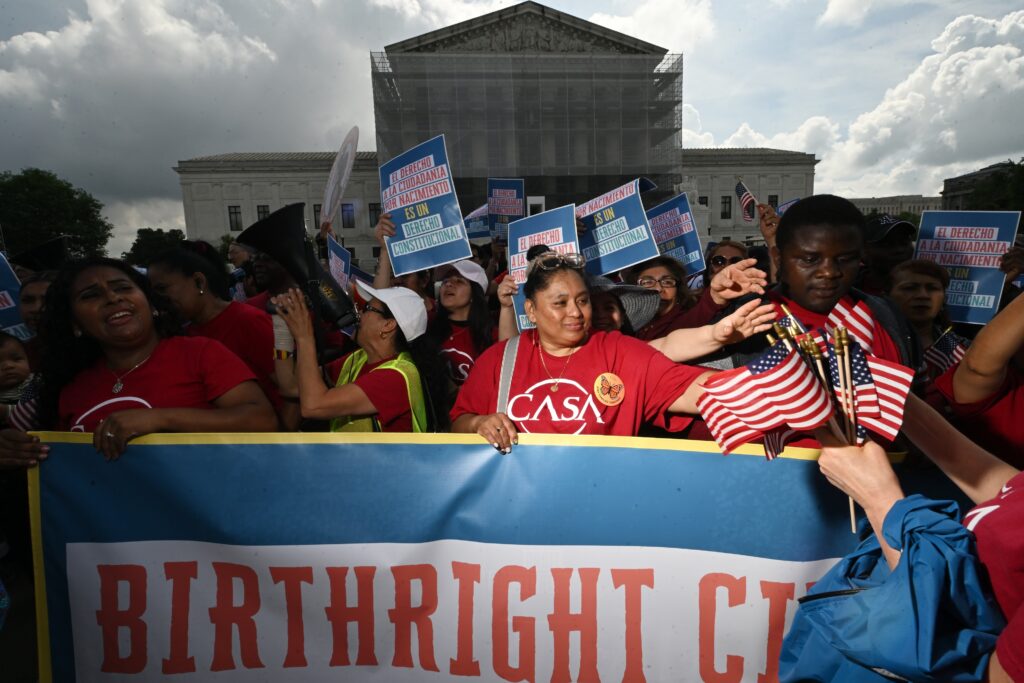
The Supreme Court appeared poised Wednesday to uphold the legal principle that almost everyone born on U.S. soil is a citizen, as they heard arguments in a major case that raises fundamental questions about who is considered American and was attended by President Donald Trump.
The justices seemed ready to hand Trump a significant political defeat in his push to end birthright citizenship, one of the signature policies of his second term and one of its most controversial because of its sweeping political, economic and social ramifications. Trump is the first president known to have attended arguments before the court, where he sat in the front row of the public section.
Trump went to court seeking to redefine American identity in ways not seen for more than 150 years, since the 14th Amendment was ratified guaranteeing citizenship to the formerly enslaved and their children in the wake of the Civil War.
The amendment was written to overturn the high court’s infamous Dred Scott decision, which denied citizenship to Black people. But the language of the amendment — “All persons born or naturalized in the United States, and subject to the jurisdiction thereof, are citizens of the United States” — has long been interpreted to cut more broadly, guaranteeing citizenship to all born here with only a few exceptions for children of foreign diplomats and those born to invading armies.
The high court adopted that understanding of the amendment in 1898 in a ruling that found Wong Kim Ark, a man born to Chinese immigrants in San Francisco, was a citizen.
Trump has pushed to dramatically narrow that scope, arguing that the amendment’s guarantee of citizenship does not apply to children born to parents in the country illegally or those on temporary visas for work, travel, school or humanitarian reasons.
Most of the justices appeared skeptical of that position during more than two hours of arguments, but several also asked sharp questions of an attorney arguing to uphold birthright citizenship, indicating that the case might not be a slam dunk.
A decision in the case is expected by June or July. Trump’s policy remains blocked until then by lower-court orders.
“The text of the clause, I think, does not support you,” Justice Elena Kagan told Solicitor General D. John Sauer, who argued for the administration. “I think you’re sort of looking for some more technical, esoteric meaning.”
At another point, Chief Justice John G. Roberts Jr. sounded a similar note of caution, telling Sauer that his contention that the 14th Amendment did not apply to people who did not have permanent immigration status was built on a flimsy legal foundation.
“The examples you give to support that strike me as very quirky … children of ambassadors, children of enemies during a hostile invasion, children on warships. And then you expand it to a whole class of illegal aliens here in the country,” Roberts said. “I’m not quite sure how you can get to that big group from such tiny and sort of idiosyncratic examples.”
The only justice who appeared to firmly back the administration was conservative Samuel A. Alito Jr. He suggested the exceptions to the 14th Amendment could be expanded to account for new realities that didn’t exist at the time of its ratification in 1868.
“What we are dealing with is something that was unknown at the time — illegal immigration,” Alito said.
Trump entered the Supreme Court chamber through a side entrance at 9:47 a.m., wearing a dark suit and red tie. He sat with Attorney General Pam Bondi, White House counsel David Warrington and Commerce Secretary Howard Lutnick. When the justices took the bench at 10 a.m., Trump rose as did everyone else. The justices did not appear to acknowledge his presence and never mentioned him being in the court during the arguments.
Trump was not visible from the media area during most of the arguments, but left about halfway through.
A ruling against Trump would be the latest of several setbacks for the president at the court in recent months. The justices struck down Trump’s tariffs in February and blocked his deployment of National Guard troops to Chicago in December.
Those decisions, especially on tariffs, have prompted Trump in recent weeks to increasingly lash out at the Supreme Court. Trump swiped at the justices again Monday in a Truth Social post that also derided birthright citizenship.
“The World is getting rich selling citizenships to our Country, while at the same time laughing at how STUPID our U.S. Court System has become (TARIFFS!),” Trump wrote without explaining what he meant by selling citizenship. “Dumb Judges and Justices will not a great Country make!”
The latest reversals for Trump at the court come after he won a string of victories on the justices’ emergency docket in the opening months of his second term. The justices allowed him on a temporary basis to ban transgender soldiers from the military, gut the Education Department, cancel foreign aid and remove the heads of independent agencies.
As one of the first acts in office in his second term, Trump issued an executive order in January instructing government agencies to stop issuing citizenship documentation to children born to families without permanent immigration status on or after Feb. 19, 2025.
Sauer’s arguments for Trump’s order turned on the phrase “subject to the jurisdiction thereof” in the amendment. That phrase invokes a political allegiance to the country which children of those here illegally or temporarily can’t demonstrate because their families haven’t established that they plan to stay in the United States permanently, he said.
He also told the justices that despite its broad language, the 14th Amendment was only meant to extend citizenship to the formerly enslaved and their children.
Granting birthright citizenship to nearly everyone drives illegal immigration and “birth tourism” — traveling to the United States to have a baby so the child can be a U.S. citizen, Sauer said. He added that migrants who take advantage of birthright citizenship undermine the rule of law.
“It demeans the priceless, profound gift of citizenship,” Sauer told the justices.
Cecillia Wang, an attorney for the American Civil Liberties Union, which sued to block Trump’s order, told the justices that the administration’s reading of the 14th Amendment flies in the face of its plain meaning, the 1898 Supreme Court ruling, legal history and decades of practice by the government.
“The framers of the 14th Amendment meant to have universal law of citizenship subject to narrow exceptions,” Wang said.
She said the phrase “subject to the jurisdiction thereof” was never read to cover children of diplomats and similar rare cases. She also argued Trump’s order undermines an ideal that has made America a beacon for people around the world — that children of immigrants have the same rights and opportunities as people who have been in the country for generations.
A ruling for Trump’s ban on birthright citizenship could have vast and unpredictable consequences.
Roughly 250,000 children would be born without citizenship in the United States each year if Trump’s order were upheld, or about 5 million by 2045, according to a friend of the court brief filed by dozens of professors. Some would likely be left stateless.
Ending birthright citizenship would create an “undocumented underclass,” a swath of society with limited access to education, health care and social safety net programs, they said. They also told the court that such a change would damage the American economy, which is boosted by immigrants.
“The creation of this caste would disrupt 150 years of intergenerational upward mobility for immigrants and would reverberate broadly through the U.S. economy and society,” the professors wrote.
The United States is one of roughly three dozen countries across the world that have birthright citizenship. Most nations follow lineage-based rules requiring parents be citizens or permanent residents for their children to obtain citizenship.
This is not the first time birthright citizenship has been before the justices. In a separate case in June, the Trump administration did not ask the court to weigh in on the merits of the policy, but to rule on the narrower question of whether lower courts could issue nationwide injunctions.
In a 6-3 ruling, the justices sided with Trump officials and limited such orders.
Soon after that decision, a group of individuals represented by the ACLU filed a class-action lawsuit in New Hampshire against Trump’s order. A federal judge issued a preliminary injunction in that case, but before an appeals court could render a decision, administration officials petitioned the Supreme Court to hear the case.
At the end of April, the justices will hear another major immigration-related case dealing with whether the Trump administration can end deportation protections for hundreds of thousands of Syrians and Hatians. The ruling could affect tens of thousands of other migrants, whom the Trump administration has tried to strip of what is known as temporary protected status.
The post Supreme Court appears skeptical of Trump’s effort to end birthright citizenship appeared first on Washington Post.