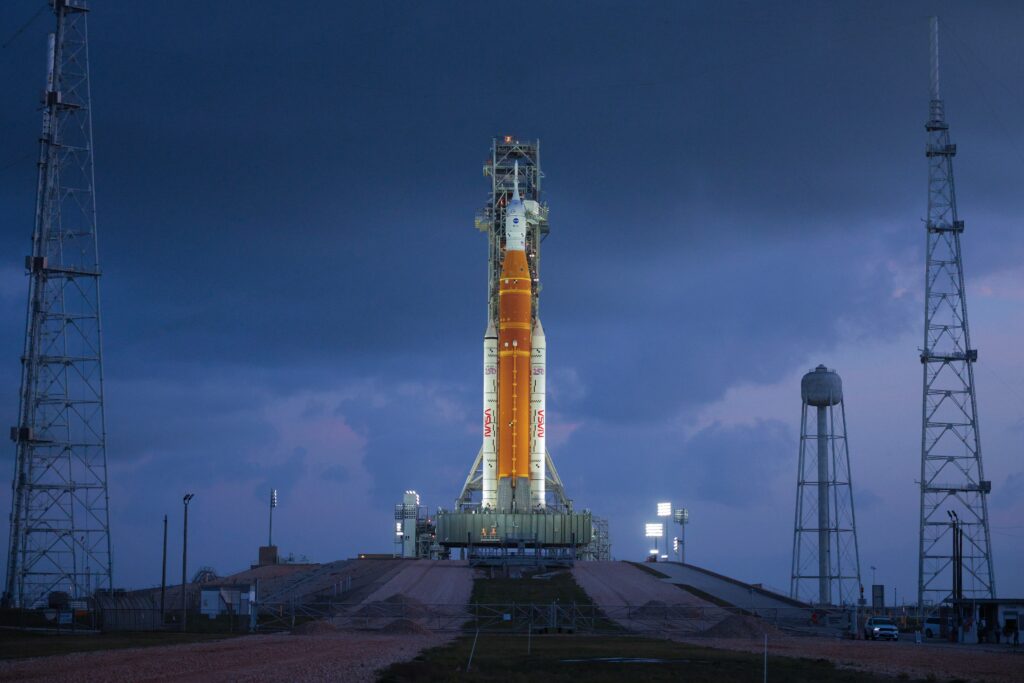
The countdown is on and the weather appears favorable for the launch of Artemis II, the historic spaceflight that aims to ferry a four-person crew around the far side of the moon for the first time since the Apollo era.
If all goes as planned, the 10-day journey will mark the first time humans have left low Earth orbit in more than half a century, break the Apollo 13 record for how far humans have traveled into space and lay the groundwork for a future moon landing and exploration of deep space.
Early Wednesday morning, crews began the nearly six-hour-long process of fueling the spacecraft. A two-hour launch window opens Wednesday evening at 6:24 p.m. at Kennedy Space Center in Cape Canaveral, Florida. If cumulus clouds, winds or rain scramble liftoff plans, there are additional opportunities on each of the next five days.
The Artemis II launch marks a risky, expensive, technically challenging landmark — the formal reopening of human ambition to explore deep space. Human spaceflight may almost seem familiar and humdrum these days, with astronauts living at the International Space Station for prolonged periods and a commercial spaceflight industry regularly sending people into low Earth orbit. But going to the moon is inherently more dangerous. It means going farther and faster, relying on hardware that has never been used to transport humans anywhere, much less the moon.
“I think this is right up there with the first launch of the space shuttle in 1981. That was the first launch of a new launch vehicle, and it had a crew on board, which was kind of a daredevil move,” said Todd Harrison a senior fellow at the American Enterprise Institute who follows space policy. “This is a capsule that’s only flown once. It had problems the first time it flew. And now we’re sending it with a crew out to the moon.”
In an era of private and commercial space contracts, this is a traditional mission, drawing on a heavy-lift rocket and capsule developed by NASA over more than a decade.
If liftoff goes forward Wednesday, Artemis II mission astronauts are expected to loop around the moon, traveling 252,799 miles away from Earth and shattering the Apollo record by more than 4,000 miles. The mission is a step toward returning to the moon’s surface in the future.
“We’re ready to go out to the moon and Mars and the rest of the solar system. We have enough knowledge now to hopefully have reduced the risk, and so really this is the first step of that path of humans through the solar system,” said Pamela Melroy, a former astronaut and deputy NASA administrator under President Joe Biden. “I think I could hardly miss it. If you go back, one of the things I’m most envious is when someone said they saw an Apollo launch.”
The astronauts who will be aboard NASA’s Orion spacecraft — Reid Wiseman, Victor Glover, Christina Koch and Jeremy Hansen of the Canadian Space Agency — will first go to low-earth orbit. If all systems are go, they will begin their journey to the moon, arriving six days after launch, following a figure-eight pattern that peaks at more than 4,600 miles beyond the far side of the moon. The spacecraft is expected to return and splash down in the Pacific Ocean next week.
The excitement — and tension — in the space community is high. At press briefings, NASA officials have stressed that previous setbacks, including an issue with helium flow needed to pressurize propellant tanks that delayed the launch earlier this year, have been addressed. When Artemis I flew in 2022, with no people aboard, the heat shield that protects the capsule upon its fast and fiery reentry into Earth’s atmosphere was damaged, a problem NASA has worked to fix but will face its most crucial test upon reentry.
Melroy is traveling to Florida to watch the launch along with other former astronauts. She sees this mission as an exciting step toward exploring the solar system, but described the big differences between traveling to low Earth orbit and going beyond.
“You have to prepare the vehicle structurally; it has to be stronger and the heat shield needs greater levels of shield,” Melroy said. “It’s not like anything we’ve built or operated since Apollo, and there’s been some learning on that.”
Jack Kiraly, director of government relations for the Planetary Society, pointed out that the rocket and capsule have never flown with human cargo. “It still kind of feels like a new vehicle a little bit, so every moment is going to be exciting,” Kiraly said.
This mission will be a crucial test for the Artemis program, estimated to have cost $107 billion by the Planetary Society. Artemis III, planned for 2027, will test operations and systems to dock with landers being made by SpaceX and Blue Origin. Artemis IV in 2028 is expected to be the first time humans will set foot on the moon again. (Jeff Bezos, the founder of Blue Origin, owns The Washington Post.)
In late March, NASA administrator Jared Isaacman announced a plan to build a $20 billion lunar base.
“I’m excited [about] going to the moon. I’m excited about establishing a presence there,” said Jeff Spaulding, test director with the Exploration Ground Systems program at Kennedy Space Center at a briefing Tuesday afternoon. “It’s part of the reason that I’m actually still here is to continue to put humans into space, and to get us back into this launch mode, so that we can continue to explore and establish a moon base, and then continue to work towards getting to Mars.”
A 50-hour countdown clock began ticking Monday afternoon, which meant powering up the Orion vehicle that will transport the astronauts on their journey and beginning a long list of checks. There are over 500 criteria that have to be met before NASA will commit to a launch, along with weather considerations.
“If we’re in violation of any of them, then we’re going to wait it out,” said Charlie Blackwell-Thompson, launch director at a preflight news conference late Monday afternoon.
Mark Burger, the launch weather officer for the 45th Weather Squadron Cape Canaveral Space Force Station, said Tuesday afternoon that there was a 20 percent chance of a “weather violation” during the two-hour window. In addition to terrestrial weather, scientists have also been closely tracking activity on the sun after a powerful solar flare Sunday night. That one is not a concern, Burger said, but they are monitoring the sun because solar flares can generate high-energy radiation that poses a health risk to astronauts.
The post NASA’s Artemis preparing to launch for historic moon flyby appeared first on Washington Post.