President Trump has suggested that reopening of the Strait of Hormuz was a problem for other countries to resolve.
America produces “plenty” of its own energy to use and sell, Mr. Trump wrote on social media on Tuesday, addressing countries that are having trouble securing jet fuel because of Iran’s blockade on the strait that carries a quarter of the world’s oil. These nations, he wrote, should “build up some delayed courage, go to the Strait, and just TAKE IT. You’ll have to start learning how to fight for yourself, the U.S.A. won’t be there to help you anymore, just like you weren’t there for us.”
He later told CBS News that the U.S. military was “not yet” ready to pull back from the effort to reopen the strait, while reinforcing that other countries were “going to have to come in and do their own work.” Early on Wednesday he posted that he would consider a cease-fire only when the waterway was “open, free, and clear.”
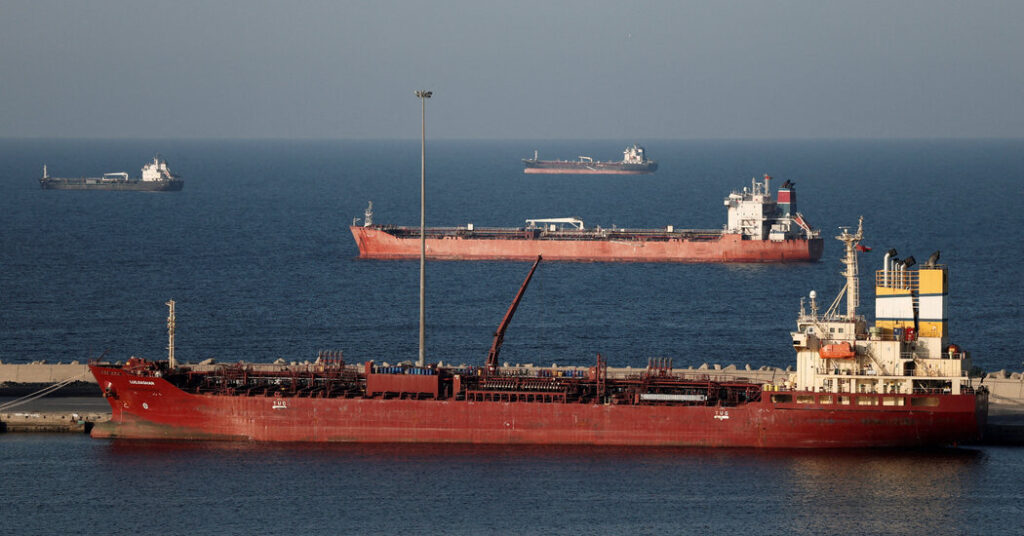
Although the United States imports very little oil and gas via Hormuz, the interconnectedness of global energy markets means that any restrictions on traffic through the waterway creates economic shocks felt around the world.
Economists warn the effects on inflation and growth, in the United States and elsewhere, will compound if disruptions persist, making the reopening of the strait a key issue for the global economy.
Even though the United States is the world’s largest oil producer and a significant exporter, oil is priced largely on supply and demand globally. When there’s a supply disruption, like there has been for the past month in the Persian Gulf, the price of oil and gas rises everywhere.
Not all American-produced oil can be easily used by U.S. refiners, since supplies produced in the United States tend to be higher-quality, so-called sweet oil, but domestic refineries are set up to handle largely imported heavy and sour oil. The United States imports millions of barrels of this type of crude oil, and fuel made from it often ends up in U.S. gas stations.
In the United States, gasoline prices have surged 36 percent since the war began to an average of more than $4 a gallon. The price of diesel, which fuels many trucks, has jumped more sharply. In Europe, which also imports little oil and gas from the Middle East, energy costs are soaring, on top of already high prices because of Russia’s invasion of Ukraine.
The effects of the strait’s closure also extend beyond energy markets. A third of the world’s supply of fertilizer is shipped through the strait, leading to a bottleneck that has not only raised prices for farmers but also threatens food security around the world. The blockade has also restricted supplies and pushed up the prices of aluminum, sugar and helium, a vital gas for semiconductor manufacturing.
An Iranian official on Wednesday said that Iran’s position was the strait would open, but not to the United States. “The Strait of Hormuz will certainly reopen, but not for you,” Ebrahim Azizi, head of the Iranian Parliament’s National Security Commission, wrote on social media. But even a partial reopening to ships that comply with Iran’s rules will continue to send ripples through the U.S. economy and around the world.
Britain’s prime minister, Keir Starmer, said on Wednesday that Britain’s foreign secretary would host counterparts from nearly three dozen countries this week to discuss diplomatic efforts to keep the Strait of Hormuz open.
Jenny Gross is a reporter for The Times covering breaking news and other topics.
The post Why Reopening the Strait of Hormuz Matters for the U.S. Economy appeared first on New York Times.